Fertility challenges touch millions of couples and individuals worldwide. Whether you’re just beginning to explore fertility concerns, navigating diagnostic uncertainty, preparing for fertility treatment, or considering in vitro fertilization (IVF), the journey can often feel overwhelming — emotionally, medically, and practically.
This comprehensive guide is designed to help you understand fertility in clear, patient-friendly language. You’ll learn:
- How fertility works
- Common causes of infertility
- Symptoms to watch for
- Diagnostic pathways
- Treatment options (non-surgical and surgical)
- IVF essentials
- Choosing the right care
- Practical tips and emotional support
This article is written for:
- Patients seeking accurate medical guidance
- Couples exploring fertility options
- Caregivers and family supporters
- People considering IVF or other treatments
- Readers researching fertility diseases and treatment choices
By the end of this guide, you will feel more informed, confident, and prepared to take the next steps on your fertility journey.
1. How Fertility Works: A Simple Overview
Fertility refers to the ability to conceive and carry a pregnancy to term. Conception involves:
- Release of a healthy egg (ovulation)
- Healthy sperm reaching the egg
- Fertilization and implantation in the uterus
Successful fertility depends on:
- Regular ovulation
- Healthy sperm count and motility
- Open fallopian tubes
- Healthy uterine environment
- Balanced hormones
When any of these elements falter, challenges arise.
2. Signs & Symptoms That Might Signal Fertility Issues
Fertility concerns are often silent, but some signs may prompt evaluation:
In Women
- Irregular periods
- Missing cycles
- Very painful periods
- Difficulty conceiving after 6–12 months of trying
- Repeated early miscarriages
In Men
- Low sperm count
- Trouble ejaculating
- Reduced libido
- Genetic or developmental factors
In Both Partners
- Age-related fertility decline
- Unexplained infertility after prolonged effort
Any of these symptoms merit evaluation by a fertility specialist.
3. Common Causes of Fertility Challenges
Infertility is defined as the inability to conceive after 1 year of regular, unprotected intercourse (6 months if over age 35).
Here are common causes by category:
A. Female-Related Causes
1. Ovulation Disorders
Issues with release of eggs, often related to:
- Polycystic ovary syndrome (PCOS)
- Thyroid dysfunction
- Excessive exercise
- Weight imbalance
Signs: Irregular or absent periods
2. Blocked Fallopian Tubes
Caused by:
- Pelvic infections
- Scar tissue from surgery
- Endometriosis
This prevents egg and sperm from meeting.
3. Uterine Conditions
- Fibroids
- Polyps
- Uterine septum or abnormalities
May affect implantation or pregnancy maintenance.
4. Age-Related Decline
Fertility naturally declines after age 35 as egg quality and quantity diminish.
B. Male-Related Causes
1. Sperm Abnormalities
Low count, poor motility, or abnormal shape can hinder fertilization.
2. Hormonal Imbalances
Can affect sperm production and sexual function.
3. Varicocele
Swelling of veins in the scrotum affecting sperm quality.
C. Combined or Unexplained Factors
In some couples, both partners contribute to fertility issues. In ~15–25% of cases, standard testing does not reveal a clear cause — referred to as unexplained infertility.
4. Diagnostic Tools in Fertility Evaluation
Fertility evaluation involves several tests:
For Women
- Ovulation tracking (blood or saliva tests)
- Hormone profiles
- Ultrasound (uterus and ovaries)
- Hysterosalpingogram (tube patency test)
- Laparoscopy for endometriosis or scarring
For Men
- Semen analysis (count, motility, morphology)
- Hormone tests
- Genetic screening (in select cases)
For Couples
- Review of medical history
- Lifestyle and environmental risk factors
- Age and reproductive timeline
Accurate diagnosis guides personalized treatment planning.
5. Treatment Options — From Lifestyle to Assisted Reproduction
Fertility treatment ranges from simple observation to advanced reproductive technologies.
A. Lifestyle & Supportive Changes
Often the first step, especially for mildly affected couples.
✔ Maintain a healthy weight
✔ Balanced diet rich in antioxidants
✔ Moderate exercise
✔ Reduce stress
✔ Smoking cessation
✔ Avoid excessive alcohol and drug use
Supportive changes can improve outcomes when combined with medical therapies.
B. Medical Treatments
1. Ovulation Induction
Drugs like:
- Clomiphene citrate
- Letrozole
- Gonadotropins
Stimulate egg release in women with ovulation disorders.
2. Hormone Regulation
For thyroid, prolactin, or pituitary imbalances contributing to infertility.
3. Sperm-Enhancing Therapies
In some male factor cases, medications can improve sperm quality.
C. Assisted Reproductive Technologies (ART)
When simpler treatments are insufficient, ART may help.
1. Intrauterine Insemination (IUI)
Sperm is processed and placed directly into the uterus around ovulation.
Best for:
• Mild male factor infertility
• Cervical issues
Less invasive, often a first step before IVF.
2. In Vitro Fertilization (IVF)
IVF is the most common and advanced fertility treatment, involving:
- Controlled ovarian stimulation
- Egg retrieval
- Laboratory fertilization with sperm
- Embryo culture
- Embryo transfer
IVF bypasses some physical barriers and optimizes fertilization chances.
D. Surgical Interventions
Surgery may address structural issues:
1. Laparoscopy
For:
- Endometriosis
- Pelvic adhesions
- Ovarian cyst removal
Minimally invasive with shorter recovery.
2. Hysteroscopy
Used to:
- Remove polyps
- Correct uterine abnormalities
- Restore normal uterine cavity
E. Donor Options & Surrogacy
When own gametes are not viable:
- Donor eggs
- Donor sperm
- Gestational surrogacy
These are sensitive but effective options for many.
6. What to Expect During IVF Treatment
IVF is a structured multi-step pathway — understanding it helps set expectations.
Step 1: Stimulation Phase
Medications help ovaries produce multiple eggs.
Step 2: Egg Retrieval
Under sedation, eggs are collected from follicles.
Step 3: Fertilization
In the lab, sperm and eggs are combined.
Step 4: Embryo Culture
Embryos grow for 3–5 days.
Step 5: Embryo Transfer
The best embryo is placed into the uterus.
Step 6: Support & Pregnancy Test
Progesterone support followed by testing ~10–14 days later.
Not every cycle succeeds — but many achieve pregnancy within a few cycles.
7. Hospital & Fertility Care Comparison Table
Choosing where to receive care matters, especially for IVF or surgical interventions.
| Hospital / Fertility Center | Country | Fertility Evaluation | Ovulation Induction | IUI | IVF/ICSI | Surgery (Laparoscopy/Hysteroscopy) | Counseling/Support |
|---|---|---|---|---|---|---|---|
| CityCare Fertility Clinic | India | Yes | Yes | Yes | Yes | Yes | Yes |
| Global IVF & Reproductive Center | Turkey | Yes | Yes | Yes | Yes | Yes | Yes |
| Prime Life Reproductive Institute | Europe | Yes | Yes | Yes | Yes | Yes | Extensive |
| Sunrise Fertility & Women’s Health | Asia | Yes | Yes | Yes | Partial | Yes | Moderate |
8. Emotional & Psychological Support — A Vital Component
Fertility journeys can be emotionally intense. Many people experience:
- Anxiety
- Grief
- Hope cycles
- Stress with treatment uncertainty
Counseling, support groups, and open communication with partners help maintain emotional health.
9. Patient Story: From Uncertainty to Hope
Story:
A couple struggled with infertility for three years. After several unsuccessful IUI attempts, they moved to IVF. Along the way, they:
- Adjusted diet and stress routines
- Joined counseling for emotional support
- Built a treatment plan with a specialist
Their first IVF cycle succeeded — and the process strengthened their partnership, understanding, and resilience.
Stories like this offer real-world context beyond clinical textbooks.
10. Preparing for Your Fertility Appointment
Tips for making the most of your clinic visit:
✔ Prepare questions ahead of time
✔ Bring timelines (menstrual, pregnancy attempts)
✔ List all medications and supplements
✔ Share lifestyle details (smoking, exercise, diet)
✔ Be honest about stress and emotional state
Prepared patients communicate better and receive more personalized care.
11. Top Questions to Ask Your Fertility Specialist
Here are helpful questions to guide your consultations:
- What is the most likely cause of our infertility?
- What tests are recommended and why?
- How many cycles of IUI/IVF should we try before considering surgery?
- What are the risks and success rates?
- What lifestyle changes improve our chances?
- What support resources are available?
Clear questions lead to clearer answers and more confidence.
12. Positive Testimonial
“When we first started trying, we had no idea where to begin. The fertility forum helped us understand our options, organize our questions, and advocate for ourselves when speaking to doctors. IVF was a journey, but we never felt alone.”
Shared community insight truly empowers patients.
Conclusion: Fertility Challenges Are Real — But Solutions Are Within Reach
Infertility can be one of life’s most emotionally difficult challenges, but it is not a dead end. With improved diagnostics, personalized care, and supportive pathways like IVF and surgery when necessary, many individuals and couples achieve their goals.
Key takeaways:
- Early evaluation improves results
- Personalized treatment works better than one-size-fits-all
- Emotional support is essential
- Clear communication empowers decision-making
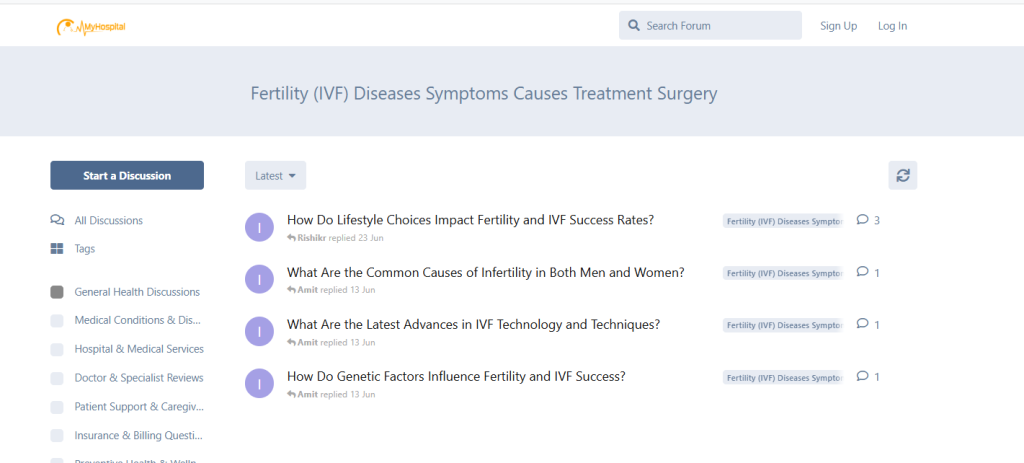
👉 Continue your learning and connect with others in the
Fertility, IVF, Diseases, Symptoms, Causes & Treatment forum:
https://www.myhospitalnow.com/forum/t/fertility-ivf-diseases-symptoms-causes-treatment-surgery
Your fertility journey is personal — and with the right information, preparation, and support, you can move forward with confidence.