Introduction
Modern IT environments generate enormous amounts of operational data from applications, servers, networks, databases, containers, and cloud platforms. Traditional monitoring can show that something is wrong, but determining why it happened and what should happen next can still require significant manual effort. AIOps observability brings artificial intelligence and machine learning into this process, helping teams analyze operational data across different systems and identify meaningful patterns. TheAIOps provides learning and practical resources for professionals exploring Artificial Intelligence for IT Operations. In this article, we will explore how AIOps observability works, its core capabilities, practical use cases, implementation considerations, challenges, and the skills professionals need to use it effectively.
What Is AIOps Observability?
AIOps observability combines observability practices with artificial intelligence, machine learning, automation, and operational analytics.
Observability focuses on understanding the internal state of technology environments through available signals such as logs, metrics, and traces. AIOps adds intelligent analysis to those signals, allowing operational teams to identify patterns, detect anomalies, correlate events, and prioritize incidents.
For example, a sudden increase in application latency may appear as one alert. A conventional monitoring system might report the alert, while an AIOps solution can analyze related application metrics, infrastructure events, logs, and deployment changes to provide additional context.
The goal is not simply to collect more data. The objective is to turn operational data into useful information for faster investigation and better decisions.
How AIOps Observability Works
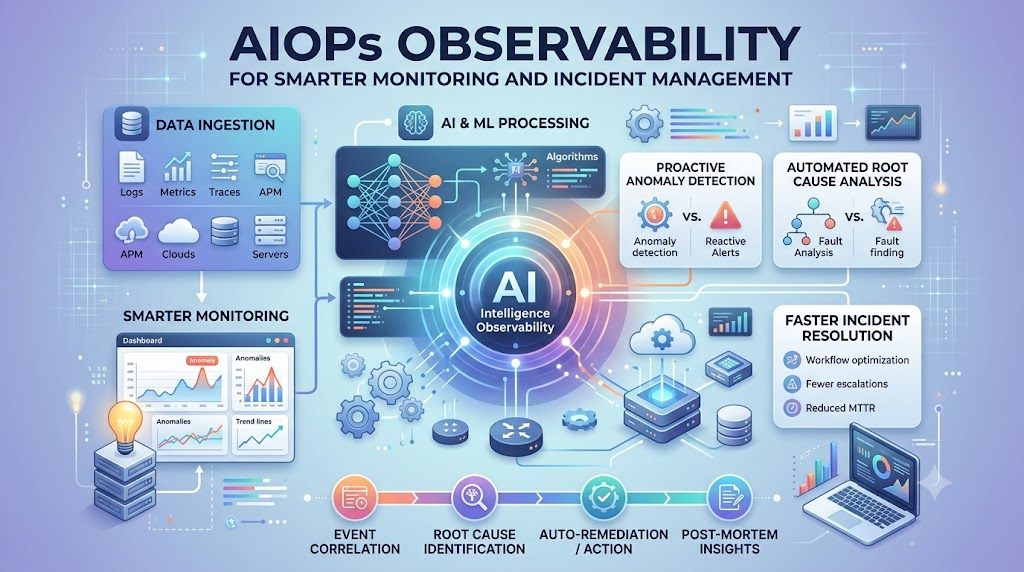
A typical AIOps observability environment brings information together from multiple operational sources.
1. Collecting Operational Data
Data may come from:
- Application monitoring systems
- Cloud infrastructure
- Kubernetes clusters
- Servers and virtual machines
- Databases
- Network devices
- Logs and traces
- DevOps pipelines
- IT service management systems
Centralizing these signals gives analytics and machine-learning models more context.
2. Detecting Anomalies
Anomaly detection identifies behavior that differs significantly from an expected pattern.
For example, an application normally receives a predictable number of requests during business hours. A sudden and unusual change in traffic, response time, memory consumption, or error rates could trigger an investigation.
AIOps can help identify these changes without requiring engineers to manually inspect every metric.
3. Correlating Events
Large environments can generate hundreds or thousands of alerts from a single underlying problem.
Event correlation groups related events and helps teams understand which alerts may be connected. This can reduce duplicate notifications and provide a more focused view of an incident.
4. Supporting Root-Cause Analysis
Root-cause analysis attempts to identify the underlying reason for an incident rather than focusing only on its visible symptoms.
AIOps can examine relationships between infrastructure, applications, deployments, dependencies, and historical operational patterns. The resulting analysis can give engineers additional evidence to investigate.
Key AIOps Observability Capabilities
AIOps observability is most useful when several capabilities work together rather than operating as isolated features.
| Capability | Purpose | Practical Example |
|---|---|---|
| Anomaly Detection | Identify unusual behavior | Detect an unexpected increase in API latency |
| Event Correlation | Connect related operational events | Group multiple alerts caused by one infrastructure issue |
| Predictive Analytics | Identify potential future risks | Detect patterns associated with resource exhaustion |
| Automated Remediation | Execute approved responses | Restart a failed service according to predefined rules |
These capabilities can support more proactive IT operations while keeping engineers involved in important decisions.
Why AIOps Observability Matters
Traditional monitoring often requires engineers to move between multiple dashboards and systems. That becomes increasingly difficult as organizations adopt cloud infrastructure, microservices, containers, and distributed applications.
AIOps observability can provide a more connected operational view.
Reduced Alert Noise
AIOps can correlate related alerts and help teams concentrate on incidents that require attention instead of treating every notification as an independent problem.
Faster Incident Investigation
Context from logs, metrics, traces, infrastructure changes, and dependencies can help engineers investigate incidents more efficiently.
Proactive Operations
Predictive analytics and anomaly detection may reveal warning signals before an incident becomes more serious.
Better Automation
Once organizations understand common operational patterns, selected responses can be automated. However, automation should be introduced carefully, particularly in production environments.
Practical AIOps Observability Use Cases
Cloud Infrastructure
Cloud environments can contain large numbers of resources that change frequently. AIOps can analyze resource utilization, application behavior, infrastructure events, and service dependencies.
For example, unusual resource consumption could be detected before it creates a significant application performance problem.
Kubernetes and Microservices
Kubernetes environments often contain many services, containers, nodes, and dependencies. An issue in one component can create symptoms across multiple services.
AIOps tools can correlate these signals and provide additional context for incident investigation.
Application Performance
Application monitoring produces information about response times, errors, requests, and transactions. Combining this information with infrastructure and deployment data can help teams investigate performance problems.
Incident Management
AIOps can integrate with incident management workflows to enrich alerts, prioritize events, and provide operational context to responders.
AIOps Implementation Approach
A successful AIOps implementation generally starts with a specific operational problem rather than attempting to automate the entire IT environment immediately.
First, identify a high-value use case such as reducing alert noise or improving incident investigation. Next, assess existing monitoring and observability coverage.
Organizations should then identify available operational data and integrate relevant sources. After selecting an appropriate AIOps platform or AIOps tools, teams can test anomaly detection and event correlation against known operational scenarios.
Automation should come later and should be introduced gradually. Teams should establish approval processes, testing requirements, auditability, and rollback procedures before allowing automated actions to affect production systems.
Choosing AIOps Tools and Platforms
Different AIOps tools and platforms provide different combinations of monitoring, observability, analytics, automation, and incident-management capabilities.
When evaluating an AIOps platform, organizations should consider:
- Integration with existing monitoring systems
- Logs, metrics, and trace support
- Event correlation
- Anomaly detection
- Root-cause analysis capabilities
- APIs and automation
- Scalability
- Security and access controls
- Deployment options
- Governance and reporting
The right choice depends on the organization’s infrastructure, operational objectives, existing tools, data quality, and automation requirements.
Security and Governance Considerations
AIOps systems may receive access to sensitive operational information and, in some cases, execute automated actions. Security therefore needs to be part of the architecture from the beginning.
Least-privilege access should be used wherever possible. Automated remediation should have clearly defined permissions and boundaries.
Organizations should also maintain audit logs, test automation before production deployment, monitor automated actions, and maintain rollback procedures. Human approval may be appropriate for high-impact changes.
Building AIOps Skills
Professionals interested in this field can use AIOps Training or an AIOps Course to build knowledge across monitoring, observability, cloud infrastructure, machine learning, automation, and incident management.
An AIOps Certification may provide a structured way to demonstrate knowledge, although certification requirements and content vary between programs.
An AIOps Engineer may work across several areas, including operational data analysis, observability, automation, incident workflows, infrastructure, and AIOps implementation. Strong knowledge of cloud platforms, DevOps, SRE concepts, scripting, monitoring, and data analysis can be useful.
Organizations may also use AIOps Consulting and AIOps Services when they need assistance with architecture, integration, implementation, or operational transformation.
Common Challenges
AIOps observability is not automatically effective simply because more data is collected.
Poor-quality or incomplete data can produce unreliable results. Incorrect event relationships may create misleading correlations, while weak anomaly-detection models can produce false positives or false negatives.
Integration can also be difficult when organizations have many legacy monitoring systems. Teams need to define clear objectives and continuously evaluate whether AIOps capabilities are actually improving operational workflows.
Best Practices for AIOps Observability
Start with measurable operational goals rather than deploying AI technology without a specific purpose.
Maintain high-quality telemetry and ensure that important applications and infrastructure are observable. Review detection and correlation results regularly, because operational environments change over time.
Automation should be progressive. Begin with low-risk actions and expand automation only after sufficient testing and governance are established.
Most importantly, treat AIOps as a decision-support and automation capability rather than a replacement for engineering judgment.
FAQs
1. What is AIOps observability?
AIOps observability combines observability data with artificial intelligence and machine learning to analyze IT operations, identify anomalies, correlate events, and support incident investigation and automation.
2. How is AIOps different from traditional monitoring?
Traditional monitoring primarily detects and reports predefined conditions. AIOps can analyze larger amounts of operational data to identify patterns, correlate events, and provide additional context for investigation.
3. What data does AIOps observability use?
It can use logs, metrics, traces, alerts, infrastructure events, application data, deployment information, and other operational signals.
4. Can AIOps reduce alert fatigue?
AIOps can help reduce alert noise by correlating related events and identifying potentially duplicate or connected alerts. Results depend on data quality and implementation.
5. Can AIOps perform automated remediation?
Yes, selected AIOps implementations can trigger predefined remediation actions. Production automation should use appropriate permissions, testing, monitoring, approvals, and rollback procedures.
6. Is AIOps useful for Kubernetes environments?
Yes. Kubernetes produces large volumes of infrastructure and application telemetry, and AIOps can help analyze relationships among containers, services, nodes, applications, and incidents.
7. What skills are useful for an AIOps Engineer?
Useful skills can include cloud infrastructure, monitoring, observability, scripting, automation, DevOps, SRE practices, incident management, data analysis, and machine-learning fundamentals.
8. What should organizations consider when selecting an AIOps Platform?
Organizations should evaluate integrations, observability support, event correlation, anomaly detection, automation, scalability, APIs, security, access control, deployment options, and governance capabilities.
9. How should an organization start AIOps Implementation?
A practical starting point is to identify a specific operational problem, assess existing telemetry, select relevant data sources, test AIOps capabilities, measure results, and introduce automation gradually.
10. Can AIOps replace IT operations teams?
AIOps is generally designed to augment operational teams rather than completely replace them. Human expertise remains important for complex incidents, governance, architectural decisions, and high-impact changes.
Conclusion
AIOps observability connects operational visibility with intelligent analysis, helping IT teams make better use of logs, metrics, traces, alerts, and infrastructure data. Anomaly detection, event correlation, predictive analytics, and controlled automation can support faster incident investigation and more proactive operations. However, successful adoption depends on reliable data, thoughtful integration, security, governance, and clearly defined use cases. For professionals and organizations exploring Artificial Intelligence for IT Operations, building strong observability foundations is an important step toward more intelligent and manageable IT operations.