
Introduction
Reliable digital services need more than servers and software. They also need organised processes for configuration, updates, monitoring, security, and recovery. As technology environments grow, teams can use automation to manage many repeated activities more consistently. NoOps explores this approach by combining cloud capabilities, reusable infrastructure, and automated workflows. It gives IT professionals new areas to study, from writing infrastructure configurations to planning automated systems and coordinating technical projects. However, automation must be designed with care because incorrect instructions can affect several services at once. Skilled people remain responsible for system quality, security, and unusual problems. NoOpsSchool focuses on NoOps education, certification learning, and related professional services for individuals and organisations interested in developing these skills.
The Meaning and Working Principles of NoOps
NoOps is an approach that uses automation and managed technology services to reduce repeated manual work in IT operations. It can support infrastructure creation, application deployment, configuration management, monitoring, and responses to familiar system issues.
The approach aims to make routine activities more predictable. Teams define how a task should work, test the instructions, and use automation to repeat the process when required.
NoOps does not remove the need for technical professionals. People still design systems, set security rules, review changes, and manage problems that cannot be resolved through predefined workflows.
What is NoOps?
The phrase what is NoOps refers to an operational approach where suitable IT activities are performed through automation rather than repeated manual steps. It helps explain how cloud platforms and software workflows can manage routine processes under human supervision.
For someone asking what is NoOps, an important point is that automation follows instructions. It does not automatically understand every business situation or make every technical decision correctly.
Essential principles
- Repeatability: Use consistent instructions for tasks that happen regularly.
- Infrastructure automation: Define resources and configurations through code.
- Managed technology: Use cloud services that reduce selected infrastructure responsibilities.
- Continuous visibility: Collect system information through monitoring and observability.
- Human accountability: Keep people responsible for approvals, security, and unusual incidents.
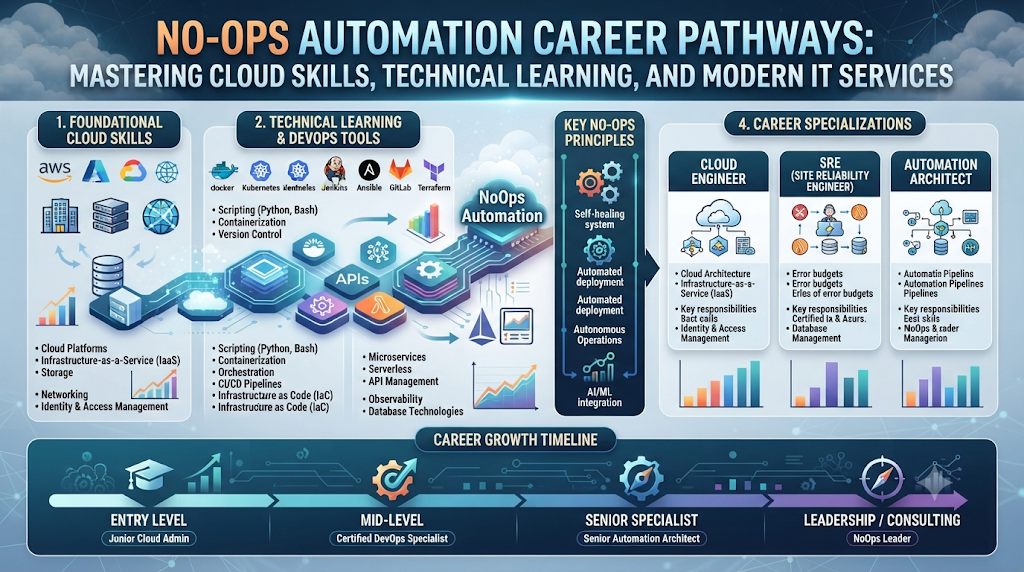
NoOpsSchool.com advertises learning tracks for NoOps Engineers, NoOps Architects, NoOps Managers, and NoOps Professionals. These tracks address different responsibilities within automation-focused IT environments.
The Professional Value of Learning NoOps
Automation knowledge can help IT professionals understand how modern systems are created, delivered, and maintained. It also helps them recognise tasks that can be improved through standard processes.
For example, an engineer who understands configuration management can help reduce differences between test and production environments. A professional who understands observability can help teams investigate application performance and service problems.
NoOps-related knowledge can be useful in several professional areas:
- Cloud infrastructure: Understand resource configuration, permissions, and networking.
- Automation engineering: Create scripts and workflows for repeatable tasks.
- Application delivery: Work with automated testing and release pipelines.
- Platform engineering: Understand reusable environments and developer platforms.
- Technical leadership: Coordinate automation projects and evaluate their risks.
These capabilities develop through practice. Reading about a technology is only the starting point. Learners should also configure systems, test changes, investigate errors, and explain how their work operates.
A planned learning route can help professionals connect individual technical skills with wider responsibilities.
NoOps vs DevOps: Comparing the Operational Focus
The term NoOps vs DevOps describes the relationship between two approaches that use automation but have different areas of emphasis.
DevOps promotes collaboration between development and operations teams. It encourages shared responsibility, continuous integration, delivery practices, and feedback.
NoOps focuses on automating suitable operational activities so that fewer routine tasks need direct manual involvement.
Main points of comparison
| Area | DevOps | NoOps |
|---|---|---|
| Central focus | Collaboration across software development and operations | Automation of suitable operational activities |
| Team approach | Shared responsibility for delivery and operations | Automated workflows with human supervision |
| Typical practices | CI/CD, testing, collaboration, monitoring | Automated provisioning, configuration, and recovery |
| Human role | Work together across the software lifecycle | Design, review, security, and exception management |
Understanding NoOps vs DevOps helps professionals explain how automation can fit into an existing delivery model. It does not mean that an organisation must remove its DevOps practices to use NoOps ideas.
The comparison of NoOps vs DevOps is most useful when teams review their current responsibilities and identify where automation could improve consistency. Both approaches can use cloud platforms, containers, infrastructure as code, and monitoring.
NoOps Automation Tools: Technologies Worth Learning
NoOps automation tools are technologies that help IT teams manage infrastructure, application delivery, configuration, and monitoring through repeatable workflows. They reduce the need for people to perform every routine activity manually.
Learning these tools means understanding their functions and how they connect to a wider system.
Infrastructure as code
Infrastructure as code allows professionals to describe resources through configuration files. Teams can reuse these definitions, review proposed changes, and manage environments more consistently.
Terraform is a widely used example in this area. Learners can practise creating a small environment and understanding how configuration changes affect resources.
Containers and orchestration
Docker packages applications and their required components into containers. Kubernetes helps manage container workloads across a cluster.
Together, these technologies help learners understand application packaging, deployment, scaling, and service management.
Continuous integration and delivery
CI/CD tools automate parts of the software delivery process. They can build applications, run tests, and prepare approved changes for release.
A useful exercise is to create a workflow that stops when a test fails instead of continuing with an unsafe release.
GitOps
GitOps uses version-controlled files to describe the desired configuration of an environment. Changes can be reviewed and applied through automated processes.
Monitoring and observability
Monitoring platforms collect information about infrastructure and applications. Logs, metrics, and traces help engineers investigate performance problems and understand system behaviour.
Serverless and AI-supported operations
Serverless computing allows code to run without requiring developers to manage every underlying server component. AI-supported operations can help analyse technical information, but their results still need human evaluation.
A good study plan for NoOps automation tools should include configuration, testing, troubleshooting, and security. NoOpsSchool.com advertises learning topics that include infrastructure as code, cloud-native computing, Kubernetes, Docker, Terraform, GitOps, CI/CD, serverless, observability, and AI-powered operations.
NoOps Certification: Selecting a Suitable Learning Route
NoOps certification refers to a learning credential associated with automation-focused IT operations. The exact subjects and assessments can differ between programmes, so learners should review the details before choosing a course.
A useful NoOps certification should explain what knowledge it covers and what learners are expected to understand after completing the programme.
Questions to consider before choosing
- Subject coverage: Does the programme explain cloud services, automation, and infrastructure management?
- Practical learning: Are there exercises that allow learners to apply the concepts?
- Security awareness: Does it cover permissions, credentials, and safe configuration?
- Assessment: Are the learning and assessment requirements explained clearly?
- Skill level: Does the programme match your current technical knowledge?
A NoOps certification can provide a structured learning target. It may also help a learner demonstrate that they have completed a particular programme.
However, a certificate does not automatically prove professional experience or guarantee employment, promotion, salary growth, or recognition. Learners should compare the course content with their actual career goals.
NoOpsSchool.com focuses on NoOps education and certification learning. People considering a NoOps certification can review its published learning information to understand the available tracks and subjects.
NoOps Engineer Certification: Building Practical Engineering Skills
NoOps engineer certification is a learning route for people interested in automated infrastructure, cloud environments, and application operations. It can help learners organise their study of provisioning, deployment, containers, monitoring, and security.
A NoOps engineer certification path should connect individual technical skills with the way a complete environment works.
Technical abilities to develop
Infrastructure provisioning
Learn how to create resources through configuration files. Practise checking planned changes before applying them.
Cloud platform knowledge
Understand resource types, permissions, networking, and basic cloud management.
Deployment workflows
Study how code moves through build, test, and release stages. Learn how to identify problems when a pipeline stops.
Container management
Understand how applications are packaged and how container workloads are managed.
Monitoring and troubleshooting
Practise reading logs, reviewing metrics, and investigating alerts. Learn which known issues may be suitable for automated recovery.
Security practices
Study access control, secret management, and safe configuration methods.
Learners preparing for NoOps engineer certification can create a practical project that provisions a test environment, deploys a small application, and monitors its performance. They should document the setup and explain how they would handle a failed deployment.
The value of NoOps engineer certification depends on the learning content and the ability to apply the skills. Practical projects and problem-solving remain important parts of professional development.
NoOps Architect Training: Developing System Design Knowledge
NoOps architect training focuses on planning technology environments where automation supports infrastructure and application management. It helps professionals understand how cloud services, security, reliability, and deployment workflows fit together.
The aim of NoOps architect training is to develop design judgement, not simply familiarity with technical products.
Subjects for architecture learners
- Infrastructure structure: Plan how resources and application components connect.
- Capacity planning: Consider how systems should respond to changes in demand.
- Resilience: Identify possible failure points and suitable recovery methods.
- Security design: Plan identity controls, network rules, and protected configurations.
- Automation standards: Create reusable patterns for provisioning and application delivery.
- Cost planning: Understand how service selection and resource use affect expenses.
Practical NoOps architect training should include design tasks. Learners can prepare an architecture proposal, explain their technology choices, and identify the risks that need attention.
Architects must also understand where automated actions need approval. Changes to critical systems may require testing, review, and a planned recovery option.
Professionals considering NoOps architect training should look for material that develops technical design, documentation, and communication skills.
NoOps Manager Certification: Planning and Coordinating Automation
NoOps manager certification is a learning option for people responsible for technical teams, automation projects, or operational improvement. It focuses on planning, governance, coordination, and the evaluation of technical work.
A NoOps manager certification programme should help managers understand how automation projects affect teams and business processes.
Management areas to understand
Process selection
Identify repeated activities that may benefit from automation. Check whether the process is stable and clearly understood before changing it.
Project coordination
Set priorities, assign responsibilities, and agree on project expectations.
Team communication
Help engineering, development, security, and business teams understand their roles.
Risk management
Make sure automated workflows have suitable permissions, testing, and approval steps.
Performance evaluation
Review service information and project results to understand whether the change is useful.
Ongoing improvement
Encourage teams to review workflows, investigate recurring issues, and update outdated processes.
People exploring NoOps manager certification should look for a balance of technical foundations and leadership subjects. Managers do not need to configure every tool, but they should understand how automation works and where risks may arise.
A NoOps manager certification can support structured professional learning. It does not guarantee a management role or a particular career result.
NoOps Training Course: A Structured Route from Basics to Practice
A NoOps training course gives learners an organised way to study the technologies and principles behind automation-focused operations. It can be suitable for beginners and professionals who want to develop new technical abilities.
An effective NoOps training course should combine clear explanations with practical work.
Suggested stages of learning
Stage 1: Technical foundations
Study cloud computing, networking, operating systems, and basic scripting.
Stage 2: Infrastructure management
Learn infrastructure as code and practise creating a simple test environment.
Stage 3: Containers and applications
Explore application packaging and container orchestration.
Stage 4: Delivery automation
Build a basic CI/CD workflow and understand how automated tests affect releases.
Stage 5: Monitoring and security
Study logs, metrics, alerts, access permissions, and credential handling.
Stage 6: Practical implementation
Combine the subjects in a small project and document how the environment works.
Before choosing a NoOps training course, review the prerequisites, learning level, and practical coverage. Beginners may need more foundational lessons, while experienced engineers may prefer advanced infrastructure and architecture subjects.
NoOpsSchool.com advertises learning tracks for NoOps Engineers, NoOps Architects, NoOps Managers, and NoOps Professionals. Its listed topics include Terraform, Kubernetes, Docker, GitOps, CI/CD, serverless, and observability.
NoOps Consulting Services: Improving Technology Workflows
NoOps consulting services can help organisations understand how automation may improve their infrastructure and operational processes. The work may involve reviewing existing activities, identifying repeated manual tasks, and planning technical changes.
The purpose of NoOps consulting services should be to address specific needs rather than introduce automation without a clear reason.
Areas of advertised support
- Operational assessments: Examine current processes and identify possible improvements.
- Automation strategy: Plan suitable activities for automation and define expected outcomes.
- Cloud-native modernisation: Review applications and infrastructure for cloud-native improvements.
- Infrastructure provisioning: Improve how environments are created and configured.
- CI/CD implementation: Establish automated processes for building, testing, and releasing software.
- AIOps integration: Explore AI-supported analysis of operational information.
- Security automation: Introduce suitable automated security checks and configuration controls.
NoOpsSchool.com advertises NoOps consulting services in areas that include operational assessments, automation strategy, cloud-native modernisation, infrastructure provisioning, CI/CD implementation, AIOps integration, and security automation.
Before selecting NoOps consulting services, organisations should prepare a clear description of their systems, current problems, security requirements, and expected results. They should also identify who will maintain the work after implementation.
Good consulting work should consider technical limitations and long-term responsibilities. An automated process is only useful when the organisation can understand and maintain it.
How to Hire NoOps Freelancers for Specific Projects
Some organisations need specialist knowledge for a limited task instead of a permanent technical role. They may decide to hire NoOps freelancers for infrastructure automation, cloud configuration, monitoring, or other defined work.
The decision to hire NoOps freelancers should begin with a realistic project description and clear technical requirements.
Steps to select a suitable specialist
1. Describe the required outcome
Explain the existing environment, the problem, and what the completed work should achieve.
2. Identify relevant technical skills
List the tools and platforms involved, such as Terraform, Kubernetes, cloud platforms, automated monitoring, or self-healing systems.
3. Review project experience
Ask candidates to describe their role in previous work and how they tested their solutions.
4. Discuss security requirements
Agree on access permissions, credential handling, confidential information, and production-system restrictions.
5. Define deliverables
Set expectations for code, configurations, testing, documentation, and handover.
6. Confirm maintenance responsibilities
Decide who will review, update, and maintain the delivered automation.
Businesses that hire NoOps freelancers should assess communication and documentation skills along with technical knowledge. The organisation remains responsible for its systems after the project ends.
NoOpsSchool.com advertises access to freelancers with skills in Terraform, Kubernetes, cloud platforms, automated monitoring, and self-healing systems. Organisations should review individual suitability and confirm project arrangements before proceeding.
Table: NoOps Learning and Service Options at a Glance
| Option | What It Covers | Who It Helps |
|---|---|---|
| NoOps certification | Structured learning about automation-focused operations | Learners seeking a planned study route |
| NoOps engineer certification | Infrastructure, cloud, deployment, and monitoring | Technical engineers |
| NoOps architect training | System design, reliability, and automation planning | Architects and senior technical professionals |
| NoOps manager certification | Project coordination, governance, and risk awareness | IT managers and team leads |
| NoOps training course | Guided lessons and practical exercises | Beginners and working professionals |
| NoOps consulting services | Assessments, strategy, and implementation areas | Organisations reviewing IT processes |
| Hire NoOps freelancers | Specialist support for defined technical tasks | Teams needing project-based expertise |
Common Mistakes in NoOps Learning and Implementation
Automation can create new problems when it is introduced without proper planning. Learners and organisations should watch for these common mistakes:
- Assuming automation can handle every situation: Unusual incidents and important decisions still need people.
- Selecting tools without a defined need: First identify the problem, then choose the technology.
- Ignoring technical foundations: Networking, cloud, and operating system knowledge support better automation.
- Applying untested changes: Workflows should be checked before they affect important services.
- Using broad permissions: Automated accounts should receive only the access they require.
- Skipping recovery planning: Teams should know how to respond when a workflow produces an incorrect result.
- Relying only on course demonstrations: Learners need independent practice to understand technical problems.
- Leaving workflows undocumented: Other professionals should be able to understand and maintain the process.
- Expecting immediate career benefits: Skills develop through study, practical work, and experience.
- Forgetting regular reviews: Infrastructure and software change, so automation needs ongoing maintenance.
A Simple Example
Consider a fictional organisation named AquaMetric Instruments, which develops digital monitoring equipment for commercial swimming facilities. Its technology platform collects equipment readings and displays service information to maintenance teams.
The organisation’s developers regularly prepare testing environments, release software updates, and check whether the platform is operating correctly. Some of these activities take time because engineers repeat similar setup and verification steps.
The team decides to define its infrastructure through reusable configuration files. It then creates a deployment workflow that runs checks before releasing an approved update. Monitoring tools collect application information and send alerts when a service behaves unexpectedly.
The team also prepares automated actions for a small number of known problems. More serious or unusual issues are assigned to engineers for investigation. A manager reviews the process and confirms that access rules, testing responsibilities, and documentation are clear.
This fictional example shows how automation can improve routine work while keeping technical professionals responsible for system quality. It also provides a practical learning scenario involving infrastructure, deployment, monitoring, and security.
How NoOpsSchool Can Help
NoOpsSchool focuses on NoOps education, certification learning, and related professional services. Its advertised learning tracks include NoOps Engineers, NoOps Architects, NoOps Managers, and NoOps Professionals.
The site lists subjects such as infrastructure as code, cloud-native computing, Kubernetes, Docker, Terraform, GitOps, CI/CD, serverless, observability, and AI-powered operations. It also advertises hands-on labs and real-world automation scenarios involving self-healing infrastructure and automated incident response.
For organisations, its advertised service areas include operational assessments, automation strategy, cloud-native modernisation, infrastructure provisioning, CI/CD implementation, AIOps integration, and security automation. The platform also offers access to freelancers with selected automation and infrastructure skills.
Learners and organisations should review the current programme and service information to confirm whether the available options match their requirements.
Frequently Asked Questions About NoOps Automation Learning and Careers
1. What should a beginner understand before studying what is NoOps?
A beginner should first understand how applications, servers, cloud resources, and networks work. Learning what is NoOps becomes easier when these foundations are clear. The next step is to explore how automation can manage routine tasks while people remain responsible for system decisions.
2. Are practical exercises important when completing NoOps certification?
Yes. Practical exercises help learners connect course concepts with technical activities. When comparing NoOps certification options, check whether the programme includes configuration, deployment, monitoring, or troubleshooting work. A certificate should be considered alongside practical ability, not as a replacement for it.
3. How can a professional prepare for NoOps engineer certification while working full-time?
A professional can divide learning into small study goals, such as infrastructure configuration, deployment automation, and monitoring. NoOps engineer certification preparation can include short practice projects and regular documentation. A consistent learning routine can make technical subjects easier to manage.
4. What architecture problems can NoOps architect training help learners examine?
NoOps architect training can help learners examine scalability, security, reliability, infrastructure design, and automation standards. Architecture exercises can also show how one design choice affects other system components. Learners should practise explaining the reasons behind their technical decisions.
5. How does NoOps manager certification relate to operational governance?
NoOps manager certification can help managers study approval processes, access responsibilities, project risks, and performance reviews. These areas are important because automation can affect multiple systems. Managers need clear rules to ensure that technical workflows remain controlled and accountable.
6. Should a NoOps training course teach troubleshooting as well as automation?
Yes. A NoOps training course should explain what happens when a script, deployment, or infrastructure change fails. Troubleshooting helps learners understand workflow behaviour and recognise when human intervention is necessary. It also encourages safer automation practices.
7. What factors should influence an organisation’s NoOps vs DevOps decision?
The NoOps vs DevOps decision should reflect the organisation’s delivery model, technical responsibilities, system complexity, and automation goals. Teams should identify which processes need better collaboration and which routine activities can be automated. Both approaches can support the same environment.
8. How can a business prepare for its first NoOps consulting services project?
The business should document its current workflows, recurring technical problems, infrastructure, and security requirements. It should also define measurable project goals. Clear preparation helps NoOps consulting services focus on relevant improvements instead of recommending unnecessary technology changes.
9. What is a sensible way to manage a project when you hire NoOps freelancers?
Start with a limited assignment that has clear deliverables and testing requirements. When you hire NoOps freelancers, agree on access controls, documentation, communication, and handover responsibilities. Review the work before allowing changes to affect important production systems.
10. What should learners compare before selecting NoOpsSchool learning options?
Learners should compare the advertised learning track, technical subjects, practical activities, and programme requirements. NoOpsSchool.com lists options for engineers, architects, managers, and NoOps professionals. Reviewing these details helps learners decide whether a particular option matches their experience and goals.
Final Thoughts
NoOps brings automation into everyday infrastructure and service management, but it does not remove the need for experienced professionals. Its successful use depends on clear workflows, tested configurations, secure access, and regular system reviews. Learning cloud platforms, infrastructure as code, containers, CI/CD, and observability can help people understand how automated environments operate. Organisations can explore their needs through assessments, consulting support, or specialist project work. NoOpsSchool.com advertises education tracks and related services for people interested in this field. Start with one practical skill, apply it in a controlled environment, and expand your knowledge as your technical confidence grows.