Introduction
The visual system is far more complex than simple image capture. While clear “20/20” eyesight measures how sharply each eye sees objects at a distance, true functional vision relies on the brain’s ability to coordinate both eyes as a unified team. When the delicate muscle systems or neural pathways controlling eye alignment, tracking, focusing, or depth perception experience disruptions, everyday activities—such as reading, computer work, spatial navigation, and sports—can become physically exhausting.Navigating your care with trusted medical resources empowers you to make proactive, well-informed choices for your family’s eye health. For reliable educational tools, hospital discovery resources, and vision rehabilitation guidance, BESTEYEHOSPITALS provides valuable information to help you locate qualified facilities and understand modern treatment options.
What Is Vision Therapy?
Vision therapy—sometimes referred to as orthoptic training, visual training, or neuro-optometric rehabilitation—is a supervised, individualized program of visual exercises designed to correct specific functional vision deficiencies. Rather than simply strengthening physical eye muscles, vision therapy focuses on improving the neurological pathways that control eye movements, binocular alignment, and visual processing speed.
The visual process involves continuous communication between the eyes and the brain. When an individual looks at an object, the brain must instruct both eyes to point at the exact same spatial coordinate (convergence), adjust their internal lenses to maintain crisp focus (accommodation), and merge two slightly different visual images into a single three-dimensional view (stereopsis). If any link in this neurological loop breaks down, visual fatigue, double vision, or eye strain can result.
Functional Vision System Dynamics
 ├── Monocular Acuity (Sharpness of vision in each eye)
 ├── Binocular Alignment & Teaming (Vergence/Convergence)
 ├── Accommodative System (Focusing flexibility and stamina)
 └── Oculomotor Function (Smooth tracking, fixations, and saccades)
Vision Therapy vs. Prescription Eyeglasses
It is essential to distinguish vision therapy from standard corrective lenses:
- Prescription Eyeglasses: Utilize optical glass or plastic lenses to bend incoming light rays, ensuring light focuses precisely on the retina. Eyeglasses correct optical refractive errors (such as myopia, hyperopia, or astigmatism) but do not fundamentally change how the eyes team or track together.
- Vision Therapy: Uses specialized optical devices—including prisms, therapeutic lenses, polarized filters, eye patches, and digital tracking software—to train the brain to control eye alignment, tracking speed, and visual processing more effectively.
Vision Therapy vs. Eye Muscle Surgery
Similarly, vision therapy serves a different clinical purpose than strabismus surgery:
- Strabismus Surgery: Involves physically shortening, lengthening, or repositioning the extraocular muscles around the eyeball to realign structurally crossed or turned eyes. Surgery alters physical muscle alignment but does not automatically teach the brain how to use both eyes together.
- Vision Therapy: Focuses on functional retraining. It teaches the brain to merge visual signals from both eyes, improving coordination and binocular depth perception.
Office-Based and Home-Based Structure
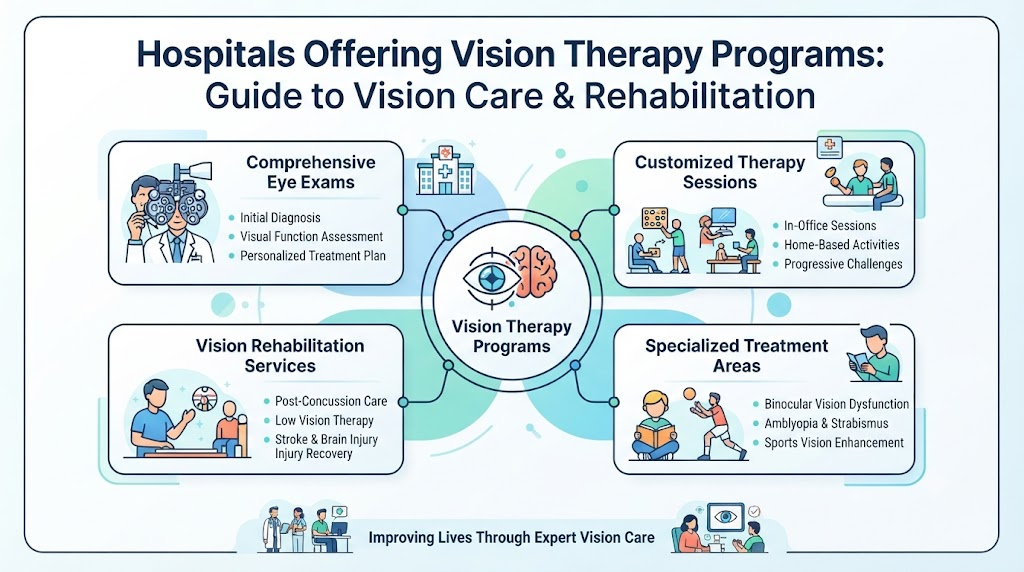
Effective hospital programs feature a combination of weekly, in-person office sessions supervised by eye care professionals alongside targeted daily home exercises. Strong clinical evidence supports the effectiveness of supervised office-based vision therapy—particularly for conditions like convergence insufficiency—while home exercises help reinforce newly learned skills between clinical visits.
Who May Benefit from Vision Therapy?
Vision therapy is not a universal solution for every eye disease or refractive error. Clinical guidelines emphasize that therapy is recommended only after a comprehensive eye examination identifies specific binocular vision, accommodative, or oculomotor disorders.
Common Candidates for Vision Therapy
 ├── Primary Binocular Dysfunction (e.g., Convergence Insufficiency, Divergence Excess)
 ├── Oculomotor Tracking Deficits (Poor saccadic/pursuit movements impacting reading)
 ├── Accommodative Disorders (Focusing insufficiency or flexibility fatigue)
 └── Acquired Neurological Changes (Post-concussion visual dysfunction, stroke recovery)
Convergence Insufficiency (CI)
Convergence insufficiency is one of the most common and widely researched binocular vision disorders. It occurs when the eyes struggle to turn inward together smoothly while focusing on near objects, such as a book, tablet, or smartphone. Individuals with CI often experience double vision, eye fatigue, headaches, blurred text, and poor reading comprehension. Supervised office-based vision therapy is considered a primary, highly effective treatment for this condition.
Binocular Vision Disorders and Eye Teaming Problems
When the two eyes fail to work together as an aligned pair, the brain receives two conflicting visual images. To avoid double vision, the brain may suppress (ignore) the image from one eye, which can lead to reduced depth perception and increased eye strain. Vision therapy helps train the brain to integrate inputs from both eyes simultaneously.
Eye Tracking Difficulties (Oculomotor Dysfunction)
Smooth reading requires precise micro-movements of the eyes, including rapid jumps between words (saccades) and smooth tracking along lines of text (pursuits). Individuals with tracking difficulties may frequently lose their place while reading, skip lines, use a finger to guide their eyes, or experience frustration during school or office tasks.
Focusing (Accommodative) Disorders
Accommodative disorders involve difficulty maintaining or changing focus when shifting gaze between near and far objects (such as looking from a classroom whiteboard down to a desk notebook). Symptoms include transient blurriness, headache, and difficulty maintaining visual focus during prolonged reading.
Selected Vision Rehabilitation Cases
Selected individuals recovering from acquired brain injuries, concussions, or strokes may develop secondary visual disruptions, such as spatial disorientation, light sensitivity, or loss of side vision awareness. Neuro-optometric rehabilitation programs help re-establish visual comfort and stability following neurological trauma.
Vision Therapy Services Comparison Table
Understanding the distinct components of a comprehensive hospital vision therapy program helps patients and families navigate their care with confidence:
| Service Component | Primary Clinical Purpose | Primary Benefit to Patient |
| Comprehensive Eye Examination | Evaluates overall eye health, visual acuity, and refraction. | Rules out underlying disease and ensures correct lens prescriptions. |
| Binocular Vision Assessment | Evaluates eye alignment, convergence, stereopsis, and focusing. | Identifies specific functional visual deficits and framing requirements. |
| Supervised Office Sessions | Guided exercises using specialized optical equipment and software. | Ensures correct technique, progressive difficulty, and clinical oversight. |
| Home Practice Program | Daily exercise routines designed to reinforce clinical training. | Accelerates neural skill retention and builds visual stamina. |
| Progress Monitoring Visits | Periodic clinical re-evaluations to measure visual skill gains. | Allows specialists to adjust therapy protocols based on objective data. |
| Long-Term Follow-Up Care | Ensures retained visual stability after active therapy ends. | Protects visual comfort and prevents skill regression over time. |
Services Offered by Leading Hospitals
Choosing a hospital-based eye care department ensures access to comprehensive clinical services before, during, and after your therapy program.
Hospital Vision Rehabilitation Pathway
 ├── Phase 1: Comprehensive Diagnostic Workup (Acuity, Refraction, Health Check)
 ├── Phase 2: Specialized Binocular & Oculomotor Evaluation (Sensorimotor Testing)
 ├── Phase 3: Custom Therapy Plan (Supervised Office Sessions + Daily Home Exercises)
 └── Phase 4: Outcome Evaluation & Long-Term Maintenance
- Comprehensive Ophthalmic Examinations: Complete health checks of internal and external eye structures to rule out organic eye diseases (such as cataracts, retinal issues, or glaucoma) before starting functional training.
- Pediatric Eye Care Services: Specialized evaluation environments equipped with kid-friendly diagnostic tools designed to engage young children and gather accurate visual performance data.
- Binocular Vision Assessment: In-depth evaluations measuring near point of convergence, fusional vergence reserves, stereopsis (3D vision), and accommodative flexibility.
- Structured Vision Therapy Programs: Custom clinical protocols tailored to the patient’s specific diagnostic profile, combining optical prisms, lens filters, and digital tracking tools.
- Oculomotor and Eye Movement Training: Targeted exercises focused on improving fixational stability, smooth pursuit tracking, and rapid saccadic jumps necessary for comfortable reading.
- Accommodation (Focusing) Therapy: Specialized regimens designed to improve the speed, stamina, and flexibility of the eye’s natural focusing mechanisms.
- Orthoptic Clinical Services: Specialized therapy overseen by certified orthoptists focusing on extraocular muscle balance, strabismus management, and amblyopia (lazy eye) support.
- Neuro-Optometric Rehabilitation: Integrated care plans designed for individuals recovering from brain injuries, stroke, or vestibular conditions that impact spatial vision.
Advanced Technologies Used
Modern hospital eye departments utilize advanced diagnostic and therapeutic equipment to deliver accurate assessments and engaging, measurable therapy sessions.
- Digital Vision Assessment Systems: Automated visual testing platforms that measure visual acuity, contrast sensitivity, and subtle refractive variations using precise digital targets.
- Eye-Tracking Technology: Infrared camera systems that track and record eye movements in real time while a patient reads or follows a moving target, providing objective data on tracking efficiency.
- Computer-Assisted Therapy Software: Interactive visual software programs that present therapeutic challenges—such as dynamic 3D targets or speed-based tracking tasks—adjusting difficulty automatically as performance improves.
- Prism Evaluation and Lens Systems: Precise trial lenses and prism bars used to measure fusional reserves and teach the brain how to align visual images comfortably.
- Stereopsis (3D Vision) Testing: Polarized and vectographic target systems used to evaluate three-dimensional depth perception and binocular fusion stability.
- Digital Sensorimotor Analysis: Integrated platforms that measure reaction times, eye-hand coordination, and spatial awareness during active visual tasks.
How to Choose the Right Hospital for Vision Therapy
Selecting an appropriate clinical facility is essential when seeking treatment for functional vision disorders. Because successful vision therapy requires accurate diagnosis, progressive therapy design, and patient commitment, evaluating a hospital’s clinical standards is critical.
                      ┌─────────────────────────────────────────┐
                      │   Hospital Evaluation Criteria          │
                      └────────────────────┬────────────────────┘
                                           │
         ┌─────────────────────────────────┼─────────────────────────────────┐
         ▼                                 ▼                                 ▼
┌──────────────────┐              ┌──────────────────┐              ┌──────────────────┐
│ Clinical Team    │              │ Comprehensive    │              │ Rehabilitation   │
├──────────────────┤              │ Diagnostics      │              │ Infrastructure   │
├──────────────────┤              ├──────────────────┤              ├──────────────────┤
│• Board-certified │              │• In-depth        │              │• Dedicated office│
│  ophthalmologists│              │  sensorimotor    │              │  therapy suites  │
│• Experienced     │              │  evaluations     │              │• Pediatric-      │
│  orthoptists &   │              │• Objective eye-  │              │  friendly space  │
│  optometrists    │              │  tracking tech   │              │• Structured home │
└──────────────────┘              └──────────────────┘              └──────────────────┘
When evaluating potential medical centers, consider the following clinical priorities:
- Qualified Specialist Team: Confirm that the hospital’s team includes board-certified ophthalmologists, pediatric eye specialists, optometrists, or certified orthoptists with extensive experience in binocular vision disorders.
- Comprehensive Diagnostic Capabilities: Select facilities that perform in-depth sensorimotor evaluations rather than relying solely on basic eye chart readings.
- Evidence-Based Therapy Protocols: Ensure the hospital emphasizes supervised office-based sessions paired with structured home practice, which is backed by clinical research.
- Pediatric Expertise and Environment: For children, choose a facility with pediatric-focused staff and engaging, child-friendly therapy spaces that make sessions positive and productive.
- Modern Equipment and Facilities: Look for centers equipped with modern eye-tracking technology, computer-assisted software, and a variety of optical training tools.
- Multidisciplinary Support: Choose facilities where eye specialists can collaborate easily with occupational therapists, neurologists, or educational specialists when needed.
Hospital Selection Checklist
Use this practical checklist when researching medical centers and evaluating treatment options:
| Feature | What to Look For | Why It Matters |
| Specialist Qualifications | Credentials in orthoptics, pediatric eye care, or binocular vision. | Ensures accurate diagnosis and tailored therapy plans. |
| Sensorimotor Diagnostics | On-site testing for convergence, tracking, accommodation, and 3D depth. | Identifies specific visual deficits beneath standard acuity testing. |
| Supervised Office Therapy | Dedicated office therapy suites staffed by trained specialists. | Ensures exercises are performed correctly and adjusted as skills improve. |
| Structured Home Exercises | Clear home practice guides, digital portals, or specialized software. | Reinforces weekly office gains through consistent daily practice. |
| Pediatric Support | Age-appropriate equipment, patient staff, and engaging formats. | Keeps young patients motivated throughout multi-week programs. |
| Progress Re-evaluations | Scheduled clinical re-assessments every 4 to 8 weeks. | Measures visual gains objectively and determines when goals are met. |
What to Expect During Vision Therapy
Understanding the clinical process helps patients and families approach vision therapy with realistic expectations and clear goals.
Comprehensive Eye Examination
Care begins with a thorough medical eye examination to verify structural eye health, assess visual acuity, and ensure that any needed glass prescriptions are up to date.
Specialized Binocular Vision Evaluation
If functional vision issues are suspected, a specialized sensorimotor evaluation is performed. The specialist measures eye alignment, near point of convergence, focusing stamina, tracking accuracy, and 3D depth perception.
       Step 1: Medical Eye Examination & Refraction
                            │
                            ▼
       Step 2: Specialized Binocular & Oculomotor Testing
                            │
                            ▼
       Step 3: Individualized Therapy Plan Creation
                            │
                            ▼
       Step 4: Weekly Supervised Office Sessions + Daily Home Exercises
                            │
                            ▼
       Step 5: Periodic Re-evaluations & Graduation
Individualized Treatment Planning
Using diagnostic findings, the care team outlines a customized therapy plan. The plan detailed the anticipated duration of therapy (typically ranging from 12 to 24 weeks), session frequency, home exercise requirements, and specific performance goals.
Supervised Office Sessions and Home Practice
Patients attend weekly in-office sessions (typically 30 to 60 minutes) guided by a therapist. During these visits, specialized equipment—such as prisms, vectograms, tracking boards, and computer programs—is used to teach new visual skills. Patients are assigned brief daily home exercises (15 to 20 minutes) to reinforce learning between clinical visits.
Recovery and Long-Term Care
Achieving lasting visual improvement requires consistent participation, proper practice techniques, and routine follow-up evaluations.
- Commit to the Full Program: Visual skill retraining takes time. Completing the full recommended course of therapy ensures that newly learned neural pathways become automatic and stable.
- Maintain Daily Home Exercises: Consistent daily practice reinforces skills developed during weekly office visits. Skipping home exercises can slow overall progress.
- Attend Scheduled Re-Evaluations: Periodic progress checks allow your specialist to measure visual improvements objectively, update exercise difficulty, and determine when therapy goals have been met.
- Practice Healthy Visual Habits: Protect your visual comfort by taking regular breaks during prolonged computer or reading work (following the 20-20-20 rule: every 20 minutes, look at an object 20 feet away for 20 seconds). Ensure adequate lighting and maintain proper screen working distances.
- Keep Up with Routine Eye Exams: Continue scheduling annual eye examinations to monitor overall eye health, check vision sharpness, and confirm that binocular stability remains strong.
Possible Limitations
While vision therapy provides significant benefits for appropriate conditions, understanding its limitations helps align expectations with achievable visual outcomes:
- Not a Universal Cure: Vision therapy is designed to treat specific functional, binocular, and oculomotor disorders. It cannot cure organic eye diseases (such as glaucoma or macular degeneration) or eliminate the need for glasses in standard refractive conditions.
- Progress Varies by Individual: Improvement depends on factors such as the specific diagnosis, age, individual neuroplasticity, and consistent participation in home exercises.
- Requires Active Time Commitment: Unlike passive treatments, vision therapy requires active effort, time, and focus over several weeks or months.
- May Require Complementary Care: Depending on the diagnosis, some patients may still benefit from eyeglasses, therapeutic prisms, temporary patching, or surgical consultation alongside or after vision therapy.
How BESTEYEHOSPITALS Helps Patients
Navigating eye care options and finding specialized hospital programs can be challenging. Platform resources help simplify your search and provide clear, educational guidance.
- Eye Hospital Discovery: Access organized information about specialized eye hospitals, orthoptic clinics, and vision rehabilitation departments.
- Vision Program Insights: Learn how different medical centers structure their binocular vision evaluations, pediatric services, and therapy technologies.
- Patient-Centered Education: Read clear, medically accurate explanations of convergence insufficiency, eye tracking issues, binocular vision, and rehabilitation options.
- Eye Care Resources: Explore educational guides covering pediatric eye health, strabismus management, corrective lenses, and preventive eye care.
- Empowered Decision-Making: Use practical tools, checklists, and expert insights to prepare for appointments and select facilities that best meet your visual needs.
Common Mistakes People Make
Achieving comfortable visual performance involves avoiding common oversights that can delay progress or lead to unnecessary frustration:
Common Mistakes to Avoid
 ├── Starting Exercises Without a Professional Diagnosis
 ├── Missing Supervised Weekly Office Therapy Sessions
 ├── Skipping Daily Home Reinforcement Exercises
 ├── Expecting Immediate Improvement After Just 1–2 Sessions
 └── Discontinuing Therapy Prematurely Once Early Symptoms Improve
Starting Exercises Without a Medical Diagnosis
Attempting generic “eye exercises” found online without an accurate diagnosis can be ineffective or increase eye strain. Visual exercises must be matched precisely to your specific binocular or focusing deficit.
Skipping Supervised Office Sessions
Relying entirely on unsupervised home exercises often leads to improper technique and slower progress. Supervised office visits ensure that exercises are performed correctly and updated as your skills improve.
Neglecting Daily Home Practice
Relying solely on weekly office visits without practicing at home slows visual skill retention. Consistent daily practice helps solidify new neural pathways.
Expecting Instant Results
Neurological retraining develops gradually over weeks of consistent effort. Expecting instant visual changes after a few sessions can lead to early frustration.
Stopping Therapy Too Soon
Discontinuing therapy as soon as initial symptoms diminish—before visual skills are fully integrated—can lead to skill regression over time. Completing the full planned program helps ensure long-term stability.
Common Myths vs. Facts
Clearing up common misunderstandings helps patients approach vision therapy with realistic expectations:
| Myth | Fact |
| Vision therapy cures all vision problems, including nearsightedness. | Vision therapy treats functional visual skill deficits (like convergence or tracking); it does not alter eyeball shape or eliminate myopia. |
| Vision therapy replaces the need for prescription glasses. | Therapy improves how the eyes coordinate, but patients with refractive errors may still require corrective lenses for crisp vision. |
| Online generic eye exercises work the same as hospital programs. | Evidence-based vision therapy requires individualized diagnosis, specialized optical equipment, and expert clinical oversight. |
| Vision therapy is only effective for young children. | While children’s visual systems adapt quickly, adults can also benefit from vision therapy due to lifelong neural plasticity. |
| If you have 20/20 visual acuity, your functional vision is perfect. | You can have 20/20 distance vision while still struggling with significant eye teaming, focusing, or tracking fatigue at close range. |
Real-Life Educational Scenarios
Scenario 1: Improving Reading Comfort in Convergence Insufficiency
A ten-year-old student struggles with reading, frequently losing their place, experiencing headaches, and reporting that text appears to split into two. A pediatric eye specialist performs a binocular assessment and diagnoses convergence insufficiency. The family enrolls in a 16-week hospital vision therapy program featuring weekly office visits and short daily home exercises. Over time, the child’s near point of convergence improves, reading stamina increases, and headaches subside.
Scenario 2: Restoring Visual Stamina for Office Work
An adult office worker experiences severe eye strain, fatigue, and intermittent blurred vision during long computer sessions. A sensorimotor evaluation reveals an accommodative (focusing) flexibility deficit and reduced fusional reserves. Through a tailored 12-week vision therapy program incorporating therapeutic prisms and digital tracking software, the patient improves focusing flexibility and achieves comfortable visual stamina at work.
Scenario 3: Supporting Recovery After a Mild Concussion
Following a sports-related concussion, a college athlete experiences spatial disorientation, light sensitivity, and difficulty tracking moving objects. A neuro-optometric evaluation identifies post-concussion visual dysfunction. The patient enters a specialized hospital rehabilitation program that combines low-power prisms, visual tracking tasks, and balance integration. Over several months, visual stability improves, supporting a safe return to daily activities.
Scenario 4: A Family Choosing Specialized Hospital Care
A family seeking support for their child’s eye coordination difficulties uses educational resources to research hospital programs. They look for facilities featuring board-certified pediatric eye care specialists, dedicated therapy suites, and structured progress reviews. Selecting an experienced hospital allows them to schedule a thorough evaluation and initiate a clear, supportive care plan.
FAQs (15 Questions)
1. What is vision therapy?
Vision therapy is a supervised, individualized program of optical and visual exercises designed to improve binocular eye coordination, eye tracking, focusing flexibility, and visual processing skills.
2. Who may benefit from vision therapy?
Individuals diagnosed with specific functional vision disorders—such as convergence insufficiency, eye teaming problems, accommodative (focusing) fatigue, or oculomotor tracking deficits—may benefit from therapy.
3. Is vision therapy suitable for children?
Yes. Vision therapy is commonly prescribed for children experiencing functional visual issues that interfere with reading, classroom learning, or sports performance.
4. How long does a vision therapy program usually last?
Most programs range from 12 to 24 weeks, depending on the diagnosis, severity of the condition, and consistency with home exercises.
5. What is convergence insufficiency?
Convergence insufficiency is a common binocular vision disorder where the eyes struggle to turn inward together smoothly when looking at near objects, leading to eye strain, double vision, and reading fatigue.
6. Does vision therapy replace prescription glasses?
No. Vision therapy trains eye coordination and visual processing; it does not correct refractive errors like nearsightedness or astigmatism. Many patients wear glasses while completing therapy.
7. Is vision therapy painful?
No. Vision therapy is non-invasive and painless. Some patients may experience mild, temporary eye fatigue early in therapy as visual muscles and neurological pathways adapt to new tasks.
8. What happens during an in-office therapy session?
During a session, a trained therapist guides you through specific visual tasks using prisms, specialized lenses, tracking targets, digital software, and balance boards to train visual skills.
9. Are home exercises necessary?
Yes. Brief daily home practice (15 to 20 minutes) is essential to reinforce skills learned during weekly office visits and support steady progress.
10. Which conditions respond best to vision therapy?
Strong clinical evidence supports vision therapy for convergence insufficiency, while accommodative disorders, eye tracking deficits, and selected binocular vision issues also respond well under specialist care.
11. How do hospitals evaluate patients before starting therapy?
Hospitals conduct a medical eye exam to verify eye health, followed by a specialized sensorimotor evaluation that measures eye alignment, convergence, focusing stamina, tracking accuracy, and 3D vision.
12. What technologies are used in vision therapy?
Key technologies include digital sensorimotor analysis systems, infrared eye-tracking software, computer-assisted visual therapy programs, vectograms, and therapeutic prism arrays.
13. How do I choose the right hospital for vision therapy?
Look for facilities with qualified eye specialists (ophthalmologists, pediatric specialists, or orthoptists), specialized diagnostic testing, supervised office therapy suites, and structured follow-up programs.
14. What results can patients realistically expect?
Patients with appropriate diagnoses who complete their program can expect improved eye coordination, reduced eye strain, enhanced reading comfort, and better visual stamina.
15. How does BESTEYEHOSPITALS help patients find vision therapy programs?
BESTEYEHOSPITALS provides educational information, insights into qualified eye departments, and tools to help patients locate experienced medical centers and explore suitable treatment options.
Final Thoughts
Functional vision health plays a vital role in everyday comfort, learning, and quality of life. When visual skill deficits like convergence insufficiency or tracking issues cause eye strain and fatigue, seeking care from an experienced eye care hospital ensures an accurate diagnosis and an evidence-based treatment plan.Partnering with qualified ophthalmologists, pediatric specialists, or orthoptists allows you to participate in a structured therapy program that combines supervised office sessions with targeted home practice, helping retrain the visual system safely and effectively.