
Introduction
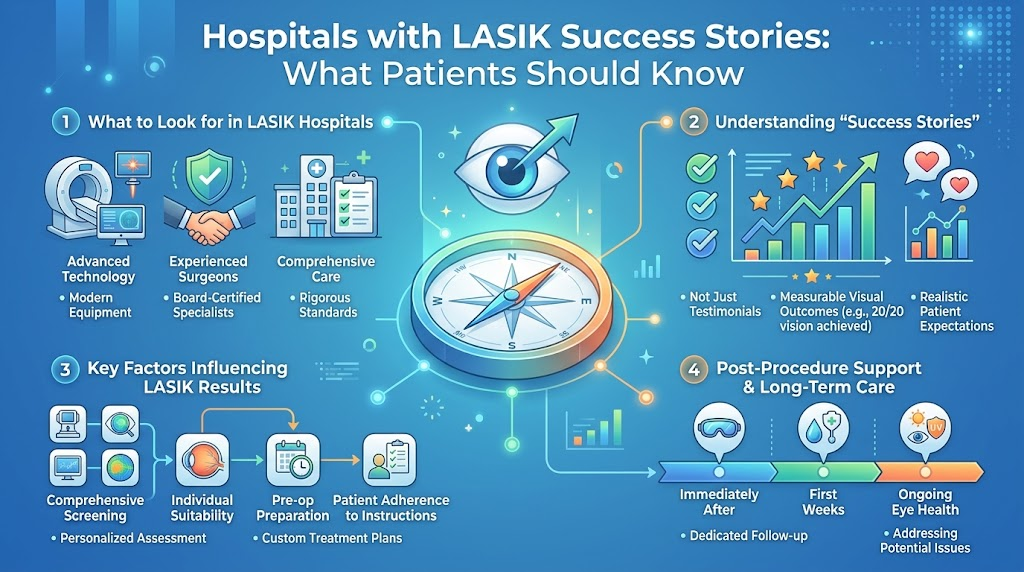
LASIK is a type of laser eye surgery that can correct certain vision problems. It may help suitable patients depend less on glasses or contact lenses. Many people explore hospitals with LASIK success stories before deciding where to have treatment.Patient experiences can offer useful information about eye care and recovery. They may show how a hospital communicates with patients and provides support. However, one person’s results cannot predict another person’s outcome.
A successful experience involves more than clear vision. It also includes careful testing, skilled surgeons, safe treatment, and proper follow-up care. Patients can explore eye care information and hospital options through BESTEYEHOSPITALS.Before choosing a hospital, it helps to understand the procedure. It is also important to know what makes a patient story trustworthy. This article explains what to check before making a decision.
What Is LASIK Eye Surgery?
LASIK stands for Laser-Assisted In Situ Keratomileusis. It is a procedure that uses a laser to change the shape of the cornea. The cornea is the clear front part of the eye.
Light passes through the cornea before reaching the retina. The retina sends visual signals to the brain. If the cornea does not bend light correctly, vision may become blurry.
LASIK changes the cornea’s shape to help light focus more clearly. It can correct certain refractive errors, including:
- Myopia (short-sightedness): Distant objects look blurry.
- Hyperopia (long-sightedness): Nearby objects may look blurry.
- Astigmatism: Uneven corneal shape can cause blurred or distorted vision.
During LASIK, the surgeon creates a thin flap in the cornea. A laser then reshapes the tissue underneath. The flap is placed back over the treated area.
LASIK may reduce the need for glasses or contact lenses. However, it does not prevent every future vision change. For example, many people develop presbyopia as they age. This makes close-up reading harder.
LASIK is not suitable for everyone. Corneal thickness, eye health, prescription stability, and other factors matter. A full examination helps an ophthalmologist decide whether the procedure is suitable.
What Do LASIK Success Stories Really Mean?
LASIK surgery success stories often describe a patient’s experience before and after treatment. These accounts can help others understand what the process may involve.
Patients may describe positive changes such as:
- Less dependence on glasses or contact lenses.
- Clearer vision during everyday activities.
- Greater convenience during sports or travel.
- A comfortable experience with the hospital team.
- Clear instructions before and after surgery.
- Helpful support during recovery.
However, success can mean different things to different people. One patient may value clear distance vision. Another may focus on comfort, communication, and recovery support.
Visual results are only one part of treatment quality. Patients should also consider side effects, safety, and long-term satisfaction.
Results depend on several factors. These include the original prescription, corneal health, eye condition, treatment method, and healing response. Some patients may still need glasses for certain activities.
A positive story should never be treated as a promise. The same procedure can produce different results in different people.
How to Evaluate LASIK Patient Stories
Patient experiences can help people compare LASIK surgery hospitals. However, not every online review provides enough detail.
Some stories may be genuine personal accounts. Others may be short promotional messages. Readers should look for clear details rather than impressive claims.
Here are useful points to consider:
- Original vision problem: Does the patient explain their vision issue before surgery?
- Treatment details: Does the account describe the procedure in general terms?
- Recovery experience: Does it explain what happened after surgery?
- Follow-up care: Does the patient mention later check-ups?
- Balanced feedback: Does the story discuss both positive and difficult parts?
- Verification: Does the hospital explain whether the testimonial is verified?
- Realistic expectations: Does the account avoid promising perfect vision for everyone?
A detailed review may provide more useful information than a short statement. Still, even a genuine review reflects only one person’s experience.
Photos and videos also have limits. Lighting, camera settings, and editing can affect how images look. They cannot prove that every patient achieved the same visual result.
Try to compare several accounts with medical information. Look for repeated comments about communication, testing, and follow-up care. Do not choose a hospital based only on its most positive reviews.
What Makes a Hospital Suitable for LASIK Surgery?
A suitable hospital should have more than modern laser equipment. It needs a skilled medical team and a clear process for patient safety.
Consider these important features:
Qualified eye specialists: The hospital should have trained ophthalmologists who understand refractive surgery.
Detailed eye examinations: Patients should receive proper tests before the surgeon recommends LASIK.
Modern diagnostic tools: Equipment should help assess corneal shape, thickness, prescription, and general eye health.
Suitable laser systems: The hospital should use equipment appropriate for the recommended procedure. Staff should know how to operate and maintain it.
Clean procedure rooms: The treatment area should follow proper hygiene and infection-control practices.
Complication management: The hospital should explain how it responds to unexpected problems.
Regular follow-up care: Patients need clear instructions and planned reviews after surgery.
Patient education: The team should explain benefits, risks, alternatives, and recovery needs in simple language.
Advanced equipment alone does not prove good care. Patient selection and the surgeon’s skills are equally important.
Qualifications and Experience of LASIK Surgeons
The surgeon plays a central role in LASIK treatment. Patients should understand who will perform their procedure.
Start by checking the surgeon’s medical qualifications. Ask about specialist training in ophthalmology and refractive surgery.
You can also ask about:
- Registration with the relevant medical authority.
- Experience performing LASIK procedures.
- Training in other vision correction methods.
- Experience managing complications.
- Knowledge of different laser systems.
- Approach to patient selection and safety.
A qualified LASIK surgeon should explain why a procedure suits your eyes. They should also discuss when LASIK may not be a good choice.
Ask who will examine your eyes and who will perform the surgery. Do not assume that the doctor who gives the first consultation will always perform the procedure.
Professional credentials should be checked through the appropriate official medical or registration body. Hospital advertisements alone are not enough to confirm qualifications.
A good surgeon welcomes questions. They should explain treatment limits without making unrealistic promises.
Tests Required Before LASIK Surgery
A detailed eye examination is essential before LASIK. It helps the ophthalmologist understand whether surgery is appropriate.
Common checks include:
- Vision and prescription testing: Measures how clearly you see and identifies refractive errors.
- Corneal thickness measurement: Checks whether the cornea has enough tissue for the planned treatment.
- Corneal topography: Creates a map of the cornea’s shape.
- Tear film assessment: Checks for dry eyes and tear quality.
- Eye pressure measurement: Helps assess pressure inside the eye.
- General eye examination: Looks for other eye conditions that may affect treatment.
- Medical history review: Checks health conditions, medicines, and other factors that may affect healing.
The surgeon may also ask about changes in your glasses prescription. A stable prescription is an important part of LASIK assessment.
These tests help identify possible risks. For example, certain corneal conditions may make LASIK unsuitable.
Some patients may be better suited to another procedure. Others may be advised against refractive surgery. A responsible hospital explains these findings before discussing treatment costs.
Understanding LASIK Technology and Treatment Options
Different technologies can be used for laser vision correction. The right option depends on the patient’s eyes and medical assessment.
Common approaches include:
- Standard LASIK: A laser reshapes the cornea to correct a refractive error.
- Wavefront-guided LASIK: Uses detailed measurements of how light travels through the eye to guide treatment.
- Topography-guided LASIK: Uses a map of the corneal surface to plan treatment.
- Femtosecond laser-assisted LASIK: Uses a laser to create the corneal flap instead of a mechanical blade.
- PRK: Reshapes the cornea without creating a LASIK flap. Recovery may take longer.
- SMILE: Uses a laser to create a small piece of corneal tissue that the surgeon removes through a small opening.
These procedures are not interchangeable. Each has different benefits, limits, and suitability requirements.
No single technology is always the safest or best choice. The surgeon should explain why a particular method fits your eye measurements and prescription.
Ask about alternatives if LASIK is not suitable. A careful recommendation should be based on your eyes, not simply on the equipment available.
Benefits and Possible Risks of LASIK
For suitable patients, LASIK may offer several benefits. It can reduce dependence on glasses or contact lenses. It may also make some daily activities more convenient.
Possible benefits include:
- Less need for distance glasses.
- Reduced use of contact lenses.
- Clearer uncorrected distance vision.
- A relatively quick initial recovery for many patients.
- Greater convenience during some sports and outdoor activities.
However, LASIK is still surgery. It carries possible side effects and risks.
These may include:
- Dry eyes or discomfort.
- Glare and halos around lights.
- Light sensitivity.
- Blurred or changing vision during recovery.
- Under-correction or over-correction.
- Infection or problems with corneal healing.
- Need for additional treatment.
- Rare but serious loss of vision.
Some side effects improve as the eyes heal. Others may last longer and need medical care.
Risks vary from person to person. Existing dry eye, corneal problems, prescription, and other health factors may affect the decision.
Ask the ophthalmologist to explain your personal risks. Make sure you understand the possible benefits and limits before agreeing to surgery.
LASIK Recovery and Follow-Up Care
Recovery after LASIK varies between patients. Some people notice clearer vision soon after surgery. Others may experience temporary irritation or blurry vision.
Your hospital should provide clear aftercare instructions. These may include:
- Use prescribed eye drops as directed.
- Avoid rubbing or pressing the eyes.
- Follow advice about bathing and washing the face.
- Ask when it is safe to return to exercise.
- Follow guidance about screen use and reading.
- Protect the eyes during recovery.
- Attend every scheduled follow-up appointment.
Do not change prescribed medicines or stop eye drops without medical advice.
Some dryness, light sensitivity, or vision changes may occur during early healing. Contact your eye care team if symptoms concern you.
Sudden vision loss, severe eye pain, or rapidly worsening vision needs urgent medical assessment. Do not wait for a routine follow-up appointment if these symptoms occur.
Follow-up visits help the surgeon check healing and visual progress. They also provide an opportunity to discuss side effects or concerns.
Warning Signs to Watch for When Comparing LASIK Hospitals
Some claims should make patients pause before booking surgery. A responsible hospital should discuss both the benefits and risks.
Be careful if you notice:
- Guaranteed 20/20 vision for every patient.
- Claims that LASIK has no risks.
- Pressure to book surgery immediately.
- No clear information about surgeon qualifications.
- A recommendation without detailed eye testing.
- No discussion of possible complications.
- Patient stories that cannot be verified.
- No clear follow-up plan.
- Unclear pricing or hidden charges.
Be cautious of advertisements that focus only on perfect results. They may leave out important details about patient selection and recovery.
A trustworthy medical team should answer questions openly. It should also explain when LASIK is not suitable.
Table 1: Factors That Help Patients Evaluate LASIK Success Stories
| Evaluation Factor | What to Look For | Why It Matters |
|---|---|---|
| Visual results | Clear details about vision before and after treatment | Helps explain the patient’s reported change |
| Patient experience | Comments about consultation and hospital communication | Shows how the team supported the patient |
| Recovery | Information about healing and side effects | Gives a more balanced view of recovery |
| Follow-up care | Details about check-ups after surgery | Shows whether care continued after treatment |
| Verified testimonials | Clear information about the source of the story | Helps readers judge how much confidence to place in it |
Table 2: Important Features to Check Before Choosing a LASIK Hospital
| Hospital Feature | What Patients Should Verify | Why It Is Important |
|---|---|---|
| Surgeon qualifications | Medical registration and refractive surgery training | Supports informed confidence in the surgeon |
| Diagnostic testing | Tests for prescription, corneal shape, and thickness | Helps assess whether LASIK is suitable |
| Laser equipment | Type of system and trained staff | Supports proper treatment planning |
| Safety practices | Hygiene and procedure-room standards | Helps reduce avoidable risks |
| Complication management | Clear plans for unexpected problems | Helps patients understand available support |
| Follow-up care | Review schedule and contact arrangements | Supports recovery monitoring |
Frequently Asked Questions
1. What makes a LASIK surgery result successful?
A successful result may include clearer vision and less dependence on glasses or contact lenses. It also includes safe treatment, proper healing, and patient satisfaction. The result should be judged against the patient’s needs and medical condition. No single measure can describe every person’s experience.
2. Are LASIK success stories reliable when choosing an eye hospital?
Patient stories can provide useful details about consultations, treatment, and recovery. However, they represent individual experiences. Check whether testimonials are genuine and detailed. Compare them with medical information, surgeon qualifications, and hospital safety practices. Never treat a positive review as a guarantee of your own result.
3. How do I choose a hospital for LASIK surgery?
Look for qualified refractive surgeons, detailed pre-surgery testing, suitable laser equipment, and clear follow-up arrangements. Ask how the hospital handles complications and explains treatment risks. Compare the information from more than one hospital if possible. Avoid making a decision based only on discounts or promotional claims.
4. What tests are needed before LASIK?
Common tests include vision and prescription checks, corneal thickness measurement, corneal mapping, tear film assessment, and eye pressure measurement. The ophthalmologist will also examine general eye health and review your medical history. The exact tests may vary according to your eyes and treatment needs.
5. Can every person with glasses have LASIK surgery?
No. Having glasses does not automatically make someone suitable for LASIK. Corneal thickness, eye health, prescription stability, dry eye, and other factors affect eligibility. Some people may need a different procedure, while others may be advised not to have laser vision correction.
6. How long does it take to recover after LASIK?
Many patients notice clearer vision soon after LASIK, but recovery differs between individuals. Temporary dryness, irritation, or blurry vision may occur. Full healing and visual stability can take longer. Follow the surgeon’s instructions and attend all planned check-ups during recovery.
7. Can LASIK results change over time?
Yes. Vision can change after LASIK due to natural ageing, changes in the eye, or other health factors. LASIK does not prevent presbyopia, which can make close-up reading harder with age. Some people may need glasses later, even after a good initial result.
8. What are the common side effects of LASIK?
Common side effects can include dry eyes, glare, halos, light sensitivity, and temporary blurred or fluctuating vision. Many improve during healing, but some may last longer. Serious complications are less common but possible. Discuss your personal risk factors with an ophthalmologist before surgery.
9. Why are follow-up visits important after LASIK?
Follow-up visits help the surgeon check how the cornea is healing and how vision is changing. They also allow the medical team to identify possible problems and answer questions. Attending scheduled reviews helps patients receive appropriate care throughout recovery.
10. Does LASIK guarantee perfect vision without glasses?
No. LASIK cannot guarantee perfect vision for every patient. Some people may still need glasses for certain tasks or later in life. Results depend on eye health, prescription, treatment choice, and healing. A surgeon should explain realistic expectations before treatment.
Final Thoughts
Patient experiences can help readers understand what LASIK treatment may involve. However, hospitals with LASIK success stories should be judged on more than positive reviews.
Check surgeon qualifications, detailed eye testing, suitable technology, safety practices, and follow-up support. Ask about risks and alternatives before making a decision. A careful medical assessment is more valuable than a promise of perfect vision.
For people researching eye hospitals and vision care options, BESTEYEHOSPITALS.COM can be a starting point. Use reliable information and advice from a qualified ophthalmologist to guide your choice.