Introduction
Urinary changes like a weak stream, frequent nighttime trips to the bathroom, or a sudden urgency to urinate can significantly disrupt daily routines. For many men, particularly those over the age of 50, these changes stem from a condition known as Benign Prostatic Hyperplasia (BPH), commonly referred to as an enlarged prostate. While an enlarged prostate is a frequent part of aging, living with unmanaged urinary distress does not have to be the norm.Understanding why these changes occur and knowing what diagnostic steps to expect can demystify the process of seeking care. Modern urology offers a wide spectrum of care tailored to individual needs, ranging from simple lifestyle adjustments to advanced surgical procedures. Educational resources like UrologyHospitals.com help patients and their families learn about urological conditions, research treatment approaches, and evaluate qualified care providers. This guide covers essential information regarding symptoms, causes, diagnostic tests, and available care paths for an enlarged prostate.
Understanding the Urological Condition
The prostate is a small, walnut-sized gland located just below the bladder in men. It surrounds the urethra—the tube that carries urine and semen out of the body. The primary function of the prostate is to produce fluid that nourishes and transports sperm.
As men age, the prostate often undergoes a secondary growth phase. Benign Prostatic Hyperplasia refers to this non-cancerous enlargement of the prostate gland. Because the growing prostate tissue can press against the urethra and squeeze it, the flow of urine out of the bladder may become restricted or partially obstructed.
       [ Bladder ]
            |
    +-------+-------+
    |   Prostate    |  <-- Expands inward as it grows,
    |  [Urethra]    |      squeezing the central channel
    +-------+-------+
            |
     (Urinary Stream)
BPH is extremely common. It frequently begins to manifest after age 40, and by age 60, approximately half of all men show some clinical signs of the condition. By age 80, that figure rises to roughly 90%. It is important to note that “benign” means non-cancerous. BPH is not prostate cancer, nor does it cause prostate cancer, though both conditions can coexist in older adults.
Common Symptoms and Warning Signs
Symptoms of an enlarged prostate typically develop gradually and vary in intensity from person to person. They are broadly categorized into obstructive symptoms (difficulty passing urine) and irritative symptoms (changes in bladder control).
- Frequent Need to Urinate: Feeling the urge to pass urine more often than usual, especially throughout the night (a condition known as nocturia).
- Urgent Urination: A sudden, strong need to urinate that can be difficult to delay.
- Weak or Intermittent Stream: A urine stream that feels weak, starts and stops, or dribbles toward the end of urination.
- Difficulty Starting Urination: Straining or waiting a notable length of time before the stream begins (hesitancy).
- Incomplete Bladder Emptying: A sensation that the bladder is still partially full even after finishing urination.
Symptoms Requiring Urgent Evaluation
While BPH often progresses slowly, certain severe symptoms require prompt medical evaluation rather than delayed routine care:
- Complete inability to pass urine (acute urinary retention).
- Visible blood in the urine (hematuria).
- High fever, chills, or severe pain alongside urinary symptoms, which may indicate a urinary tract infection or prostate inflammation.
Causes and Risk Factors
The exact trigger for prostate growth remains a subject of ongoing clinical study, though changes in male hormone balances as men age play a primary role. Throughout a man’s life, testosterones and estrogens shift, which can promote cell multiplication within the prostate gland.
Recognized Risk Factors
- Aging: BPH rarely causes noticeable symptoms before age 40, but the likelihood increases steadily each decade thereafter.
- Family History: Having a biological father or brother with prostate problems increases the statistical likelihood of developing BPH.
- Metabolic Health: Conditions such as type 2 diabetes, heart disease, and high blood pressure have been associated with an increased incidence of BPH symptoms.
- Lifestyle Dynamics: Physical inactivity and obesity can contribute to higher rates of symptomatic prostate enlargement.
Diagnosis and Medical Tests
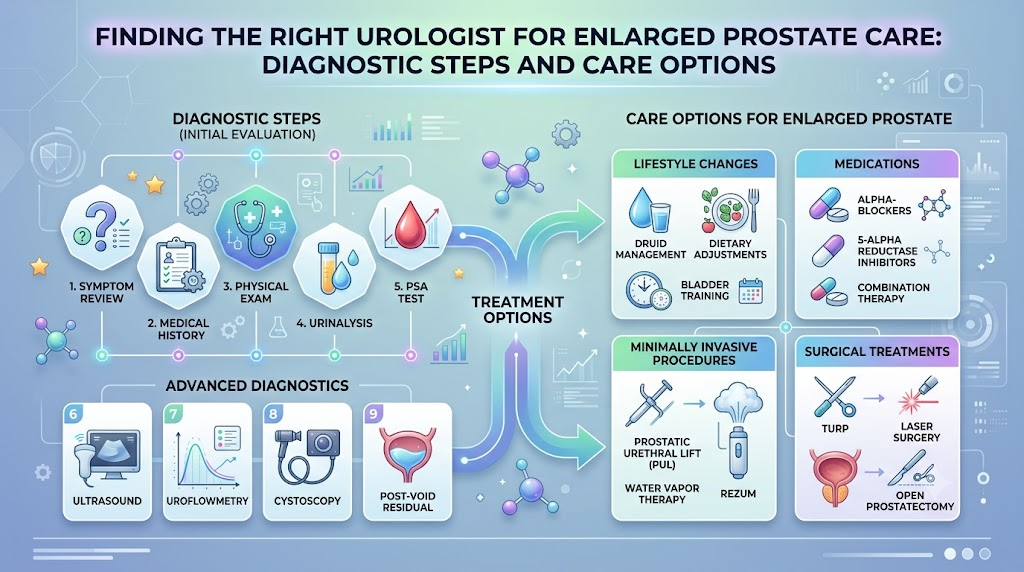
Evaluating urinary symptoms begins with a comprehensive medical background review and a discussion of daily habits. A specialist will typically assess the severity of your symptoms using standardized scoring tools like the International Prostate Symptom Score (IPSS).
Standard Diagnostic Procedures
- Digital Rectal Exam (DRE): The physician inserts a lubricated, gloved finger into the rectum to assess the size, shape, and firmness of the prostate gland.
- Urinalysis: A basic urine sample test used to rule out active infections or screen for blood in the urinary tract.
- Prostate-Specific Antigen (PSA) Blood Test: PSA is a protein produced by the prostate. Elevated blood levels can occur with BPH, prostate inflammation (prostatitis), or prostate cancer. A PSA test helps specialists decide if further investigation is warranted.
- Uroflowmetry: A test measuring how fast urine flows out of the body during a normal bathroom trip. It helps evaluate the degree of blockage.
- Post-Void Residual (PVR) Volume Measurement: An ultrasound scan performed right after urination to check how much urine remains in the bladder.
- Ultrasound or Imaging: Transrectal ultrasound (TRUS) or abdominal scans can measure exact prostate volume and inspect surrounding urinary organs.
- Cystoscopy: A thin, lighted tube with a camera is passed through the urethra to visualize the interior of the urethra and bladder directly.
Urology Treatment Options for Enlarged Prostate
Treatment decisions depend on the severity of symptoms, how much the condition impacts daily life, overall health, and individual preference. A treatment that works well for one person may not be the optimal choice for another.
Watchful Waiting and Lifestyle Adjustments
For mild symptoms that do not significantly disrupt routine, a doctor may recommend periodic monitoring without active medication or surgery.
- Fluid Timing: Decreasing fluid intake in the late evening reduces nighttime bathroom trips.
- Bladder Training: Scheduling urination times to gradually train the bladder to hold urine longer.
- Reducing Irritants: Limiting alcohol, caffeine, and spicy foods that can irritate the bladder wall.
- Reviewing Medications: Adjusting the timing of certain prescription drugs (like diuretics) under medical guidance.
Prescription Medications
When symptoms become bothersome, medications are often the first active treatment step.
- Alpha-Blockers: These drugs relax the smooth muscles at the bladder neck and in the prostate, making it easier to pass urine. They work relatively quickly, but they do not shrink the prostate gland itself.
- 5-Alpha Reductase Inhibitors: These medications alter hormonal signals to gradually shrink the prostate gland over several months. They are generally most effective for larger prostates.
- Combination Therapy: Taking an alpha-blocker and a 5-alpha reductase inhibitor together may be recommended for moderate-to-severe symptoms or larger prostates.
- Corticosteroids or Anticholinergics: Sometimes prescribed if irritative symptoms persist, provided there is no significant urine retention risk.
Minimally Invasive Procedures
If medications do not provide adequate relief or cause unwanted side effects, office-based or outpatient procedures may be considered. These treatments generally aim to shrink, lift, or clear obstructing prostate tissue with minimal downtime.
- Prostatic Urethral Lift: Small implants are inserted to pull the enlarged prostate tissue away from the urethra, widening the passageway.
- Water Vapor Therapy: Controlled steam injections destroy targeted prostate tissue, which the body then naturally absorbs over time.
- Laser Ablation/Enucleation: Focused laser light cuts away or vaporizes obstructing tissue with minimal blood loss.
Surgical Treatments
Surgical interventions are typically reserved for severe symptoms, recurrent urinary tract infections, kidney issues, urinary retention, or when conservative measures have failed.
- Transurethral Resection of the Prostate (TURP): Long considered a standard surgical approach, TURP uses a specialized instrument inserted through the urethra to trim away obstructing prostate tissue.
- Transurethral Incision of the Prostate (TUIP): Small cuts are made in the prostate neck to widen the urethra in men with smaller prostates.
- Open or Simple Prostatectomy: Recommended for significantly enlarged prostates. The surgeon removes the core of the prostate tissue through an incision in the lower abdomen.
The Role of Advanced Techniques and Surgical Innovations
Surgical care for complex urological conditions continues to evolve. While traditional open procedures remain effective, modern institutions frequently offer endoscopic and robotic-assisted techniques for qualifying patients.
Robotic Urology Surgery
In cases requiring precise tissue removal—such as simple prostatectomy for massive BPH or radical prostatectomy for prostate cancer—robotic-assisted surgical systems allow specialists to operate through small keyhole incisions.
- How It Works: The surgeon sits at a console, directing miniaturized instruments that move with high precision while viewing a high-definition 3D image of the surgical area.
- Potential Considerations: Robotic approaches can reduce blood loss and shorten hospital stays. However, technical outcomes depend heavily on surgical skill and proper patient selection. Robotic approaches are not necessary or appropriate for every urological condition.
Related Urological Conditions
Urinary symptoms should be evaluated carefully because different parts of the urinary tract can cause similar complaints.
| Condition | Primary Symptoms | Diagnostic Focus | Overview of Common Care Approaches |
| Enlarged Prostate (BPH) | Weak stream, night urination, hesitation | DRE, PSA, Uroflowmetry | Lifestyle changes, medications, minimally invasive procedures, TURP |
| Prostate Cancer | Often asymptomatic early; urinary changes similar to BPH | PSA blood test, MRI, Prostate Biopsy | Active surveillance, surgery, radiation, systemic therapies |
| Urinary Tract Infection | Burning pain during urination, fever, cloudy urine | Urinalysis, Urine culture | Targeted antibiotic treatment, increased hydration |
| Kidney Stones | Sharp back/side pain, blood in urine, nausea | Non-contrast CT, Ultrasound | Hydration, pain management, lithotripsy, ureteroscopy |
| Bladder Cancer | Painless blood in urine, frequent urgent urination | Urine cytology, Cystoscopy, CT | Surgical removal, intravesical therapy, systemic treatments |
Evaluating Urology Hospitals and Specialists
Finding the right care requires considering factors beyond general hospital reputation. Patients seeking treatment for complex or persistent urological issues should evaluate candidates using practical criteria.
                  [ CARE EVALUATION PROCESS ]
                               |
       +-----------------------+-----------------------+
       |                                               |
[ SPECIALIST CRITERIA ]                     [ FACILITY CAPABILITIES ]
 - Targeted urology focus                    - Diagnostic imaging (MRI, CT)
 - Experience with specific procedures      - Surgical suites & technology
 - Clear communication style                 - Emergency & post-op support
Specialist Experience
Seek out urologists who regularly manage your specific condition. A specialist who routinely performs minimally invasive prostate procedures or specialized surgical options brings practical experience to treatment planning.
Diagnostic Capabilities
A well-equipped hospital should offer on-site urodynamic testing, high-resolution imaging, transrectal or transperineal ultrasound, and cystoscopy facilities. Having diagnostic tools under one roof streamlines care.
Facility Infrastructure and Support
Look for institutions with comprehensive patient support, including clear post-operative guidance, accessible nursing staff for recovery questions, and organized follow-up care. Educational platforms such as UrologyHospitals.com offer centralized resources to help patients compare facility offerings and review care services before booking consultations.
Practical Patient Scenarios
Example A: Experiencing Initial Symptoms
- Scenario: A 54-year-old accountant notices he wakes up three times a night to urinate and experiences a slowing urine stream.
- Action: He schedules a baseline consultation with a local urologist. The doctor performs a digital rectal exam, orders a urinalysis and PSA test, and calculates his IPSS score.
- Outcome: The evaluation confirms mild BPH without bladder obstruction. The patient starts with lifestyle changes, including limiting late-night fluids, and schedules a six-month check-up.
Example B: Managing Moderate Symptoms
- Scenario: A 66-year-old retired teacher experiences worsening urinary urgency and incomplete bladder emptying that interferes with daily travel, despite lifestyle changes.
- Action: He uses online research tools to evaluate nearby medical centers offering targeted BPH services.
- Outcome: After discussing medical history and treatment preferences with a urologist, he decides to start daily medication to relax the prostate capsule, returning after 90 days to evaluate improvement.
Step-by-Step Decision-Making Framework
Making decisions about urological health works best when approached systematically:
[Step 1: Document Symptoms]
   └── Track frequency, night visits, and pain levels over a 2-week period.

[Step 2: Seek Clinical Evaluation]
   └── Schedule an appointment with a primary doctor or urologist.

[Step 3: Complete Diagnostic Testing]
   └── Undergo basic non-invasive tests (urinalysis, PSA, flow tests) as advised.

[Step 4: Review Treatment Pathways]
   └── Discuss lifestyle, medication, and procedural options with your doctor.

[Step 5: Compare Facilities & Specialists]
   └── Evaluate provider experience, diagnostic equipment, and follow-up support.

[Step 6: Confirm Your Care Plan]
   └── Agree on a clear treatment path and map out necessary follow-up care.
Common Mistakes to Avoid
- Assuming Symptoms Are Normal Aging: Decreased quality of life from urinary problems does not have to be accepted as inevitable. Treatments are available.
- Confusing BPH with Prostate Cancer: While symptoms can overlap, BPH is non-cancerous. However, independent screening is essential to rule out other issues.
- Self-Diagnosing or Stopping Medication Early: Stopping prescribed prostate medications without consulting your doctor can lead to sudden symptom recurrence or urinary retention.
- Delaying Care for Blood in the Urine: Seeing blood in the urine requires prompt medical attention to check for infection, stones, or bladder and kidney conditions.
- Selecting Treatment Based Solely on Marketing: Ensure that any recommended surgical procedure or technology matches your specific prostate size and clinical needs rather than relying on promotional claims.
Key Takeaways
- BPH is Non-Cancerous: An enlarged prostate is common as men age and is distinct from prostate cancer.
- Symptoms Vary: Obstructive signs like a weak stream and irritative signs like night visits affect every individual differently.
- Comprehensive Diagnostics Matter: Accurate diagnosis involves physical exams, blood tests (PSA), urine tests, and flow measurements.
- Multiple Care Options Exist: Treatments range from watchful waiting and daily medications to office-based therapies and surgery.
- Urgent Signs Require Immediate Care: Sudden inability to pass urine or severe pain calls for prompt medical evaluation.
- Individualized Care is Key: Prostate size, symptom severity, overall health, and personal goals determine the best treatment choice.
Frequently Asked Questions
1. What does a urologist treat?
A urologist is a medical specialist focused on conditions affecting the male and female urinary tracts (kidneys, ureters, bladder, urethra) and the male reproductive system (prostate, testes).
2. When should someone see a urologist for urinary symptoms?
You should see a specialist if urinary frequency, night visits, weak stream, or urgency interfere with daily activities, or immediately if you notice blood in your urine or cannot pass urine.
3. What is the difference between BPH and prostate cancer?
BPH is a benign (non-cancerous) enlargement of prostate tissue that compresses the urethra. Prostate cancer involves malignant cell growth within the gland. They are different conditions, though their symptoms can overlap.
4. How do doctors diagnose an enlarged prostate?
Diagnosis involves reviewing symptom history (IPSS scale), performing a digital rectal exam, running urine tests and PSA blood screens, and measuring urine flow rates or post-void residual urine volume.
5. Are medications always necessary for an enlarged prostate?
No. Mild BPH symptoms can often be managed through lifestyle adjustments and regular medical check-ups. Medications are introduced when symptoms begin to disrupt daily life.
6. What are the main types of surgery for an enlarged prostate?
Surgical procedures include Transurethral Resection of the Prostate (TURP), laser ablation or enucleation, transurethral incision (TUIP), and open or robotic simple prostatectomy for very large glands.
7. Is robotic urology surgery better than standard surgery?
Robotic-assisted surgery offers high precision and smaller incisions for complex operations, but standard transurethral or open procedures remain effective options depending on the patient’s anatomy and doctor expertise.
8. How can a patient locate a qualified urologist nearby?
Patients can consult local medical directories, request primary care referrals, or use educational platforms like UrologyHospitals.com to find verified urology specialists and facilities in their area.
9. Can an enlarged prostate cause urinary tract infections?
Yes. If an enlarged prostate prevents the bladder from emptying completely, stagnant urine left behind can increase the risk of developing bacterial infections or bladder stones.
10. Can lifestyle choices improve BPH symptoms?
While lifestyle adjustments cannot shrink prostate tissue, limiting late-night liquids, reducing caffeine and alcohol, staying active, and avoiding constipation can reduce daily urinary discomfort.
Conclusion
Navigating an enlarged prostate begins with recognizing early urinary changes and discussing them openly with a qualified physician. Benign Prostatic Hyperplasia is manageable, and modern urology provides a broad range of options tailored to distinct clinical needs—from lifestyle strategies and daily medications to advanced procedures. Educating yourself about diagnostic steps, treatment paths, and specialist qualifications empowers you to make confident decisions alongside your medical team. Platforms like UrologyHospitals.com offer reliable educational content and facility information to help patients explore care options and take proactive steps toward improved urological health.