Introduction
Your vision is one of your most precious senses, and maintaining corneal health is fundamental to how you interact with the world. Keratoconus, a condition that causes the cornea—the clear, front surface of the eye—to thin and bulge into a cone shape, can significantly alter one’s vision and quality of life. Understanding this condition and knowing where to find high-quality medical expertise is essential. That is why identifying specialized hospitals for keratoconus treatment is the most important step for patients navigating this diagnosis.
At BESTEYEHOSPITALS, we believe that patients deserve clarity and confidence throughout their journey toward better sight. Whether you are seeking an initial diagnosis, exploring specialized contact lenses, or investigating surgical options, having access to reputable medical centers is key. In this guide, we explore the nuances of keratoconus, the importance of choosing a specialized eye hospital, and the technological advancements that are currently transforming corneal care. By educating yourself on your options, you are taking proactive control of your eye health.
What Is Keratoconus?
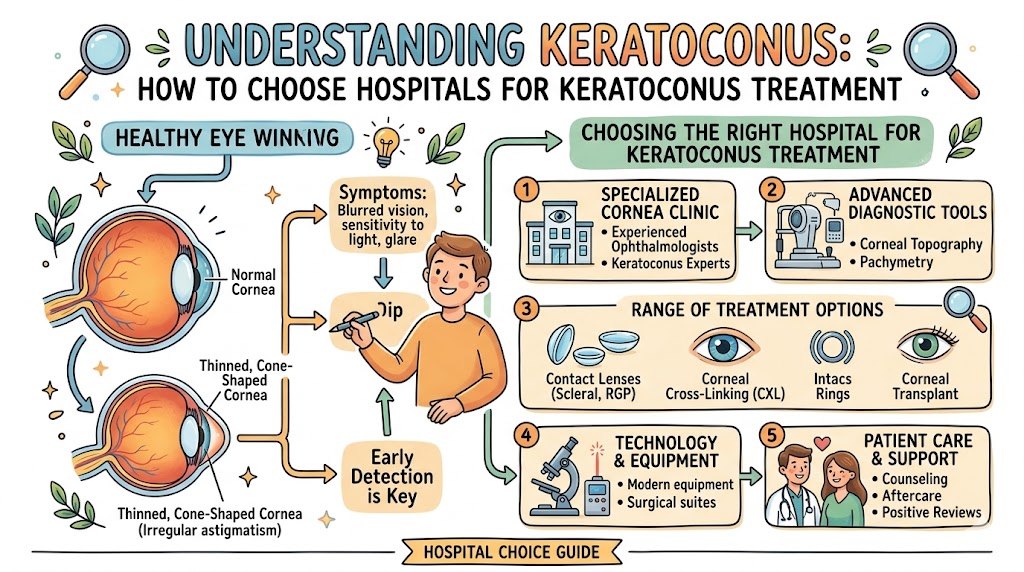
Keratoconus is a non-inflammatory eye condition where the normally round, dome-shaped cornea progressively thins and bulges outward into a cone shape.
- Impact: Because the cornea is responsible for refracting light as it enters the eye, this “coning” causes light to scatter, resulting in blurred, distorted, and often unpredictable vision.
- Progression: It usually begins in late adolescence or early adulthood. The progression can be rapid or slow, and it typically affects both eyes, though often to different degrees.
- Vision Quality: Patients often report “ghosting,” multiple images, or extreme glare, making daily tasks like driving at night or reading increasingly difficult.
Signs and Symptoms of Keratoconus
Recognizing the symptoms early is vital for effective management. Common indicators include:
- Blurred Vision: A general lack of sharpness that standard glasses may struggle to correct.
- Frequent Prescription Changes: Needing to update your eyeglass or contact lens prescription more often than usual.
- Light Sensitivity: Increased discomfort in bright or glaring environments.
- Night Vision Issues: Seeing halos or starbursts around streetlights and headlights.
- Eye Strain: A persistent feeling of fatigue or discomfort, especially after concentrated tasks like computer use.
Causes and Risk Factors
While the exact cause of keratoconus is still being studied, several factors are known to contribute:
- Genetics: Approximately 10% of patients have a family history of the condition.
- Eye Rubbing: Chronic, vigorous eye rubbing is strongly linked to the progression of corneal thinning.
- Corneal Weakness: An imbalance in the enzymes within the cornea may lead to structural weakness.
- Environmental Influences: Allergies and conditions causing chronic eye irritation play a significant role.
Why Hospitals for Keratoconus Treatment Matter
Choosing the right facility is about more than just convenience. Leading hospitals for keratoconus treatment provide:
- Accurate Diagnostics: Using advanced mapping to catch the disease in its earliest stages.
- Cornea Specialists: Doctors who focus exclusively on the front surface of the eye offer deeper expertise than general ophthalmologists.
- Continuity of Care: A specialized facility can monitor your progression over years, adjusting your treatment as your needs evolve.
Diagnostic Tests Used for Keratoconus
| Diagnostic Test | Purpose |
| Corneal Topography | Creates a 3D map of the cornea’s curvature. |
| Pachymetry | Measures the thickness of the cornea. |
| Slit Lamp Examination | Allows the doctor to physically inspect the corneal structure. |
| Visual Acuity Testing | Checks the severity of the vision distortion. |
| Corneal Mapping | Helps identify early, sub-clinical thinning. |
Treatment Options Available
The goal of treatment is to improve visual quality and halt the progression of the disease.
- Prescription Glasses/Soft Contacts: May work in very mild, early stages.
- Rigid Gas Permeable (RGP) Lenses: Harder lenses that provide a smooth, spherical surface over the irregular cornea.
- Scleral Lenses: Large-diameter lenses that vault over the cornea, providing comfort and clarity for advanced cases.
- Corneal Cross-Linking (CXL): A minimally invasive procedure using riboflavin (vitamin B2) drops and UV light to strengthen the corneal tissue and slow disease progression.
- Intacs Corneal Implants: Tiny, arc-shaped inserts that help flatten the cornea.
- Corneal Transplant: For severe cases where other treatments have failed, the surgeon replaces the damaged cornea with healthy donor tissue.
Key Features of Leading Keratoconus Hospitals
Look for facilities that prioritize:
- Experienced Cornea Specialists: Experts who have managed thousands of keratoconus cases.
- Advanced Diagnostic Equipment: Tools that provide high-definition imagery of the corneal shape.
- On-site CXL Facilities: The ability to perform cross-linking in a safe, controlled environment.
- Surgical Expertise: For those who eventually reach the stage where a transplant or implant is necessary.
Benefits of Early Treatment
Early intervention is the best way to safeguard your sight. Benefits include:
- Vision Preservation: Halting progression early means you may never need a corneal transplant.
- Reduced Complexity: Early treatments like CXL are far less invasive than surgical alternatives.
- Improved Quality of Life: Maintaining functional vision allows you to continue working, driving, and enjoying daily life without significant lifestyle changes.
How to Choose the Best Hospital
| Factor | Why It Matters |
| Specialist Experience | Ensures that your doctor understands the nuance of keratoconus management. |
| Technology | Determines the accuracy of your diagnostic data and the quality of treatments. |
| Treatment Options | A top hospital offers a full spectrum, from lenses to surgery. |
| Follow-Up Care | Long-term monitoring is required to detect progression early. |
| Patient Support | Understanding your diagnosis and plan is key to long-term success. |
Patient Journey: From Diagnosis to Recovery
- Initial Consultation: A thorough exam to establish your corneal health baseline.
- Diagnostic Evaluation: Utilizing topography and mapping to confirm the status of your cornea.
- Treatment Planning: Determining if you are a candidate for CXL or if you require advanced lens fitting.
- Procedure/Therapy: Executing the selected treatment plan with professional oversight.
- Follow-Up Visits: Regular check-ins to monitor vision stability and lens fit.
- Management: Long-term periodic monitoring to ensure your vision remains stable.
How BESTEYEHOSPITALS.COM Helps Patients
[suspicious link removed] is your resource for navigating the complex world of eye care. We provide a platform where you can:
- Explore Eye Hospitals: Browse profiles of centers specializing in corneal disorders.
- Learn: Access accurate, jargon-free information about your condition and treatment options.
- Compare: Use our guides to evaluate which hospitals offer the services that matter most to your specific case.
Future of Keratoconus Treatment
The future of care is bright, with AI-assisted diagnostic tools that can predict progression before it happens. Researchers are also working on gene-based therapies to potentially treat the root cause of corneal thinning, and improved lens materials that offer even greater oxygen permeability and comfort.
Expert Tips for Patients with Keratoconus
- Avoid Eye Rubbing: This is the most critical habit to break to stop mechanical trauma to your cornea.
- Annual Exams: Even if your vision seems stable, regular topography scans are vital.
- Advocate for Yourself: Ask your doctor about the latest CXL protocols and if they are appropriate for you.
- Find Support: Connect with patient communities; learning from others’ experiences can be incredibly helpful.
FAQs
Q1. What is keratoconus?
A: A condition where the cornea thins and bulges outward.
Q2. Can keratoconus be cured?
A: Currently, there is no “cure,” but it can be managed and halted through various treatments.
Q3. What is corneal cross-linking?
A: A procedure to strengthen corneal fibers using riboflavin and UV light.
Q4. Is keratoconus hereditary?
A: Genetics play a role; family history is a significant risk factor.
Q5. When is a corneal transplant needed?
A: Only in advanced cases where other options no longer provide functional vision.
Q6. Will I go blind?
A: Total blindness is extremely rare, but vision can be significantly impacted without management.
Q7. Is CXL painful?
A: It is managed with numbing drops; most discomfort happens during the short healing phase.
Q8. Can I wear contacts?
A: Yes, specialized lenses (RGP or Scleral) are often the preferred way to correct vision.
Q9. Is eye rubbing really that bad?
A: Yes, it is widely considered a leading environmental trigger for progression.
Q10. How often should I get mapped?
A: Typically once or twice a year to monitor stability.
Q11. Are there support groups?
A: Yes, many organizations provide resources for patients living with corneal conditions.
Q12. Does insurance cover CXL?
A: Many insurance providers do cover CXL, but it is always best to check with your specific policy.
Q13. How do I start?
A: Use [suspicious link removed] to find an expert near you.
Q14. Can I use computers?
A: Yes, but take frequent breaks and use artificial tears to reduce strain.
Q15. Are there new treatments on the horizon?
A: Yes, researchers are constantly testing new ways to stabilize the cornea and improve imaging.
Conclusion
Keratoconus is a manageable condition, provided it is approached with early diagnosis and expert care. The importance of finding highly qualified hospitals for keratoconus treatment cannot be overstated, as the expertise of your ophthalmologist directly impacts the long-term integrity of your vision. From the diagnostic mapping that defines your early journey to the sophisticated lens fitting or CXL procedures that stabilize your cornea, your care team is your most valuable asset.Remember that progress in corneal health is relentless. Modern medicine offers more ways than ever to maintain high-quality vision, even for those diagnosed with advanced disease. By staying informed, adhering to follow-up schedules, and avoiding detrimental habits like eye rubbing, you empower yourself to live a full and visually clear life.