Introduction
Your vision is one of your most precious senses, and its clarity relies heavily on the health of your cornea. The cornea is the clear, dome-shaped front surface of your eye; it acts as a window, focusing light as it enters. When this delicate structure is affected by disease, injury, or genetic conditions, it can significantly blur your vision and impact your daily life.At BESTEYEHOSPITALS, we are dedicated to providing the educational resources you need to navigate your eye health journey. In this guide, we will explore common corneal conditions, the technology used in modern eye centers, and how to choose a facility that aligns with your specific needs. Please remember that every patient’s eyes are unique, and any diagnosis or treatment plan must be discussed directly with a qualified ophthalmologist.
What Is the Cornea and Why Is It Important?
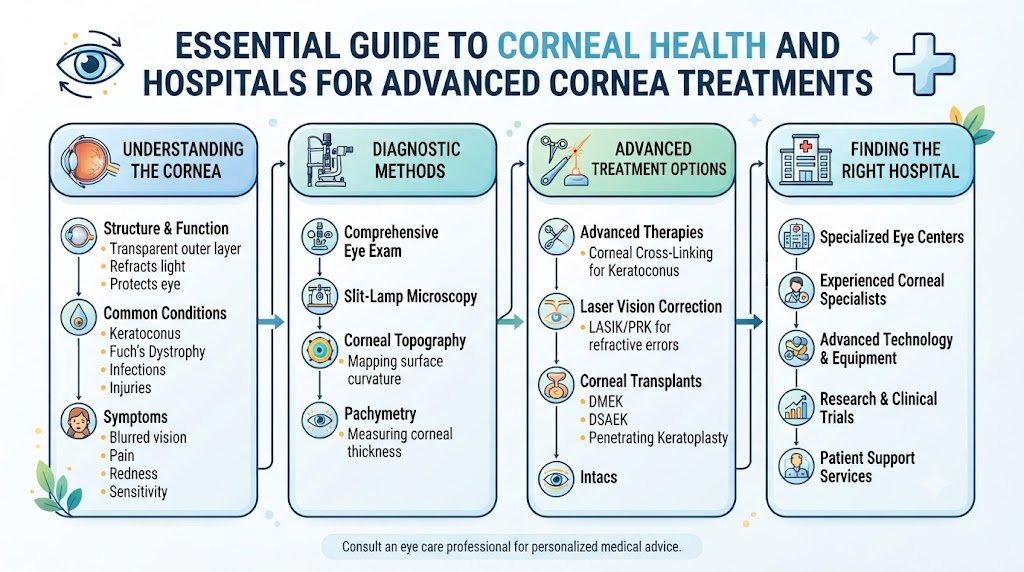
The cornea is the outermost layer of your eye. Think of it as the lens of a camera—it is responsible for refracting, or bending, the majority of the light that enters your eye so that it can be focused onto the retina.
A healthy cornea must be perfectly clear and smooth. If its shape becomes distorted or if the tissue becomes cloudy, light cannot focus properly, leading to blurred or distorted vision. Protecting this transparent tissue is essential, as even minor surface damage can have a noticeable impact on your ability to see clearly.
Understanding Corneal Disorders
Several conditions can affect the integrity and function of the cornea.
- Keratoconus: A progressive condition where the cornea gradually thins and bulges into a cone shape, causing significant vision distortion.
- Corneal Infections: Often caused by bacteria, fungi, or viruses, these can lead to inflammation and scarring if not treated promptly.
- Corneal Scarring: Results from previous injuries or infections, creating opaque areas that block light.
- Corneal Dystrophies: Inherited conditions where specific layers of the cornea lose their clarity.
- Dry Eye and Ocular Surface Disorders: Chronic dryness can damage the surface of the cornea, leading to discomfort and blurred vision.
Common Corneal Conditions Comparison Table
| Condition | Description | Possible Symptoms |
| Keratoconus | Progressive thinning/bulging | Blurred vision, frequent prescription changes |
| Corneal Infection | Microorganism-led inflammation | Pain, redness, vision changes |
| Corneal Scar | Damage affecting clarity | Reduced vision clarity |
| Dry Eye Disease | Reduced surface moisture | Burning, discomfort, gritty sensation |
| Corneal Dystrophy | Inherited structure changes | Gradual vision decline |
Symptoms That May Require Cornea Specialist Evaluation
If you experience persistent changes in your vision, it is important to seek a professional opinion. Common warning signs include:
- Blurriness that does not improve with current glasses or contacts.
- Increased sensitivity to light (photophobia).
- Frequent changes in your glasses prescription.
- Persistent eye pain, redness, or a feeling that something is “stuck” in your eye.
- Distortion of images or halos around lights.
Advanced Diagnostic Technologies
Specialized eye centers utilize precise tools to evaluate corneal health:
- Corneal Topography: Creates a detailed “map” of the cornea’s surface, essential for diagnosing conditions like keratoconus.
- Pachymetry: An ultrasound-based or optical test that measures the exact thickness of your cornea.
- Slit Lamp Examination: A high-powered microscope that allows the specialist to examine the eye in high detail.
- Digital Imaging: Captures high-resolution images to track disease progression over time.
Advanced Cornea Treatments
Treatment strategies vary based on the severity of the condition. Advanced centers offer a range of options:
- Medication-Based Treatment: Targeted eye drops to manage inflammation or infections.
- Corneal Cross-Linking (CXL): A procedure used to strengthen the corneal tissue, often used to stop the progression of keratoconus.
- Specialty Contact Lenses: Custom-fitted lenses that can help neutralize the irregular shape of a distorted cornea.
- Laser-Based Procedures: Used in specific cases to treat superficial surface issues.
- Corneal Transplant Surgery: In cases where the cornea is severely damaged, a transplant may be necessary to replace the unhealthy tissue with healthy donor tissue.
Types of Corneal Transplant Procedures
- Full Thickness Transplant (PK): Replacing the entire depth of the corneal tissue.
- Partial Thickness Transplant (DALK): Replacing only the outer and middle layers of the cornea.
- Endothelial Keratoplasty (DMEK/DSAEK): Replacing only the innermost layer of the cornea, often used for conditions like Fuchs’ Dystrophy.
How to Choose the Right Hospital
Selecting an eye hospital is a significant decision. Focus on programs that emphasize a patient-centered approach.
Hospital Selection Checklist
| Feature | Importance |
| Cornea Specialists | Expert, specialized evaluation |
| Advanced Diagnostics | Accurate assessment of corneal shape and thickness |
| Surgical Facilities | Capability to perform complex transplants |
| Patient Support | Clear communication and care throughout treatment |
| Follow-Up Programs | Crucial for monitoring long-term recovery |
Recovery and Aftercare
Post-procedure care is as vital as the surgery itself.
- Prescribed Medications: Adhering strictly to eye drop schedules to prevent infection and manage inflammation.
- Vision Monitoring: Regularly checking for improvements or sudden changes.
- Follow-up Visits: Attending all scheduled appointments to ensure the graft or treatment is healing correctly.
- Eye Protection: Wearing protective eyewear to prevent accidental bumps or injury.
Common Myths vs. Facts
| Myth | Fact |
| All corneal problems require surgery | Many are managed with drops or specialized lenses |
| Vision changes are always about glasses | Corneal health is often the hidden cause |
| Eye discomfort can be ignored | Persistent pain or redness requires professional review |
| Corneal treatment is the same for everyone | Plans are highly personalized to your eye anatomy |
Real-Life Educational Scenarios
- Scenario A: A patient notices frequent changes in their prescription and visits a specialist, where corneal topography reveals early-stage keratoconus. They begin monitoring and cross-linking to preserve their vision.
- Scenario B: A patient with corneal scarring due to an old injury undergoes a partial-thickness transplant, resulting in a significant improvement in their clarity of vision.
- Scenario C: An individual maintains corneal health by avoiding unnecessary eye rubbing and scheduling regular comprehensive eye exams to screen for early signs of disease.
FAQs
- What are corneal disorders?
Conditions that affect the clarity or shape of the cornea. - Why is the cornea important?
It acts as the eye’s primary focusing lens. - What symptoms matter?
Persistent blurriness, pain, or light sensitivity. - What does a specialist do?
They diagnose and treat complex diseases of the corneal surface. - How is keratoconus managed?
Through mapping, specialty lenses, and cross-linking. - What is cross-linking?
A treatment to stabilize the cornea. - When is a transplant needed?
When the cornea is too scarred or distorted to focus light properly. - How are diseases diagnosed?
Using topography and high-resolution imaging. - How to choose a hospital?
Look for dedicated cornea specialists and modern facilities. - Are treatments safe?
Yes, when performed by experts in appropriate facilities. - Can vision loss be permanent?
Untreated corneal disease can lead to severe loss of clarity. - How to protect my eyes?
Avoid rubbing and wear protection during activities. - What tech is used?
Topography and high-frequency ultrasound. - Why follow-up?
To ensure the eye is healing and the vision is stable. - How does BESTEYEHOSPITALS help?
We provide the information you need to make informed care choices.
Final Thoughts
The health of your cornea is central to your quality of life. By understanding the importance of specialized care and choosing a hospital equipped with advanced diagnostic and surgical technologies, you are taking the best possible step toward preserving your vision.Don’t wait for vision changes to become a disruption. Regular eye exams and prompt consultation with a specialist for any persistent symptoms are the most effective ways to manage your corneal health. We invite you to explore BESTEYEHOSPITALS for more resources on eye care, corneal treatments, and expert guidance to help you navigate your path to better vision.