Introduction
Laser vision correction has transformed the field of ophthalmology, offering millions of individuals worldwide an effective path to reduce or completely eliminate their dependence on prescription eyeglasses and contact lenses. By utilising highly precise laser technology to reshape the surface of the eye, these procedures correct common refractive issues such as nearsightedness, farsightedness, and astigmatism. For many, the prospect of waking up with clear, unassisted vision is a life-changing milestone.In this comprehensive guide, we will explore the different types of laser procedures, outline what to expect during the healing timeline, and detail the technologies used to safeguard your eyes during recovery.To help you navigate your options, online educational resources like BESTEYEHOSPITALS serve as an invaluable platform, connecting patients with specialized eye hospitals and leading refractive surgeons dedicated to safe, comprehensive visual recovery.
What Is Laser Vision Correction?
Laser vision correction, also known as refractive surgery, refers to a group of advanced surgical procedures designed to alter the focusing power of the eye.
Reshaping the Cornea
The cornea is the clear, dome-shaped window at the very front of your eye. It acts as the eye’s primary lens, bending (refracting) incoming light so that it focuses directly onto the retina at the back of the eye. If the shape of your cornea is imperfect, the light focuses in front of or behind the retina, resulting in blurred vision.
During laser vision correction, a highly specialized computer-guided laser removes microscopic amounts of tissue to reshape the curvature of the cornea. This allows light rays to focus precisely on the retina, restoring sharp focus.
[ Light Rays ] ──► [ Irregular Cornea ] ──► [ Focuses off-center of Retina ] = Blur
                                 │
                   (Reshaped by Guided Laser)
                                 ▼
[ Light Rays ] ──► [ Reshaped Cornea ]  ──► [ Focuses precisely on Retina ] = Clear
Common Vision Problems Corrected
- Myopia (Nearsightedness): The eye is too long or the cornea is too curved, causing distant objects to look blurry. The laser flattens the central cornea.
- Hyperopia (Farsightedness): The eye is too short or the cornea is too flat, making close-up objects blurry. The laser steepens the central cornea.
- Astigmatism: The cornea is shaped more like an oval football than a round sphere, causing distorted or blurry vision at all distances. The laser smooths out the irregular curves.
The Goals of Treatment
The primary objective of refractive surgery is to dramatically reduce your reliance on corrective lenses. While many patients achieve excellent visual acuity, the ultimate goal is to deliver comfortable, stable, and functional vision that matches or exceeds what was previously possible with glasses or contacts.
Types of Laser Vision Correction Procedures
Modern eye care hospitals offer several distinct laser vision correction options. During your initial consultation, your ophthalmologist will perform a comprehensive assessment of your corneal thickness, eye structure, and lifestyle to recommend the safest option for you.
LASIK (Laser-Assisted In Situ Keratomileusis)
In traditional LASIK, a surgeon uses a microscopic mechanical blade (microkeratome) to create a thin flap on the surface of the cornea. This flap is gently folded back, an excimer laser is used to reshape the underlying corneal tissue, and the flap is then laid back down, where it bonds naturally without any stitches.
Femto-LASIK
Femto-LASIK is a modern, all-laser variation of traditional LASIK. Instead of using a blade, a high-precision femtosecond laser is used to create the corneal flap. This allows for a much thinner, more uniform, and highly predictable flap, which preserves corneal structural integrity and leads to a safer recovery.
SMILE (Small Incision Lenticule Extraction)
SMILE is a minimally invasive, flapless procedure. Utilizing a femtosecond laser, the surgeon carves a tiny, keyhole-shaped disc of tissue (lenticule) inside the layers of the cornea. This lenticule is then gently drawn out through a microscopic incision of less than 4 mm. Because no large flap is created, the surface of the eye remains highly stable, reducing the severity of dry eyes during recovery.
PRK (Photorefractive Keratectomy)
PRK is a surface ablation technique that is highly suited for patients with thin or irregular corneas. Instead of creating a flap or internal incision, the ultra-thin outer layer of the cornea (the epithelium) is gently brushed away. The excimer laser then reshapes the exposed surface. Because the outer skin of the eye must regrow completely, the initial healing phase is longer and requires a protective contact lens.
Contoura Vision
Contoura Vision is a topography-guided, personalized LASIK procedure. Before surgery, diagnostic equipment maps up to 22,000 unique elevation points on your cornea. The laser uses this highly detailed map to smooth out minute corneal surface irregularities, which can improve visual quality, contrast sensitivity, and night vision.
CLEAR (Corneal Lenticule Extraction)
CLEAR is another modern, flapless lenticule extraction method. Similar to SMILE, it uses an advanced femtosecond laser to create and remove a thin lenticule through a tiny incision. This procedure features advanced eye-tracking and centration technologies, making it a highly precise option for correcting nearsightedness and astigmatism.
Laser Vision Procedures Comparison Table
| Procedure | Common Purpose | Typical Recovery | Best Suited For |
| LASIK | Corrects myopia, hyperopia, and astigmatism. | Very rapid visual recovery; functional vision is often restored within 24 hours. | Patients with normal corneal thickness and mild to moderate refractive errors. |
| Femto-LASIK | All-laser correction for broad refractive errors. | Fast healing with minimal discomfort; flap stabilizes within days. | Patients seeking a highly precise, blade-free procedure with rapid visual recovery. |
| SMILE | Minimally invasive correction of myopia and astigmatism. | Quick surface healing; less disruption to corneal nerves, lowering dry eye risk. | Active individuals, athletes, or those prone to mild chronic dry eyes. |
| PRK | Flapless surface treatment for refractive errors. | Longer recovery; requires 3 to 5 days for the outer surface skin layer to regrow. | Patients with thin corneas, dry eye concerns, or high-contact lifestyles. |
| Contoura Vision | High-definition, topography-guided correction. | Rapid visual recovery; often results in excellent night vision and contrast. | Patients with subtle corneal surface irregularities looking for highly customized care. |
Why Recovery Programs Matter
The healing phase after a laser eye procedure is a dynamic process where corneal cells remodel and the eye’s tear film re-establishes its natural balance. Participating in a structured recovery program at a specialized hospital is essential for several reasons:
- Continuous Postoperative Monitoring: Regular checkups allow eye care specialists to evaluate the corneal flap or incision, track visual acuity, and ensure that the surface of the eye is healing symmetrically.
- Early Intervention for Complications: Rare complications such as localized inflammation, flap displacement, dry eye syndromes, or micro-infections are highly treatable when caught early during scheduled follow-up visits.
- Personalized Medication Adjustments: Patients are prescribed various anti-inflammatory, antibiotic, and lubricating eye drops. A recovery team monitors your eye’s response and adjusts your drop schedule to prevent under- or over-medication.
- Managing Vision Fluctuations: It is completely normal for vision to fluctuate or drift slightly during the first few weeks as the cornea stabilizes. A dedicated recovery team provides clinical guidance and reassurance, helping you understand what is normal.
- Safeguarding Long-Term Eye Health: A structured program instills healthy habits, such as regular eye exams and UV protection, ensuring that your clear vision remains stable for many years to come.
Services Included in Laser Vision Recovery Programs
Hospitals offering laser vision correction recovery programs provide comprehensive, patient-centered services designed to make your healing process as smooth and comfortable as possible.
                    [ Components of a Recovery Program ]
                                      │
         ┌────────────────────────────┼────────────────────────────┐
         ▼                            ▼                            ▼
[ Clinical Checkups ]        [ Medication Therapy ]       [ Lifestyle Support ]
├── Flap/Incision Scans      ├── Antibiotic Drops         ├── Night Protective Shields
├── Digital Vision Testing   ├── Anti-inflammatory Drops  ├── Customized Screen Guides
└── Tear Film Assessments    └── Advanced Lubrication     └── Emergency 24/7 Hotlines
Scheduled Follow-Up Visits
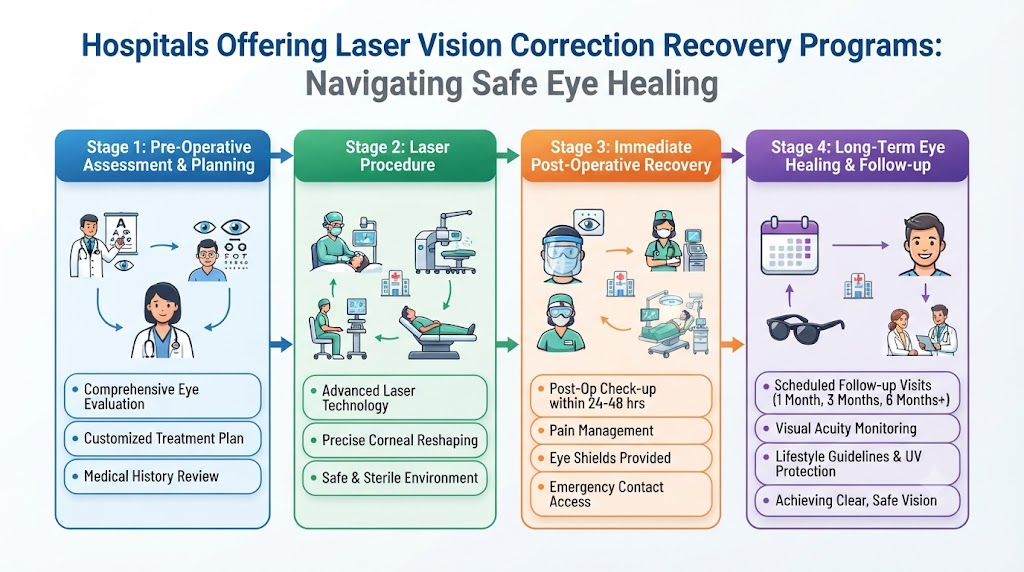
A standard recovery program includes several essential, face-to-face checkups with your eye care team. These typically occur at 24 hours post-surgery, 1 week, 1 month, 3 months, and 6 months to monitor your progress step-by-step.
Digital Vision Testing
At every visit, clinicians use digital eye charts to measure your visual acuity, checking your progress at both near and far distances to ensure your eyes are focusing correctly.
Corneal and Eye Healing Assessment
Using high-powered slit-lamp microscopes, your ophthalmologist examines the microscopic layers of your cornea. They verify that the flap is perfectly aligned, the surface skin has regrown smoothly, and there are no signs of microscopic dust, dryness, or irritation.
Custom Medication and Drop Instructions
You will receive a detailed, printed calendar outlining when and how to apply your prescribed eye drops. The clinical team will demonstrate proper application techniques to prevent you from touching your eye with the tip of the bottle.
Comprehensive Dry Eye Management
Temporary dry eye is a common side effect of laser vision correction. Recovery programs offer proactive dry eye care, providing custom recommendations for preservative-free lubricating drops, warm compresses, or specialized punctal plugs if your eyes need extra moisture support.
Tailored Activity and Lifestyle Guidelines
Your recovery team will provide a clear list of what you can and cannot do during the weeks following your procedure, helping you transition back to exercise, screen time, and outdoor activities safely.
Protective Eye Gear
To prevent accidental rubbing while sleeping, hospitals provide protective eye shields or goggles that are worn for the first few nights after surgery. They also provide high-quality UV-blocking sunglasses to shield your healing eyes from bright sunlight.
Recovery Timeline After Laser Vision Correction
While everyone’s eyes heal at their own pace, understanding the typical milestones can help you prepare for a comfortable recovery.
[ Day 1: Immediate Rest ] ──► [ Week 1: Soft Stabilization ] ──► [ Months 1-3: Refinement ]
            │                                                                │
            ▼                                                                ▼
{ Mild watering & sensitivity }                                    { Fluctuations settle completely }
The First 24 Hours: The Critical Window
- What to Expect: Immediately after your procedure, you may experience mild burning, watering, scratchiness, and light sensitivity. Your vision will likely look somewhat blurry or hazy, similar to looking through a dirty window.
- Care Steps: Go straight home, keep your eyes closed as much as possible, and rest in a dark room. Do not rub your eyes under any circumstances. Wear your protective eye shields when sleeping, and begin applying your prescribed eye drops exactly as directed.
The First Week: Functional Stabilization
- What to Expect: For most patients (especially those who had LASIK or SMILE), vision improves dramatically within 24 to 48 hours, allowing them to return to work or school. However, you may still experience mild light sensitivity, halos around lights at night, and dry eyes.
- Care Steps: Continue your eye drop routine diligently. Avoid getting water, soap, or shampoo directly in your eyes when showering. Keep makeup, dust, and sweat away from your face, and wear your UV sunglasses outdoors.
The First Month: Visual Refinement
- What to Expect: Your vision will become increasingly crisp and stable. You might notice subtle visual fluctuations, where your eyes feel slightly blurry on some days and very sharp on others—especially when using computers or in dry environments.
- Care Steps: Attend your one-month follow-up appointment. Keep using preservative-free lubricating drops regularly, even if your eyes do not feel dry, to support ongoing corneal healing.
Three to Six Months: Complete Maturation
- What to Expect: By this point, your corneal tissues have mostly stabilized, and any dry eye symptoms or night-time glare should be minimal or completely resolved. Your eyes will feel comfortable and normal.
- Care Steps: Complete your final scheduled follow-up exams. Your doctor will verify that your vision has stabilized beautifully and discuss long-term eye health maintenance.
Advanced Technologies Used by Specialized Eye Hospitals
High-quality refractive hospitals combine the skills of expert surgeons with advanced diagnostic and monitoring systems to ensure your recovery is safe and highly predictable.
Femtosecond and Excimer Lasers
Modern laser platforms feature high-frequency trackers that measure eye movements hundreds of times per second. If your eye moves even slightly, the laser adjusts instantly or pauses automatically, ensuring that every pulse is placed with absolute precision.
Corneal Topography and Wavefront Mapping
Using advanced mapping systems like the Pentacam or Orbscan, clinicians can create detailed 3D maps of your cornea’s shape and thickness. This allows doctors to detect any subtle tissue changes early during your recovery.
Anterior Segment Optical Coherence Tomography (AS-OCT)
AS-OCT is a non-contact imaging technology that provides high-resolution, cross-sectional views of the front of your eye. This tool allows doctors to check the exact thickness and placement of your corneal flap down to the micrometer, ensuring it is healing perfectly.
   [ AS-OCT Laser Scan ] ──► [ Cross-Section of Eye Surface ]
                                       │
                                       ▼
                  [ Verifies Flap Placement & Thickness ]
                       (Accurate to the micrometer)
Non-Contact Dry Eye Diagnostic Systems
Advanced tear-film analyzers can evaluate the quality, thickness, and evaporation rate of your natural tears without touching your eye. This technology helps your recovery team tailor your dry eye therapy with high precision.
Common Side Effects During Recovery
It is completely normal to experience mild side effects as your eyes adapt and heal. Understanding what is normal—and what is not—can help you feel confident throughout your recovery.
Expected, Temporary Side Effects
- Mild Scratchiness or Discomfort: Often described as having a grain of sand in your eye, this is normal during the first day or two.
- Fluctuating Vision: Your sight may shift from sharp to slightly hazy, especially when reading or working on screens.
- Dryness and Grittiness: Laser reshaping temporarily reduces corneal nerve sensitivity, which slows down your natural tear production.
- Light Sensitivity: Sunlight, headlights, and bright screens may feel unusually intense during the first week.
- Halos, Glare, and Starbursts: You may see rings or bursts of light around streetlights or headlights at night. This gradually improves over several weeks.
Symptoms Requiring Immediate Medical Attention
If you experience any of the following warning signs, contact your eye hospital’s emergency care line immediately:
- Sudden, severe, or worsening eye pain.
- A sudden drop in your vision.
- Excessive eye discharge, redness, or swelling.
- Accidentally poking, rubbing, or bumping your eye hard.
Tips for a Faster and Safer Recovery
- Be Diligent with Eye Drops: Set reminders on your phone so you never miss a dose of your prescribed antibiotic, steroid, or lubricating eye drops.
- Avoid Rubbing Your Eyes: This is the most important rule. Rubbing your eyes can displace a healing flap or irritate a sensitive surface incision, potentially requiring a corrective procedure.
- Wear Your Eye Shields at Night: Wear your protective plastic shields for at least the first week while sleeping to prevent accidental rubbing or pressure from your pillow.
- Limit Initial Screen Time: Give your eyes a rest. Limit your time on phones, tablets, and computers for the first 24 to 48 hours to prevent severe eye strain and dry eyes.
- Keep Water and Soap Away from Your Eyes: Avoid swimming pools, hot tubs, saunas, and lakes for at least two weeks to protect your eyes from water-borne bacteria.
- Wear Sunglasses Outdoors: Shield your eyes from harsh UV rays and wind-blown dust by wearing high-quality, polarized sunglasses outside.
- Attend Every Scheduled Checkup: Even if your eyes feel perfectly fine and your vision feels clear, never skip a follow-up visit. These checks are essential for detecting early signs of dry eye or inflammation.
Choosing the Right Hospital for Laser Vision Recovery
A successful laser vision correction experience depends heavily on the medical center you choose. Because your recovery is as important as the surgery itself, selecting a hospital with a comprehensive care program is essential.
[ High-Quality Eye Care Facility ]
 ├── Accredited Refractive Specialists (Ophthalmologists)
 ├── Multi-Platform Laser Technologies (SMILE, LASIK, PRK)
 └── Integrated, Scheduled Postoperative Support Plans
When evaluating eye hospitals, consider the following key factors:
- Board-Certified Refractive Surgeons: Confirm that the hospital’s surgeons are specialized, fellowship-trained ophthalmologists with extensive experience in all types of laser vision procedures.
- A Dedicated Postoperative Care Team: Look for centers that have clinical coordinators, optometrists, and nurses specialized in postoperative monitoring and patient support.
- Advanced Laser Platforms: Ensure the hospital uses modern, all-laser technology (such as femtosecond lasers) and advanced diagnostic equipment.
- Structured, Comprehensive Recovery Programs: Choose a hospital that includes a full schedule of follow-up visits, dry eye treatments, and protective care kits in their treatment plans.
- 24/7 Emergency Support: Your hospital should provide a direct, reliable phone line to reach an on-call eye doctor in case of any urgent concerns outside of regular clinic hours.
- A Commitment to Patient Education: Clear, transparent discussions about what to expect, recovery steps, and realistic visual outcomes are signs of a high-quality medical center.
Hospital Selection Checklist
| Feature | Why It Matters | Checked |
| Experienced Surgeons | Ensures expert planning and precise laser treatment. | ☐ |
| Multi-Laser Technology | Allows the hospital to offer the safest, most tailored procedure for your eyes. | ☐ |
| Structured Recovery Program | Provides a complete schedule of follow-up care and visual monitoring. | ☐ |
| Slit-Lamp and Corneal Scans | Allows doctors to check flap alignment and tissue healing at every visit. | ☐ |
| Dedicated Dry Eye Therapies | Provides early, proactive treatment for post-surgical dry eye symptoms. | ☐ |
| 24/7 Emergency Eye Support | Gives you peace of mind knowing help is available if you have an urgent concern. | ☐ |
Long-Term Eye Care After Laser Vision Correction
While laser vision correction permanently reshapes your cornea, taking proactive care of your eyes remains essential for preserving your vision and maintaining overall eye health throughout your life.
- Schedule Routine Eye Exams: Refractive surgery corrects your focus, but it does not change the internal structures of your eye. You still need regular exams to monitor your eye pressure, retina, and overall optic nerve health.
- Protect Your Eyes from UV Light: Chronic exposure to UV rays can increase your risk of cataracts and macular changes. Wear UV-blocking sunglasses whenever you are in the sun.
- Manage Dry Eyes Early: If you work on screens all day, follow the 20-20-20 rule: every 20 minutes, look at an object 20 feet away for 20 seconds. Use lubricating drops whenever your eyes feel dry.
- Maintain a Healthy Lifestyle: A balanced diet rich in leafy greens, omega-3 fatty acids, and vitamins A, C, and E supports healthy tear film production and overall retinal health.
- Protect Your Eyes During Sports: If you play racquet sports, basketball, or contact sports, wear protective eye goggles to shield your eyes from accidental injuries.
How BESTEYEHOSPITALS Helps Patients Find Specialized Eye Hospitals
Finding an eye care hospital that offers both advanced surgical technology and a dedicated recovery program can feel overwhelming. The online directory at BESTEYEHOSPITALS is designed to simplify this search, connecting you with trusted, high-quality care.
- A Simple Search Platform: Easily locate accredited eye care hospitals and refractive centers in your region.
- Detailed Specialist Profiles: Learn about the credentials, surgical experience, and recovery philosophies of leading refractive surgeons.
- Comprehensive Educational Guides: Access clear articles, checklists, and guides to help you understand your recovery steps and feel confident about your care.
- Hospital Comparison Support: Evaluate different medical centers based on their technology, follow-up programs, and patient support options.
- Support for Informed Choices: By providing transparent, reliable information, the platform helps you make informed decisions in close partnership with eye care professionals.
Common Mistakes Patients Make
Avoiding these common errors can help protect your eyes and ensure a safe, successful visual recovery.
- Skipping Follow-Up Visits: Assuming your eyes are healing perfectly because your vision feels clear, and missing appointments that could detect early, symptom-free dry eye or inflammation.
- Rubbing Healing Eyes: Yielding to a temporary itch or irritation and rubbing your eyes, which can wrinkle or displace a healing corneal flap.
- Stopping Prescribed Drops Early: Stopping your antibiotic or anti-inflammatory drops ahead of schedule because your eyes feel comfortable. This can lead to recurring inflammation or a micro-infection.
- Returning to Heavy Exercise Too Soon: Engaging in contact sports, heavy lifting, or swimming before your surgeon has cleared you, which increases your risk of flap displacement or infection.
- Ignoring Unusual Redness or Pain: Dismissing persistent scratchiness, worsening redness, or a sudden change in your vision as “normal,” rather than contacting your doctor right away.
Practical Solutions
To keep your recovery on track, set alarms on your phone for each eye drop dose, and check off each one on a daily printed calendar. Keep your protective eye shields in a convenient spot next to your bed so you never forget to wear them, and write down any questions you have so you can ask them at your next follow-up appointment.
Common Myths vs Facts
| Myth | Fact |
| Your vision will be perfectly clear immediately after laser surgery. | While many patients notice an immediate change, vision typically improves gradually and may fluctuate slightly over the first few weeks as the cornea heals. |
| Once the surgery is done, postoperative follow-up visits are optional. | Follow-up visits are essential. They allow your doctor to monitor corneal healing, manage dry eyes, and adjust your medications for a safe recovery. |
| Everyone heals at the exact same rate after laser eye surgery. | Healing times vary based on the type of procedure (PRK takes longer than LASIK/SMILE), your eye characteristics, and your body’s natural healing response. |
| Laser vision correction means you will never need eye exams again. | Refractive surgery does not prevent age-related vision changes (like presbyopia) or other eye conditions. Regular comprehensive eye exams remain essential. |
Real-Life Educational Scenarios
Scenario 1: Smooth Recovery Through Consistent Follow-Ups
A high school teacher chose Femto-LASIK to correct her nearsightedness. Although her vision felt incredibly clear the next morning, she attended all of her scheduled follow-up visits. At her one-week checkup, her doctor noticed mild, early signs of corneal inflammation that were not causing any pain. By adjusting her anti-inflammatory drops early, the inflammation resolved quickly, and she achieved stable, excellent vision without any complications.
Scenario 2: Proactive Dry Eye Care Post-LASIK
An office worker who spent long hours on computers underwent traditional LASIK. During his first month of recovery, he noticed his eyes felt gritty and his vision blurred slightly when reading screens. He contacted his hospital’s recovery team, who evaluated his tear film and recommended a personalized plan combining preservative-free lubricating drops with temporary warm compresses. Within a few weeks, his eyes felt comfortable, and his vision stabilized beautifully.
Scenario 3: Returning Safely to an Active Lifestyle After SMILE
An amateur athlete chose SMILE surgery because of his active lifestyle. Thanks to the minimally invasive, flapless technique, his recovery team cleared him to return to light jogging after just a few days. By wearing UV-blocking sports sunglasses and avoiding swimming for two weeks, he returned to his regular training routine safely, enjoying clear, unassisted vision on the field.
Scenario 4: Patient Healing Support After PRK
A patient with thin corneas was recommended to have PRK. Because PRK requires the surface layer of the eye to regrow, her eyes felt scratchy and sensitive for the first three days. Her hospital’s recovery team monitored her progress closely, placing a protective bandage contact lens on her eye and guiding her through her recovery step-by-step. Within a week, the surface had healed smoothly, and she went on to achieve excellent, stable vision.
FAQs
What is a laser vision correction recovery program?
It is a structured care plan offered by specialized eye hospitals that includes scheduled checkups, custom eye drop instructions, and personalized monitoring to ensure your eyes heal safely after refractive surgery.
How long does LASIK recovery usually take?
Most patients experience a dramatic improvement in their vision within 24 hours. However, complete healing and visual stabilization continue over a period of three to six months.
Is SMILE recovery different from LASIK?
Yes. Because SMILE is a flapless, minimally invasive procedure, it involves a smaller incision. This often leads to faster early surface healing and less temporary dry eye discomfort during recovery.
Why are postoperative follow-up visits so important?
Even if your vision feels clear, follow-up visits allow your doctor to check that the corneal flap or incision is healing perfectly, monitor your eye pressure, and catch any subtle, early signs of inflammation.
When can I return to work after laser eye surgery?
Most patients who have LASIK or SMILE can return to light desk work and normal daily activities within one to two days, provided they keep their eyes well-lubricated.
What activities should I avoid during recovery?
Avoid rubbing your eyes, getting tap water or soap directly in your eyes, wearing eye makeup, swimming in pools or lakes, and participating in high-impact sports for at least two weeks.
Are dry eyes common after laser vision correction?
Yes. Temporary dry eye is a common side effect because the laser temporarily reduces corneal nerve sensitivity. This resolves gradually over several weeks to months with the use of lubricating drops.
When can I drive after surgery?
Most patients are cleared to drive after their 24-hour checkup, once their ophthalmologist confirms that their unassisted vision meets safe driving standards.
How often should postoperative eye checkups be scheduled?
A standard recovery schedule includes appointments at 24 hours, 1 week, 1 month, 3 months, and 6 months post-surgery.
What warning signs require immediate medical attention?
Contact your eye hospital immediately if you experience sudden or severe eye pain, a sudden drop in your vision, excessive eye discharge, or if you accidentally bump or rub your eye hard.
Can my vision continue to improve after surgery?
Yes. While your vision will be functional quickly, your clarity, contrast sensitivity, and night vision will continue to refine and stabilize over three to six months.
How do I choose the right eye hospital for my treatment?
Look for accredited hospitals staffed by board-certified refractive surgeons, equipped with modern diagnostic and laser platforms, and offering structured, comprehensive recovery programs.
What technologies support a safer recovery?
Technologies like anterior segment OCT (AS-OCT), 3D corneal mapping, eye-tracking laser systems, and non-contact tear analyzers ensure your recovery is monitored with high precision.
Are recovery programs available for all laser procedures?
Yes. Reputable eye hospitals provide tailored recovery and follow-up protocols for all refractive procedures, including LASIK, Femto-LASIK, SMILE, PRK, and CLEAR.
How does BESTEYEHOSPITALS help patients find specialized eye hospitals?
The platform offers an easy-to-use search directory to help you locate, compare, and connect with accredited eye hospitals and experienced specialists dedicated to safe, high-quality postoperative care.
Final Thoughts
Undergoing laser vision correction is a highly effective way to transform your vision and improve your quality of life. However, achieving the best possible visual outcome depends as much on your recovery as it does on the surgery itself.Choosing hospitals offering laser vision correction recovery programs ensures that your eyes are monitored with care by experienced ophthalmologists using advanced diagnostic tools. By committing to your recovery plan, applying your drops diligently, protecting your eyes from dust and sun, and attending all your follow-up checkups, you play an active role in securing a successful result.