Introduction
Maintaining clear vision and protecting long-term eye health requires proactive attention and professional guidance. Comprehensive eye consultations help detect vision problems and eye diseases early, often before symptoms become noticeable. Choosing a hospital with experienced ophthalmologists and appropriate diagnostic technology supports accurate diagnosis and personalized treatment planning (ASG Eye Hospital).This comprehensive educational guide explores what eye care consultations involve, common diagnostic procedures, advanced technologies utilized in modern ophthalmology, and how patients can select the right facility. For reliable educational resources, hospital comparisons, and patient guidance, readers can explore BESTEYEHOSPITALS.
What Is an Eye Care Consultation?
An eye care consultation is a structured medical evaluation performed by qualified eye care professionals to assess visual acuity, examine ocular structures, and screen for potential eye diseases.While routine vision screenings focus primarily on how clearly a person sees at various distances, a comprehensive ophthalmology consultation involves a thorough clinical assessment of the internal and external health of the eyes. This includes checking eye pressure, evaluating retinal tissues, and testing coordination between both eyes.The role of ophthalmologists and specialized eye care teams is to interpret these diagnostic findings accurately, provide clear education, and recommend appropriate medical, surgical, or optical solutions tailored to the individual’s needs.
Common Reasons for Eye Care Consultations
Patients schedule eye consultations for a wide variety of preventive, diagnostic, and therapeutic reasons.
Routine Vision Checkups
Scheduled periodic evaluations to monitor changes in vision and ensure ongoing ocular health.
Blurred Vision
Experiencing a gradual or sudden decrease in visual sharpness that interferes with daily tasks.
Cataracts
Clouding of the natural eye lens, leading to faded colors, hazy vision, and difficulty seeing at night.
Glaucoma Screening
Evaluating intraocular pressure and optic nerve health to detect signs of fluid pressure buildup.
Diabetic Eye Examinations
Specialized retinal monitoring for individuals with diabetes to prevent vision-threatening complications.
Dry Eye Evaluation
Assessing tear film quality and ocular surface lubrication to relieve chronic irritation and burning.
Eye Infections
Investigating sudden redness, discharge, pain, or swelling associated with bacterial or viral pathogens.
Retina Problems
Assessing flashes, floaters, or sudden visual distortions that may indicate retinal detachment or macular issues.
Pediatric Eye Care
Screening children for crossed eyes, lazy eye, or refractive errors that can affect learning and development.
Age-Related Vision Changes
Managing presbyopia and other age-related shifts in focusing ability.
Eye Care Consultation Services Comparison Table
| Service | Purpose | Patient Benefit |
| Comprehensive Eye Examination | Evaluate overall eye health | Early detection of eye diseases |
| Vision Testing | Assess visual acuity | Accurate prescription updates |
| Intraocular Pressure Measurement | Screen for glaucoma | Early diagnosis |
| Retinal Examination | Evaluate retina and optic nerve | Detect retinal diseases |
| Slit Lamp Examination | Examine front of the eye | Identify infections and abnormalities |
| Follow-Up Consultation | Monitor treatment progress | Better long-term eye care |
Services Offered by Specialized Eye Hospitals
Medical institutions dedicated to excellence in ophthalmology offer a wide spectrum of specialized clinics and diagnostic services.
- General Ophthalmology Consultations: Primary evaluations for common vision complaints and routine prescriptions.
- Cataract Evaluation: Detailed assessments to determine the need for surgical lens replacement.
- Retina Services: Advanced medical and surgical care for conditions affecting the back of the eye.
- Glaucoma Assessment: Specialized diagnostic tracking of optic nerve damage and pressure regulation.
- Cornea and External Eye Care: Treatment for corneal dystrophies, infections, and surface injuries.
- Pediatric Ophthalmology: Child-friendly environments for diagnosing and managing developmental vision disorders.
- Neuro-Ophthalmology: Evaluation of vision problems linked to nervous system and brain conditions.
- LASIK Eligibility Consultation: Comprehensive measurements to assess candidacy for laser refractive surgery.
- Low Vision Rehabilitation: Supportive services and optical aids for individuals with permanent vision loss.
- Emergency Eye Care: Immediate triage and treatment for sudden eye injuries or acute vision loss.
Advanced Technologies Used
Modern ophthalmology relies on high-resolution imaging and precision diagnostic tools to uncover microscopic changes in eye tissue.
- Digital Retinal Imaging: Captures wide-field photographs of the retina to document health and track disease progression.
- Optical Coherence Tomography (OCT): Uses light waves to take cross-sectional scans of the retina and optic nerve layers.
- Visual Field Testing: Maps peripheral vision performance to detect blind spots associated with glaucoma or neurological conditions.
- Corneal Topography: Creates a detailed three-dimensional map of the cornea’s curvature to guide surgical planning.
- Fundus Photography: Specialized close-up imaging of the interior surface of the eye.
- Ultrasound Imaging: Sound wave diagnostics utilized when dense cataracts obscure internal views.
- Digital Refraction Systems: Automated computerized equipment for precise eyeglass prescription measurement.
How to Choose the Right Eye Hospital
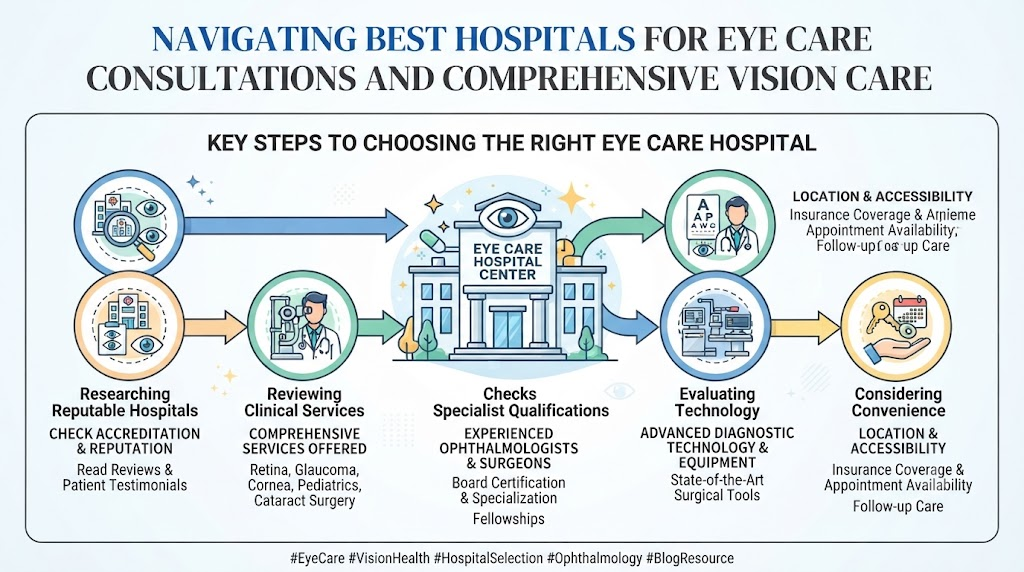
Selecting an appropriate healthcare facility for eye care involves evaluating clinical expertise, technology, and scope of services.
- Experienced Ophthalmologists: Board-certified medical doctors specializing in eye and vision care.
- Availability of Subspecialists: Access to experts in retina, glaucoma, cornea, and pediatric care.
- Advanced Diagnostic Equipment: Modern imaging and testing devices on-site.
- Comprehensive Eye Care Services: Ability to transition seamlessly from routine consultation to surgical or medical treatment.
- Patient Safety Standards: Strict hygiene, sterilization, and infection control protocols.
- Convenient Follow-Up Care: Accessible locations and scheduling systems for long-term monitoring.
- Transparent Consultation Process: Clear communication regarding findings, treatment options, and costs.
Hospitals with multiple ophthalmology subspecialties are often better equipped to manage both routine and complex eye conditions (ASG Eye Hospital).
Hospital Selection Checklist
| Feature | Why It Matters |
| Experienced Ophthalmologists | Accurate diagnosis |
| Advanced Diagnostic Equipment | Comprehensive eye evaluation |
| Multiple Eye Care Specialties | Better treatment options |
| Modern Imaging Technology | Precise diagnosis |
| Patient Education | Better understanding of eye health |
| Follow-Up Services | Ongoing vision care |
What to Expect During an Eye Consultation
Understanding the flow of an eye examination helps demystify the visit and ensures active patient participation.
- Medical History Review: Discussing current symptoms, past medical history, and family eye health.
- Vision Testing: Measuring how clearly you see letters on a chart at various distances.
- Eye Pressure Check: Utilizing non-contact or applanation tonometry to measure internal fluid pressure.
- Slit Lamp Examination: Examining the eyelids, cornea, iris, and lens using magnified light.
- Retinal Examination: Dilating the pupils with drops to inspect the back of the eye and optic nerve.
- Additional Diagnostic Tests (If Needed): Performing specialized scans like OCT or visual field tests based on initial findings.
- Discussion of Findings: Reviewing results directly with the ophthalmologist in clear, accessible terms.
- Personalized Treatment Plan: Outlining recommendations for glasses, medications, or ongoing observation.
Preparing for an Eye Consultation
Taking a few preparation steps ensures you get the most out of your appointment.
- Bring Previous Eye Records: Carry copies of past prescriptions, surgical notes, or imaging results.
- Carry Current Glasses or Contact Leases: Bring all pairs of spectacles and lens boxes currently in use.
- List Medications: Write down all prescription drugs, eye drops, vitamins, and supplements you take.
- Mention Family History of Eye Disease: Note if conditions like glaucoma or macular degeneration run in your family.
- Prepare Questions for the Ophthalmologist: Write down specific concerns regarding your vision or eye comfort.
Common Eye Conditions Detected During Consultations
Regular clinical evaluations help identify several prevalent ocular disorders early in their course.
- Cataracts: Progressive clouding of the eye lens that blurs vision over time.
- Glaucoma: A group of conditions damaging the optic nerve, frequently linked to elevated eye pressure.
- Diabetic Retinopathy: Damage to retinal blood vessels caused by long-term high blood sugar.
- Dry Eye Disease: Chronic lack of adequate lubrication and moisture on the eye surface.
- Refractive Errors: Common focusing issues including nearsightedness, farsightedness, and astigmatism.
- Macular Degeneration: Deterioration of the central portion of the retina affecting sharp, straight-ahead vision.
- Corneal Disorders: Conditions affecting corneal clarity, thickness, or shape.
- Retinal Diseases: Tears, detachments, or vascular blockages impacting the neural retina.
How BESTEYEHOSPITALS Helps Patients
Navigating eye care options requires accessible, dependable health information. Platforms like BESTEYEHOSPITALS support patients and families by offering:
- Eye Health Education: Providing clear, easy-to-understand guides on eye anatomy and common conditions.
- Hospital Discovery: Helping users locate specialized ophthalmology centers and eye clinics nearby.
- Vision Care Awareness: Promoting the importance of routine eye examinations and preventive screenings.
- Hospital Comparison Resources: Offering structured insights to evaluate hospital facilities and diagnostic technology.
- Patient Guidance: Equipping readers with effective questions to ask during eye care consultations.
- Informed Healthcare Decisions: Empowering individuals to take charge of their visual health.
Common Mistakes Patients Make
- Delaying Routine Eye Examinations: Waiting until noticeable vision loss occurs before seeking professional care.
- Ignoring Mild Vision Changes: Dismissing subtle blurriness or eye strain as simple tiredness.
- Wearing Outdated Prescriptions: Continuing to use old glasses that no longer match current refractive needs.
- Skipping Follow-Up Appointments: Neglecting scheduled monitoring visits for chronic eye conditions like glaucoma.
- Choosing Hospitals Based Only on Cost: Selecting eye care centers based exclusively on cheap pricing while overlooking clinical quality and technology.
Practical Solutions: Schedule routine eye exams proactively, address minor vision shifts promptly, and prioritize experienced ophthalmologists and advanced diagnostic capabilities over cost alone.
Common Myths vs Facts
| Myth | Fact |
| Eye exams are only needed when vision changes | Regular eye exams can detect diseases before symptoms appear |
| Good vision means healthy eyes | Some eye diseases develop without noticeable vision loss |
| Only older adults need eye consultations | People of all ages benefit from routine eye care |
| Glasses weaken eyesight | Corrective lenses help improve vision but do not weaken the eyes |
Real-Life Educational Scenarios
Scenario 1: Early Glaucoma Detection During Routine Consultation
An adult attending a routine eye checkup has their intraocular pressure checked and optic nerve scanned via OCT. The ophthalmologist notices subtle early changes consistent with open-angle glaucoma, allowing treatment to begin long before permanent peripheral vision loss occurs.
Scenario 2: Updating a Prescription for Blurred Vision
A student experiencing frequent headaches and mild blurriness during evening reading visits an eye clinic. A digital refraction test reveals a shift in astigmatism, and a new eyeglass prescription restores sharp, comfortable vision.
Scenario 3: Regular Retinal Examinations for Diabetes
A patient diagnosed with type 2 diabetes schedules annual comprehensive eye examinations as part of their systemic care plan. Dilated retinal evaluations ensure that any emerging microvascular changes are monitored and treated immediately.
Scenario 4: Pediatric Vision Screening and Treatment
A young child struggling with classroom reading is brought in for a pediatric ophthalmology consultation. The specialist diagnoses a significant refractive error and prescribes corrective lenses, noticeably improving the child’s academic engagement and comfort.
FAQs (15 Questions)
1. What is an eye care consultation?
An eye care consultation is a professional medical evaluation to assess vision, check eye health, and screen for ocular diseases.
2. How often should I have an eye examination?
Frequency depends on age, health status, and risk factors, but adults typically benefit from comprehensive exams every one to two years or as advised by their ophthalmologist.
3. What happens during a comprehensive eye exam?
The exam includes a medical history review, visual acuity testing, eye pressure measurements, slit-lamp examination, and a dilated retinal evaluation.
4. When should I see an ophthalmologist?
See an ophthalmologist for sudden vision changes, eye pain, flashes of light, floaters, injury, or routine specialized eye health evaluations.
5. What tests are commonly performed?
Common tests include visual acuity charts, tonometry for eye pressure, OCT scans, and visual field testing.
6. Can eye consultations detect glaucoma?
Yes, routine screenings measure eye pressure and examine the optic nerve to catch glaucoma early.
7. Are retinal examinations painful?
No, retinal exams and pupil dilation are painless, though bright lights and temporary light sensitivity may occur afterward.
8. How long does an eye consultation take?
A comprehensive eye consultation typically lasts between 45 minutes to two hours, depending on whether pupil dilation or specialized scans are needed.
9. Do children need regular eye exams?
Yes, children should have vision screenings during pediatric check-ups and comprehensive exams if vision issues are suspected.
10. What should I bring to my appointment?
Bring current eyeglasses, sunglasses for post-dilation glare, a list of medications, and your medical insurance details.
11. How do hospitals diagnose eye diseases?
Hospitals use advanced diagnostic tools like digital imaging, OCT, and specialized clinical examinations performed by ophthalmologists.
12. Can eye problems develop without symptoms?
Yes, serious conditions like glaucoma and early diabetic retinopathy often develop without noticeable early warning signs.
13. How do I choose the right eye hospital?
Look for hospitals with board-certified ophthalmologists, advanced diagnostic technology, subspecialty care, and strong safety standards.
14. Why are follow-up visits important?
Follow-up visits ensure that treatments are working effectively and allow doctors to monitor stable chronic eye conditions.
15. How does BESTEYEHOSPITALS help patients find hospitals for eye care consultations?
BESTEYEHOSPITALS provides reliable educational resources, hospital comparisons, and guidance to help patients access expert eye care services.
Final Thoughts
Regular eye care consultations are an essential component of preventive healthcare and lifelong wellness. The combination of experienced ophthalmologists, advanced diagnostic imaging, and comprehensive clinical evaluations ensures that vision issues and eye diseases are caught and managed early. Choosing hospitals with robust ophthalmology departments guarantees access to expert care tailored to individual needs. Maintaining consistent follow-up appointments safeguards visual clarity and overall eye health for years to come.