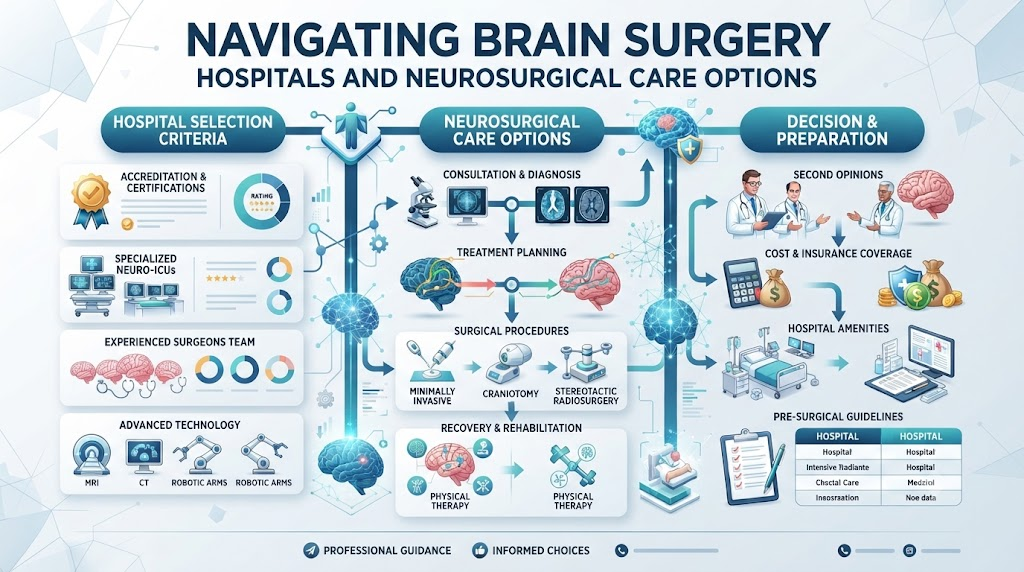
Receiving a neurological diagnosis or being told that you or a family member might need surgical care can be overwhelming. Facing complex medical terminology, unfamiliar procedure names, and crucial health decisions creates immense anxiety for patients and caregivers alike. During such times, understanding how to evaluate brain surgery hospitals becomes vital for navigating your healthcare journey effectively. Specialized facilities vary significantly in their capabilities, technologies, diagnostic tools, and multidisciplinary support teams.Because neurological conditions range from complex tumors to structural vascular anomalies, matching a specific diagnosis with an appropriately equipped center and experienced specialist is essential. This comprehensive guide outlines what specialized neurosurgical centers offer, the specific roles of neurosurgeons, common treatment pathways, key evaluation factors, and how seeking a second opinion can help you make well-informed healthcare decisions in collaboration with your medical team.
What Are Brain Surgery Hospitals?
Specialized medical institutions dedicated to neurosurgical treatment are designed to manage intricate conditions involving the brain, skull base, spinal cord, and peripheral nerves. When researching brain surgery hospitals, it helps to understand the core services these medical centers generally provide to support patients throughout their care journey.
Neurosurgical Evaluation
A comprehensive evaluation involves detailed clinical examinations, cognitive assessments, and a thorough review of past medical records to determine the underlying nature of a neurological symptom.
Diagnostic Imaging and Testing
Advanced imaging capabilities—including high-resolution magnetic resonance imaging (MRI), computed tomography (CT) scans, cerebral angiography, and functional brain mapping—allow medical teams to visualize complex neural structures accurately.
Specialist Consultation
Patients meet with neurosurgical specialists to discuss diagnostic findings, potential treatment approaches, structural risks, and expected clinical goals.
Surgical and Non-Surgical Treatment Planning
Care planning involves assessing whether open surgery, minimally invasive techniques, targeted radiation, or non-surgical monitoring represents the most appropriate initial path.
Post-Treatment and Follow-Up Care
Recovery requires structured oversight, including specialized intensive monitoring, neuro-rehabilitation services, and long-term follow-up consultations to track healing.
Because individual institutional capabilities vary, patients should review available infrastructure directly with qualified healthcare providers to confirm a facility matches their diagnostic requirements.
Neurosurgery Hospitals and Specialist Care
Evaluating specialized neurosurgery hospitals involves looking beyond standard medical facilities to examine dedicated neurosurgical infrastructure. Complex neurological care often requires coordinated input from diverse medical disciplines rather than an isolated surgical decision.
Leading neurosurgical facilities utilize integrated multidisciplinary teams. Neurologists, neurosurgeons, neuroradiologists, neuro-oncologists, neuropathologists, and specialized critical care nurses collaborate to design personalized management plans. Operating rooms within these centers are typically equipped with specialized microsurgical instrumentation, intraoperative imaging technologies, stereotactic navigation systems, and neurophysiological monitoring devices to protect functional brain tissue during complex procedures.
Beyond the operating room, dedicated neuro-intensive care units (Neuro-ICUs) play a crucial role in post-operative monitoring. Specially trained medical staff manage intracranial pressure, vital parameters, and fluid dynamics during early recovery. Following immediate post-surgical care, specialized physical, occupational, and speech therapists assist patients in regaining cognitive and motor functions. Because institutional capabilities differ, confirm specific services during direct clinical consultations.
Brain Surgeons and Neurosurgeons
Understanding the qualifications and roles of brain surgeons and neurosurgeons can provide clarity when seeking specialized medical care. Neurosurgeons are medical doctors who have completed extensive post-graduate residency training specifically focused on the surgical and non-surgical management of neurological conditions.
Within neurosurgery, many physicians complete fellowship training focused on subspecialties such as neuro-oncology (brain tumors), cerebrovascular surgery (aneurysms and vascular malformations), skull base surgery, functional neurosurgery (epilepsy and movement disorders), or pediatric neurosurgery. When evaluating specialists, patients often research a surgeon’s experience regarding specific conditions or procedural techniques.
In addition to performing procedures, neurosurgeons evaluate diagnostic studies, discuss potential therapeutic pathways, outline potential risks, and coordinate long-term post-operative care strategies. Communication between neurosurgeons, primary physicians, and patients helps ensure treatment plans align with clinical needs and personal values.
Brain Tumor Treatment
Modern brain tumor treatment encompasses a range of therapeutic options designed to address benign (non-cancerous) or malignant (cancerous) growths within the central nervous system. Treatment strategies depend on multiple variables, including tumor type, size, precise anatomical location, histological grade, genetic biomarkers, and overall patient health.
Diagnosis and Imaging
Detailed visualization using contrast-enhanced MRI, functional MRI, or PET scans helps delineate tumor boundaries and proximity to critical brain structures responsible for speech or movement.
Tumor Classification
Pathological examination of tissue samples determines whether a tumor is primary or metastatic, as well as its specific cellular grade and molecular characteristics.
Surgery
Surgical resection aims to remove as much tumor tissue as safely possible while minimizing injury to surrounding functional brain regions.
Radiation Therapy
Targeted radiation modalities, such as stereotactic radiosurgery or intensity-modulated radiation therapy, may be utilized post-surgery or as a primary intervention for deep-seated lesions.
Drug-Based Treatments
Systemic therapies, including chemotherapy, targeted drug therapies, and immunotherapies, are incorporated based on specific tumor biology and molecular profiles.
Monitoring and Follow-Up
Regular neuro-imaging and clinical assessments monitor for tumor recurrence or treatment-related changes over extended periods.
Brain Tumor Surgery Hospitals
When researching brain tumor surgery hospitals, patients frequently evaluate centers with dedicated neuro-oncology programs. Managing complex central nervous system tumors requires coordinated expertise across multiple disciplines.
High-volume brain tumor centers typically host multidisciplinary tumor boards where neurosurgeons, neuro-oncologists, radiation oncologists, neuroradiologists, and pathologists collectively review individual patient cases. This collaborative review ensures comprehensive evaluation of surgical feasibility, radiation protocols, and targeted drug options.
Advanced operating facilities often incorporate intraoperative MRI or CT, fluorescence-guided surgery, and continuous cortical mapping to help surgeons differentiate tumor tissue from healthy brain parenchyma. Post-operative care infrastructure, including specialized pathology services for molecular profiling, supports personalized treatment design. Patients should discuss specific hospital workflows and procedure suitability directly with their healthcare team.
Brain Aneurysm Surgery
A brain aneurysm is a weak or bulging spot in the wall of an intracranial artery. Because a ruptured aneurysm leads to subarachnoid hemorrhage—a life-threatening medical emergency—specialist evaluation is crucial for evaluating both unruptured and ruptured vascular malformations.
Surgical and endovascular options are available for addressing brain aneurysms:
- Surgical Clipping: A neurosurgeon performs a craniotomy to access the aneurysm directly, applying a microscopic metal clip across the neck of the aneurysm to block blood flow and prevent rupture.
- Endovascular Coiling and Flow Diverters: A minimally invasive catheter-based approach where small platinum coils or mesh stents (flow diverters) are guided through blood vessels into the aneurysm to encourage clotting and seal off the bulge.
Neither surgical clipping nor endovascular coiling is universally superior for every patient. The selection depends on aneurysm size, shape, structural neck geometry, anatomical location, patient age, overall medical condition, and specialized neuro-interventional expertise.
Emergency Note: A ruptured brain aneurysm is a life-threatening emergency. If someone experiences a sudden, extremely severe headache (often described as the “worst headache of your life”), sudden numbness, vision loss, or confusion, call emergency services immediately.
Epilepsy Surgery
For individuals living with epilepsy, anti-seizure medications provide effective symptom control in many cases. However, when seizures persist despite trying multiple appropriate medication regimens, a condition referred to as drug-resistant or refractory epilepsy, epilepsy surgery may be considered.
Surgical evaluation involves comprehensive diagnostic testing, including prolonged video-electroencephalography (video-EEG) monitoring, high-resolution MRI, positron emission tomography (PET), and neuropsychological assessments. The goal of this evaluation is to identify the precise anatomical origin of seizure activity (the epileptogenic zone) and determine whether it can be safely targeted without impairing essential functions such as memory, language, or motor control.
Depending on diagnostic findings, surgical strategies may include focal surgical resection, laser interstitial thermal therapy (LITT), or neuromodulation approaches (such as vagus nerve stimulation or responsive neurostimulation). Surgical intervention is considered only after extensive multidisciplinary evaluation confirms that non-surgical options are insufficient and that surgery can be conducted safely.
Minimally Invasive Brain Surgery
Technological advancements have expanded the development of minimally invasive brain surgery techniques. These approaches utilize specialized instruments, endoscopic camera systems, and micro-port access routes to reach intracranial targets while minimizing disruption to surrounding brain tissue.
Common applications include endoscopic endonasal surgery—accessing pituitary tumors and skull base lesions through the nasal passages—and stereotactic laser ablation for specific deep-seated lesions. Potential benefits of minimally invasive approaches can include smaller surgical incisions, reduced surgical trauma, and shorter hospital stays in select cases.
However, minimally invasive techniques are not universally applicable or safer for every condition. Large, complex, or hyper-vascular lesions may still require traditional open craniotomies to ensure complete visual access and safe resection. The choice of surgical technique depends on anatomical location, tumor size, underlying diagnosis, and surgeon expertise.
How to Research Brain Surgery Hospitals
Evaluating medical facilities requires systematic research to gather objective information before scheduling consultations.
Research Factors Checklist
- Identify the Diagnosis or Suspected Condition: Gather all current diagnostic imaging, formal radiology reports, and clinical notes from referring physicians.
- Research Relevant Neurosurgical Expertise: Look for centers with specific experience treating your specific neurological condition.
- Review Diagnostic Capabilities: Confirm the facility offers modern imaging tools such as high-field MRI, functional imaging, and advanced neuro-pathology support.
- Understand Available Treatment Approaches: Determine whether the hospital offers surgical, non-surgical, radiation, and interventional capabilities.
- Check Multidisciplinary Support: Ensure the facility utilizes collaborative teams including neurologists, neuro-oncologists, and specialized therapists.
- Review Rehabilitation and Follow-Up Care: Confirm post-operative inpatient and outpatient neuro-rehabilitation services are available.
- Understand Location and Accessibility: Consider travel requirements, local accommodation, and follow-up consultation feasibility.
- Ask About Medical Records Requirements: Clarify how imaging files (DICOM format) and clinical records should be submitted for preliminary review.
- Discuss Costs and Insurance Separately: Contact hospital billing departments and insurance providers directly to clarify coverage, in-network status, and out-of-pocket estimates.
Neurosurgery Second Opinion
Seeking a neurosurgery second opinion is a standard, widely respected practice in complex medical care. Obtaining another specialist’s perspective can help confirm a diagnosis, explore alternative treatment approaches, or provide reassurance before proceeding with invasive procedures.
| Consideration | Key Aspect |
| Diagnostic Verification | Re-evaluating imaging studies and pathology reports to confirm the primary diagnosis. |
| Alternative Pathways | Exploring non-surgical, minimally invasive, or clinical trial options that may exist. |
| Risk-Benefit Assessment | Gaining alternative clinical perspectives on potential procedural risks and expected outcomes. |
| Peace of Mind | Helping patients make healthcare decisions with increased confidence. |
Seeking a second opinion does not imply that the initial physician was incorrect. Rather, it reflects the complexity of neurosurgical decision-making, where multiple valid approaches may exist depending on individual clinical parameters.
To prepare for a second opinion consultation, gather complete medical records, official radiology reports, original digital imaging files (on CD or USB drive), pathology slides (if applicable), surgical history, and a list of current medications.
Benefits of Researching Specialized Neurosurgical Care
Proactively researching healthcare options empowers patients and families during challenging medical situations. Understanding your diagnosis, potential interventions, and facility capabilities allows you to participate actively in treatment discussions.
Thorough research helps you identify specialized medical centers equipped with appropriate infrastructure for complex cases. Furthermore, being informed enables clearer communication with clinical teams, helping you ask targeted questions regarding procedure risks, recovery timelines, and post-treatment expectations without relying on unverified claims.
Limitations of Online Medical Research
While online resources provide valuable educational background, digital information has clear limitations:
- No Diagnostic Capability: Online content cannot diagnose individual medical conditions.
- Absence of Personal Context: Articles cannot account for individual health histories, co-morbidities, or unique anatomical variations.
- Variable Quality: Medical information online ranges in accuracy and may contain outdated or unverified claims.
- Inability to Replace Clinical Assessment: Digital material cannot replace physical neurological examinations or direct imaging reviews by qualified specialists.
All online research should serve as a foundation for informed discussions with qualified physicians rather than as independent medical guidance.
Emergency Warning Signs
Certain neurological symptoms represent potential medical emergencies requiring immediate clinical evaluation. Seek urgent emergency care if you or someone near you experiences:
- Sudden, unusually severe headache (“thunderclap” headache)
- Sudden weakness, numbness, or paralysis on one side of the face or body
- Sudden difficulty speaking, slurred speech, or trouble understanding language
- Sudden loss of vision in one or both eyes, or double vision
- New-onset seizures or sudden loss of consciousness
- Sudden loss of balance, severe dizziness, or inability to walk
If someone experiences severe sudden neurological symptoms, contact local emergency medical services immediately.
BrainSurgeryHospitals.com and Patient Research
BrainSurgeryHospitals.com serves as a dedicated educational resource designed to support patients, families, and caregivers researching complex neurological care. The platform offers structured information regarding brain surgery hospitals, specialized neurosurgery hospitals, and facilities focusing on complex care such as brain tumor surgery hospitals.
Through accessible content, users can learn about the roles of brain surgeons and neurosurgeons, explore therapeutic avenues like brain tumor treatment, and read about complex interventions including brain aneurysm surgery, epilepsy surgery, and minimally invasive brain surgery. Additionally, the platform provides practical guidance on how to evaluate specialized centers and prepare for a neurosurgery second opinion, helping patients approach clinical consultations with greater clarity and confidence.
Comparison Table: Key Research Factors
| Research Factor | Why It Matters |
| Neurosurgical Expertise | Helps identify specialists relevant to the specific neurological condition. |
| Diagnostic Capabilities | Supports accurate evaluation and precise surgical treatment planning. |
| Multidisciplinary Care | Ensures diverse medical specialists contribute to complex treatment plans. |
| Surgical Techniques | Identifies whether open, endoscopic, or minimally invasive approaches apply. |
| Intensive and Follow-Up Care | Essential for post-operative recovery, neuro-rehabilitation, and monitoring. |
| Second-Opinion Access | Allows review of diagnostic findings and treatment options by another specialist. |
Frequently Asked Questions
- How can I research brain surgery hospitals effectively?
Start by gathering complete medical records and diagnostic scans. Research specialized centers with dedicated neurosurgical departments, evaluate their diagnostic capabilities, check for multidisciplinary care teams, and verify their experience managing your specific neurological diagnosis. - What is the difference between specialized neurosurgery hospitals and general medical facilities?Specialized neurosurgical centers feature dedicated intraoperative equipment, high-resolution neuro-imaging tools, specialized Neuro-ICUs, and integrated multidisciplinary teams (including neurosurgeons, neuro-oncologists, and neuroradiologists) experienced in managing complex central nervous system conditions.
- What factors define top-tier brain tumor surgery hospitals?
Key factors include multidisciplinary tumor boards, advanced intraoperative guidance tools (such as intraoperative MRI and cortical mapping), access to subspecialized neuro-oncology teams, comprehensive pathology support, and structured neuro-rehabilitation services. - What qualifications should I look for in brain surgeons?
Look for board-certified neurosurgeons who have completed accredited residency programs and, where applicable, subspecialty fellowship training in areas like neuro-oncology, cerebrovascular surgery, or skull base procedures related to your condition. - How do neurosurgeons determine whether surgery is necessary?
Neurosurgeons evaluate patient history, clinical symptoms, neurological exam results, high-resolution imaging scans, and tissue biopsies to assess whether surgical intervention, non-surgical monitoring, or targeted alternative therapies offer the safest approach. - What does modern brain tumor treatment involve?
Treatment options range from active surveillance and surgical resection to targeted radiation therapies and systemic treatments (chemotherapy, immunotherapy). Strategies depend on tumor size, location, histology, molecular grade, and patient health. - How is brain aneurysm surgery performed?
Brain aneurysm treatment typically involves either micro-surgical clipping (placing a metal clip across the aneurysm neck via craniotomy) or endovascular coiling/stenting (threading coils or flow diverters into the vessel via a catheter). Suitability depends on aneurysm anatomy. - When is epilepsy surgery considered an option?
Epilepsy surgery is evaluated for patients with drug-resistant epilepsy after detailed diagnostic testing (video-EEG, MRI, PET scans) confirms that seizures originate from a specific, safely operable area of the brain without compromising vital functions. - What are the advantages of minimally invasive brain surgery?
Minimally invasive techniques use small access routes or natural openings (like nasal passages) to treat lesions, potentially offering reduced tissue disruption and faster initial recovery times. However, applicability depends heavily on tumor size, type, and location. - Why should I consider seeking a neurosurgery second opinion?
A second opinion helps confirm diagnostic findings, explore alternate surgical or non-surgical strategies, clarify potential treatment risks, and provide peace of mind before proceeding with major neurological procedures. - How should I prepare for a neurosurgical hospital consultation?
Compile your complete medical history, previous operative reports, list of medications, high-resolution imaging files on disc (DICOM format), official radiology reports, and a prioritized list of written questions regarding your diagnosis and treatment choices. - Are non-surgical treatment options available at specialized centers?
Yes. Specialized neurosurgical facilities evaluate non-surgical strategies, including active imaging surveillance, targeted stereotactic radiosurgery, medication management, and interventional pain management, depending on the underlying neurological condition.
Conclusion
Navigating a complex neurological diagnosis requires access to clear educational information, clear communication with medical professionals, and careful evaluation of healthcare facilities. Specialized brain surgery hospitals offer advanced diagnostic tools, subspecialized surgical expertise, and multidisciplinary care models designed to address intricate brain and spinal conditions. Because treatment suitability varies significantly based on individual medical histories, structural anatomy, and clinical parameters, discussing all potential options with qualified specialists is an essential step. Engaging in open dialogue, preparing targeted questions, and seeking a second opinion when appropriate empowers patients and caregivers to make informed healthcare choices alongside their care team.