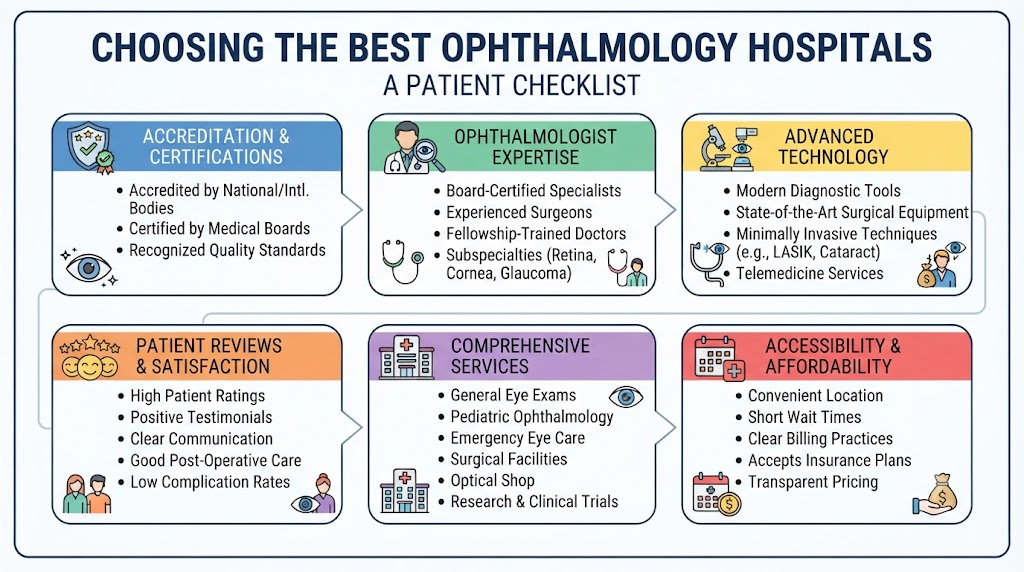
Choosing the right platform for vision care is one of the most critical health decisions you will ever make. Our sight shapes how we interact with the world, making high-quality clinical outcomes the top priority. When dealing with complex conditions like cataracts, glaucoma, or refractive errors, finding the best eye hospitals requires careful research.Navigating the global healthcare system can feel overwhelming. Patients frequently face conflicting information regarding diagnostic tools, surgical options, and varying clinical facilities. This comprehensive educational guide provides a clear framework to evaluate top-tier facilities, compare treatment modalities, and understand cost structures worldwide. Armed with these insights, you can protect your long-term vision and make medical choices with absolute confidence.
Why Choosing the Right Eye Hospital Matters
The success of any vision correction procedure depends heavily on the ecosystem where it is performed. The best eye hospitals in the world stand out because they integrate three vital pillars: highly skilled human expertise, rigorous patient safety protocols, and state-of-the-art diagnostic imaging systems. Selecting an accredited facility protects you from avoidable surgical complications and ensures accurate pre-operative mapping.
Clinical infrastructure varies significantly between general medical centers and specialized eye clinics. Dedicated ophthalmology hubs invest heavily in target-specific technologies, such as advanced flap-creation lasers for refractive surgery or micro-incision systems for lenses. Furthermore, top-tier centers follow strict international healthcare standards that govern everything from sterilization in the operating room to post-operative infection control, keeping your safety at the forefront.
Key Factors to Compare Eye Hospitals
When evaluating clinical options globally or locally, you must look past basic marketing claims and look directly at verified quality benchmarks.
Hospital Accreditation and Quality Standards
Look for recognized regional and international stamps of approval. In global medical tourism, accreditations from bodies like the Joint Commission International (JCI) show that a facility meets strict safety and care requirements. Nationally, look for top-tier credentials such as NABH in India. These certifications ensure the hospital undergoes regular audits covering clinical outcomes, sanitation, and ethical pricing models.
Clinical Expertise of the Eye Surgeon
A hospital’s technology is only as good as the professional using it. Research the specific credentials of the medical staff, looking for highly qualified cornea or retina specialists who have completed fellowships at respected global institutions. Pay close attention to their specific case volumes; a surgeon who performs hundreds of successful procedures annually is naturally more adept at handling complex anatomical variations.
Diagnostic and Surgical Technologies Available
Modern vision care relies heavily on precise imaging. The best ophthalmology hospitals feature top-of-the-line diagnostic suites, including Optical Coherence Tomography (OCT) for high-resolution retinal mapping and advanced corneal topography scanners. Having these tools on-site means your pre-surgery measurements will be incredibly accurate, which drastically lowers the risk of post-operative refractive surprises.
Understanding Major Eye Surgeries
Navigating modern vision correction options requires a clear understanding of the specific surgical methods available for different structural eye conditions.
Cataract Surgery Overview
Cataracts occur when the eye’s natural crystalline lens progressively clouds over, a common part of the aging process. Modern treatment replaces this cloudy lens with an artificial Intraocular Lens (IOL). Patients can choose between traditional manual incisions or advanced laser-assisted options, which use ultra-precise light paths to break up the cataract for smoother removal.
LASIK Surgery Overview
LASIK remains a top choice for correcting refractive errors like nearsightedness, farsightedness, and astigmatism. During this quick outpatient procedure, a specialized laser reshapes the inner cornea so light focuses perfectly onto the retina. Modern variations include completely blade-free options, which use advanced femtosecond lasers to maximize comfort and speed up recovery times.
Treatment Cost Considerations
Medical pricing plays a massive role in how families map out their healthcare journeys. Expenses fluctuate based on geographic location, the specific technology selected, and the complexity of the patient’s case.
Breakdown of Cataract Surgery Cost in India
The cataract surgery cost in India offers an excellent balance of affordability and world-class quality. Basic procedures using rigid monofocal lenses start around INR 15,000 to INR 25,000 per eye at reputable clinics. However, choosing premium premium trifocal or extended depth of focus (EDOF) lenses alongside laser-assisted systems can bring the total cost to INR 80,000 or INR 1,20000 per eye. This premium price point significantly reduces your long-term dependence on reading glasses.
Breakdown of LASIK Surgery Cost in India
The overall LASIK surgery cost in India changes based on the exact technology used to reshape the cornea. Standard microkeratome LASIK options using a mechanical blade typically run between INR 25,000 and INR 35,000 for both eyes. On the other end, advanced customized blade-free options (Contoura Vision or SMILE) range from INR 75,000 to INR 1,15,000, delivering higher visual sharpness and fewer night-glare side effects.
Essential Treatment Comparison Matrices
Table 1: Cataract Surgery vs. LASIK Surgery
This comparison highlights the fundamental differences between these two widely performed procedures.
| Features | Cataract Surgery | LASIK Surgery |
| Primary Indication | Clear vision loss from a cloudy natural lens. | Refractive errors (nearsightedness, astigmatism). |
| Advantages | Permanent cloudiness removal; sharp long-term vision. | Rapid recovery; drops dependence on glasses. |
| Limitations | Requires physical lens replacement inside the eye. | Depends on having adequate, healthy corneal thickness. |
| Suitable Patients | Individuals with age-related or traumatic cataracts. | Adults with a stable vision prescription for over a year. |
| Cost Factors | Varies by the specific type of intraocular lens used. | Determined by the choice of blade or blade-free laser. |
Table 2: Traditional vs. Laser-Assisted Cataract Surgery
This breakdown details the technical differences between manual methods and modern laser systems.
| Features | Traditional Phacoemulsification | Laser-Assisted Cataract Surgery |
| Incision Method | Handheld surgical blades guided by the surgeon. | Computer-programmed femtosecond laser beams. |
| Advantages | Highly reliable; lower entry cost for patients. | Extreme precision; perfectly round lens placement. |
| Limitations | Relies entirely on manual hand precision. | Higher out-of-pocket costs for the technology. |
| Suitable Patients | Broad range of standard cataract cases. | Patients seeking premium astigmatism-correcting IOLs. |
| Cost Factors | Economical and widely covered by basic insurance plans. | Features an added premium fee for laser programming. |
Table 3: LASIK vs. PRK (Photorefractive Keratectomy)
A look at the two primary laser methods used to correct refractive errors.
| Features | LASIK Surgery | PRK Surgery |
| Flap Creation | Yes, creates a thin protective surface flap. | No, gently removes the outer epithelial cell layer. |
| Advantages | Minimal discomfort; vision improves within 24 hours. | Eliminates all potential long-term flap complications. |
| Limitations | Requires a thicker initial corneal structural base. | Longer healing timeline; mild discomfort for 3-5 days. |
| Suitable Patients | Patients with normal corneas looking for fast recovery. | Individuals with naturally thin corneas or active lifestyles. |
| Cost Factors | Pricing depends on choosing blade or blade-free tools. | Comparable base cost, but needs more follow-up care. |
Medical Tourism for Vision Care
India has grown into a major hub for international patients seeking advanced eye care. The country draws medical tourists by pairing high-level clinical outcomes with highly competitive treatment costs.
Benefits for International Patients
Choosing the best eye hospitals in India gives international patients direct access to infrastructure that matches top Western hospitals at a fraction of the cost. Leading regional hubs feature internationally trained specialists fluent in English, which removes communication barriers. Furthermore, specialized international patient departments streamline the entire journey by managing medical visas, local transport, translation services, and scheduling immediate consultations without long waiting lists.
Expert Tips for Selecting Vision Care Providers
Making the right choice requires looking closely at verified medical benchmarks rather than relying on promotional materials.
- Verify True Case Volume: Always ask the eye surgeon how many times they have performed your specific procedure over the past year. High volume consistently correlates with safer outcomes.
- Look Beyond the Lowest Price: A unusually low price tag often means a clinic is using older diagnostic equipment or older generation intraocular lenses.
- Check Comprehensive Care Offerings: Choose a hospital that houses retina, glaucoma, and cornea specialists under one roof. If a rare complication pops up during surgery, you will have immediate access to expert cross-consultations.
- Examine Real Patient Reviews: Look for authentic, independent testimonials focused on post-operative care and how the clinic handles recoveries, rather than just reading front-page marketing quotes.
Best Practices for Patient Treatment Planning
Following a structured timeline ensures you are fully prepared for surgery and helps set the stage for a smooth, uneventful recovery.
- Get a Detailed Baseline Screening: Complete an extensive initial eye examination that includes detailed corneal mapping and measurements of your tear film health before locking in a surgery date.
- Stop Wearing Contact Lenses Early: If you are prepping for laser eye surgery, swap out contact lenses for traditional glasses at least two weeks before your consultation to let your corneas return to their natural shape.
- Share Your Full Medical History: Give your eye surgeon a complete list of your medications, paying special attention to blood thinners or auto-immune treatments that can affect how you heal.
- Follow Post-Op Drop Schedules Visually: Stick exactly to your prescribed schedule for antibiotic and anti-inflammatory eye drops, even if your vision feels perfectly clear within the first few days.
Common Mistakes Patients Make
Avoiding these frequent oversights will protect you from unexpected bills and ensure a smooth recovery.
- Rushing the Recovery Process: Trying to return to intense physical workouts, swimming, or heavy screen use too quickly can disrupt corneal flaps or shift newly placed intraocular lenses.
- Confusing Eye Care Specialties: Assuming an optometrist (who specializes in basic vision checks and glasses fittings) can provide the same surgical advice as a fully trained ophthalmologist or eye surgeon.
- Ignoring Hidden Medical Fees: Forgetting to check if your initial price quote covers essential extras like pre-op scans, post-surgery checkups, protective shields, or emergency follow-up visits.
- Skipping a Second Medical Opinion: Hesitating to seek a second medical opinion out of politeness. A clean second look confirms your diagnosis and helps you choose the safest, most effective path forward.
Frequently Asked Questions
1. What is the main difference between an ophthalmologist and an optometrist?
An ophthalmologist is a medical doctor who diagnoses all eye diseases, performs delicate surgeries, and prescribes complex medical treatments. An optometrist focuses primarily on performing standard vision tests, prescribing corrective glasses or contact lenses, and managing basic eye conditions.
2. How long does the recovery process take after modern LASIK surgery?
Most patients notice a significant improvement in their vision within 24 hours after a standard LASIK procedure. However, the complete deep tissue healing phase takes about three to six months, during which minor changes, dryness, or night glare may occur.
3. Is the cataract surgery cost in India covered by international insurance plans?
Many of the best eye hospitals in India work directly with major international insurance providers. However, coverage depends entirely on your specific policy, so it is crucial to confirm pre-authorization with both your provider and the hospital’s billing team beforehand.
4. What exactly is a premium intraocular lens used in cataract procedures?
A premium intraocular lens, such as a multifocal, trifocal, or extended depth of focus (EDOF) lens, allows the eye to focus clearly across multiple distances. This advanced option significantly reduces or eliminates your need for reading glasses after surgery, unlike basic monofocal lenses.
5. Can a patient develop cataracts again after undergoing surgery?
No, a true cataract cannot return because the eye’s natural crystalline lens has been completely removed. However, some patients may develop a common, easily treatable condition called posterior capsule opacification, often referred to as a “secondary cataract,” which is quickly cleared using a quick, non-invasive YAG laser.
6. Are you awake during modern laser eye surgery procedures?
Yes, patients remain fully awake during laser eye surgeries like LASIK or SMILE. Surgeons use highly effective numbing eye drops to ensure you feel no pain, and they may provide a mild sedative to help you stay relaxed during the short process.
7. What steps should I take if I experience dry eyes after a LASIK procedure?
Dryness is a very common temporary side effect after laser eye surgery. You can manage it effectively by using preservative-free lubricating drops exactly as directed by your surgeon, avoiding direct airflow to the face, and taking regular breaks from digital screens.
8. Why do the costs of cataract procedures vary so much between private hospitals?
Prices vary based on the specific type of intraocular lens chosen, the technology used (manual vs. femtosecond laser), the surgeon’s experience level, and the hospital’s location. Premium facilities also build advanced diagnostic testing and long-term post-operative care into their base packages.
9. What specific medical accreditations should I look for in an eye clinic?
For international standards, look for accreditation from the Joint Commission International (JCI). On a national level, certifications like the NABH in India ensure the facility follows strict safety guidelines, maintains sterile operating rooms, and delivers reliable clinical outcomes.
10. Can laser eye surgery treat severe presbyopia in older adults?
Standard LASIK is primarily designed to correct nearsightedness, farsightedness, and astigmatism. For older adults dealing with presbyopia (age-related reading vision loss), specialists often recommend alternative options like monovision LASIK or Refractive Lens Exchange (RLE) to achieve clear, multi-distance vision.
11. What risks are associated with traveling internationally shortly after eye surgery?
Flying too soon after surgery exposes your eyes to very dry cabin air, which can worsen irritation, while travel movement increases the risk of accidental rubs. Always get an explicit clearance from your eye surgeon before boarding a flight during your early recovery.
12. How do I know if I am a good candidate for PRK instead of LASIK?
PRK is often the ideal choice for patients with naturally thin or irregular corneas, chronic dry eye issues, or lifestyles involving high-contact sports. An eye specialist will determine your eligibility after a comprehensive mapping of your corneal thickness and shape.
13. What diagnostic tests are required before booking a cataract procedure?
Pre-operative testing typically includes corneal topography to map the eye’s surface, optical biometry to measure the eye’s length for exact lens sizing, a detailed macular OCT scan, and a gentle tonometry check to monitor intraocular fluid pressure.
14. How do top eye hospitals prevent dangerous infections during surgery?
Top centers use dedicated positive-pressure air filtration systems (HEPA) in their operating rooms, use single-use surgical tools whenever possible, follow strict sterilization protocols, and have patients use preventative antibiotic drops both before and after the procedure.
15. What should I do if I notice sudden flashes of light or floaters?
Sudden flashes of light or a shower of new floaters are potential warning signs of a retinal tear or detachment. This is a medical emergency that requires immediate evaluation by a specialized retina doctor to protect your sight.
Conclusion
Navigating the world of vision care requires a careful balance of clear information, clinical transparency, and a solid understanding of modern medical technologies. Whether you are researching the cataract surgery cost in India, exploring advanced blade-free LASIK options, or comparing the best eye hospitals in the world, the choices you make today will shape your quality of life for years to come. By focusing on essential quality indicators—like international facility accreditations, verified surgeon case volumes, and comprehensive diagnostic suites—you can confidently look past marketing noise and find truly exceptional care. Taking a proactive approach to your eye health ensures you receive a highly accurate diagnosis, a personalized treatment plan, and a safe, well-monitored recovery.