Introduction
Eye lens replacement surgery is a transformative medical procedure that has restored clarity to millions of patients worldwide. Whether performed to remove a cloudy cataract or as a Refractive Lens Exchange (RLE) to correct vision without the use of laser surgery, this procedure involves replacing the eye’s natural, aging lens with a sophisticated, custom-fit Intraocular Lens (IOL).As surgical techniques and lens technology evolve, the importance of selecting an advanced eye care hospital has never been greater. Patients today have access to premium lenses that can offer vision correction at multiple distances, significantly reducing or even eliminating the need for glasses. Navigating these choices requires reliable information and access to top-tier expertise. BESTEYEHOSPITALS serves as a central resource for patients seeking to compare institutions and understand the modern landscape of vision correction. In this guide, we will explore the nuances of lens replacement, the technology behind IOLs, and the critical factors to consider when choosing a hospital for your vision journey.
Understanding Eye Lens Replacement Surgery
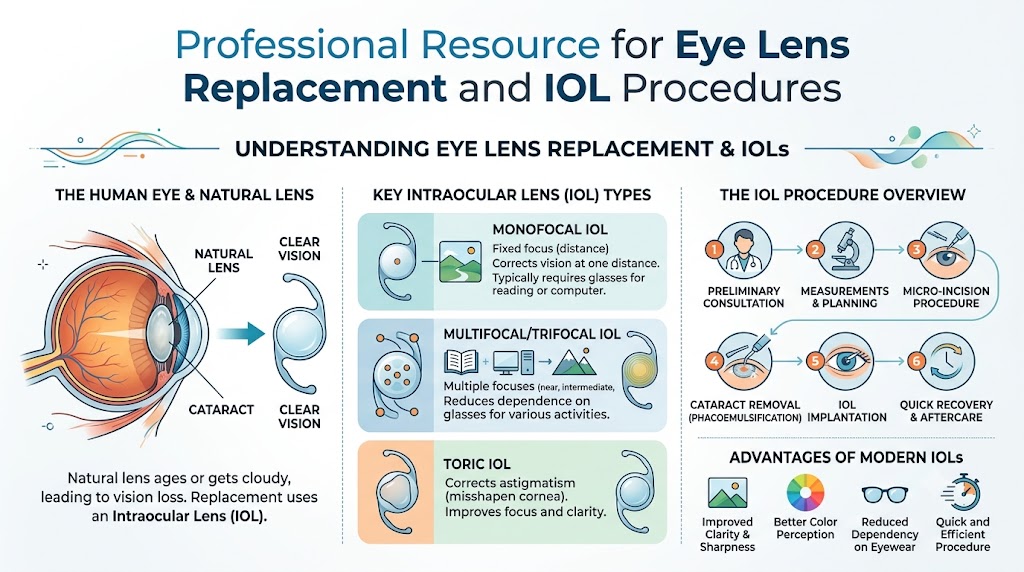
Lens replacement surgery involves the removal of the eye’s natural lens, which may have become clouded by cataracts or lost its flexibility due to age. Once removed, it is replaced with a clear, artificial lens known as an Intraocular Lens (IOL).
- Cataract Surgery: The primary goal is to remove the natural lens that has developed a cataract (clouding) and replace it with a clear IOL to restore lost vision.
- Refractive Lens Exchange (RLE): Similar in technique to cataract surgery, RLE is often performed on patients who have significant refractive errors (such as high nearsightedness or farsightedness) but do not yet have cataracts. It is frequently chosen by patients who are not suitable candidates for LASIK.
EYE LENS REPLACEMENT OVERVIEW TABLE
| Aspect | Description |
| Procedure Type | Microsurgical lens exchange |
| Target Condition | Cataracts, high refractive error, presbyopia |
| Lens Type Used | Artificial Intraocular Lens (IOL) |
| Anesthesia | Topical numbing eye drops |
| Recovery Time | Days for initial recovery; weeks for full stabilization |
Why Eye Lens Replacement Surgery Is Performed
Cataracts and Clouded Lenses
As we age, proteins in the lens can clump, causing it to turn yellow or cloudy. Surgery replaces this obstructive tissue to restore clear sight.
Refractive Errors
For individuals with high myopia (nearsightedness) or hyperopia (farsightedness) where laser surgery may not be effective, lens replacement offers an alternative pathway to visual independence.
Age-Related Vision Decline
Presbyopia—the gradual loss of the eye’s ability to focus on near objects—is a universal experience. Advanced IOLs can correct this, reducing dependence on reading glasses.
Dependence on Glasses or Contact Lenses
Many patients seek lens replacement surgery to simplify their lives by reducing or eliminating the need for corrective eyewear.
Types of Intraocular Lenses (IOLs)
Monofocal Lenses
Set to provide clear vision at a single focal point (usually distance). Patients typically still need glasses for reading or close work.
Multifocal Lenses
Designed with multiple zones to provide vision correction at both distance and near ranges.
Toric Lenses
Specifically designed to correct astigmatism, helping patients see clearly at a distance without needing additional glasses for their astigmatism.
Trifocal Lenses
Provide excellent vision at three ranges: distance, intermediate (like computer use), and near (reading).
Extended Depth of Focus (EDOF) Lenses
Utilize advanced optics to provide a continuous range of vision, reducing halos and glare often associated with older multifocal designs.
IOL TYPES COMPARISON TABLE
| Lens Type | Purpose | Best For | Visual Outcome |
| Monofocal | Distance OR Near | Basic vision needs | Clear at one distance |
| Multifocal | Distance AND Near | Reducing glasses dependence | Good overall range |
| Toric | Correct Astigmatism | Patients with high astigmatism | Sharp, astigmatism-free |
| Trifocal | Three-distance focus | High lifestyle activity | Excellent all-range |
| EDOF | Continuous range | Night driving/active use | Smooth transitions |
Top Hospitals Offering Eye Lens Replacement Surgery
Metropolitan Ophthalmic Center
- Hospital Overview: A premier institute dedicated to advanced refractive surgery and cataract care.
- Ophthalmology Department: A specialized team of fellowship-trained cataract and refractive surgeons.
- Lens Replacement Expertise: High volume of complex RLE and premium IOL implantations.
- Technology & Equipment Used: Femtosecond laser-assisted technology for precise incisions.
- Surgeon Experience: Surgeons with extensive tenure and thousands of successful procedures.
- Types of IOLs Available: Full spectrum, including all EDOF and Trifocal models.
- Patient Care Services: Personalized vision consultation to match lens type to lifestyle.
- Recovery Support: Structured post-operative check-ups and 24/7 emergency support.
- Why Patients Choose This Hospital: The focus on precision and low complication rates.
- Key Strengths: Advanced laser platforms and high precision in lens power calculation.
Global Vision & Refractive Institute
- Hospital Overview: A globally recognized center known for pioneering new techniques in IOL technology.
- Ophthalmology Department: Research-focused center that integrates the latest academic findings into practice.
- Lens Replacement Expertise: Specialists in high-correction lens exchanges for extreme refractive errors.
- Technology & Equipment Used: Advanced diagnostic AI for intra-operative planning.
- Surgeon Experience: Faculty-level surgeons who train other practitioners worldwide.
- Types of IOLs Available: Premium EDOF and customized Toric lenses.
- Patient Care Services: Comprehensive diagnostic suite and long-term vision management programs.
- Recovery Support: Advanced tele-monitoring for early-stage post-op patients.
- Why Patients Choose This Hospital: Access to cutting-edge lens designs and expert diagnostic planning.
- Key Strengths: Excellent diagnostic accuracy and advanced patient safety protocols.
HOSPITAL COMPARISON TABLE
| Hospital Name | Location | Lens Replacement Expertise | IOL Technology | Cataract Surgery | Refractive Lens Exchange |
| Metropolitan Ophthalmic | Metro City | Expert | Laser/Advanced | Yes | Yes |
| Global Vision | Capital City | Specialized | AI/Robotic | Yes | Yes |
Benefits of Eye Lens Replacement Surgery
Improved Vision Clarity
The primary benefit is the restoration of vision through the removal of cloudy or aged lenses.
Reduced Dependence on Glasses
Advanced IOLs often eliminate the need for glasses for daily activities, driving, and even reading.
Treatment of Cataracts
Surgery is the only definitive treatment for cataracts, preventing total vision loss if left untreated.
Long-Term Visual Stability
Once replaced, the IOL is permanent and does not age or develop cataracts in the future.
Faster Recovery
With modern techniques like phacoemulsification, surgery is quick and recovery is often rapid.
BENEFITS TABLE
| Benefit | Explanation | Patient Impact |
| Clear Vision | Replaces cloudy/worn lenses | Sharp, bright images |
| Glasses Reduction | Premium lens technology | Active, unencumbered lifestyle |
| Cataract Removal | Restores transparency | Prevents vision loss |
| Better Focus | Corrects presbyopia/astigmatism | Freedom from reading glasses |
| Quick Recovery | Micro-incision techniques | Rapid return to normal life |
Who Needs Lens Replacement Surgery?
Candidates often include:
- Cataract Patients: Individuals whose cloudy lenses interfere with daily activities.
- High Refractive Error Patients: Those who cannot safely have LASIK.
- Age-Related Focus Issues: Patients over 45 who are frustrated with reading glasses and looking for a permanent refractive solution.
- Vision affecting daily life: Anyone whose quality of life is compromised by their current vision.
Pre-Surgery Evaluation
Before surgery, a thorough diagnostic session is conducted:
- Detailed Eye Exam: To ensure the health of the retina and the rest of the eye.
- Biometry (Lens Power Calculation): Precise measurements to ensure the perfect fit for the new lens.
- Corneal Mapping: To identify the shape of the eye, which is vital for IOL selection.
- General Health Check: To ensure the patient is ready for the procedure.
What Happens During the Procedure
- Preparation: Numbing eye drops are applied; no stitches are typically needed.
- Incision: A tiny, self-sealing incision is made in the cornea.
- Removal: The old lens is gently broken up using ultrasound energy (phacoemulsification) and removed.
- Implantation: The new, folded IOL is inserted through the same incision, where it unfolds into its permanent position.
- Completion: The incision heals naturally; the entire process usually takes less than 20 minutes per eye.
Recovery After Surgery
First 24–48 Hours
Vision may be slightly blurry; rest is essential. You will be provided with a protective eye shield for sleeping.
First Week
Mild sensitivity is normal. You will use prescribed eye drops to prevent infection and inflammation. Avoid heavy lifting and swimming.
Full Recovery Phase
Vision typically stabilizes significantly within 2–4 weeks as the eye adjusts to the new lens.
RECOVERY TABLE
| Phase | What Happens |
| Immediate Recovery | Mild blur/sensitivity; use eye shield |
| First Week | Dropping usage; avoid dusty environments/swimming |
| 2–4 Weeks | Stabilization of vision; return to routine |
| Full Stabilization | Final visual acuity achieved |
How to Choose the Right Eye Hospital
When researching, prioritize:
- Surgeon Experience: Look for specialists who perform a high volume of lens replacement surgery.
- IOL Variety: The hospital should offer a wide range of premium lenses, not just one brand.
- Advanced Diagnostics: Ensure they utilize the latest equipment for lens power calculation.
- Post-op Care: Quality care includes thorough follow-up exams.
- Patient Feedback: Look for reviews regarding the overall care and clarity of information provided.
Common Mistakes Patients Make
- Delaying Surgery: Letting cataracts advance too far can make surgery more complex.
- Focusing Only on Cost: Choosing a surgeon based on price rather than expertise can affect your lifetime visual outcome.
- Ignoring Lens Options: Not discussing all premium IOL options with the surgeon to see what fits your lifestyle.
- Neglecting Post-Op Drops: Skipping eye drops can increase the risk of infection.
- Missing Follow-ups: Regular checks are vital to ensure the IOL has stabilized correctly.
Future of Eye Lens Replacement Surgery
The future promises more personalization:
- AI Lens Selection: Algorithms to predict the exact lens needed based on lifestyle.
- Smart IOLs: Lenses that may eventually be adjustable after implantation.
- Robotic-Assisted Surgery: Increasing the level of precision in lens placement.
- Digital Mapping: More accurate imaging leading to better visual comfort.
FUTURE OF EYE SURGERY TABLE
| Innovation | Benefit |
| AI Lens Selection | Personalized outcome satisfaction |
| Smart IOLs | Potential for fine-tuning after surgery |
| Laser-Assisted | Extremely precise incisions |
| Digital Mapping | Better handling of astigmatism |
| Robotic Precision | Minimized manual surgical error |
FAQs
- What is eye lens replacement?
Replacing the eye’s natural lens with a clear artificial IOL. - Is it painful?
No, the eye is numbed with drops. - How long does recovery take?
Initial recovery in days, full stabilization in weeks. - Who is eligible?
Those with cataracts or those wanting to correct vision without glasses. - What is an IOL?
An artificial intraocular lens used to replace the eye’s natural lens. - Are results permanent?
Yes, the IOL is a long-term solution. - What are the risks?
Typical surgical risks include infection or dryness, which are manageable. - LASIK vs Lens Replacement?
LASIK reshapes the cornea; lens replacement swaps the lens inside the eye. - Can both eyes be treated?
Yes, typically performed on separate days. - Will I need glasses?
Many modern premium lenses minimize or eliminate the need for glasses. - How long does surgery take?
Under 20 minutes per eye. - Is it covered by insurance? Cataract surgery is often covered; RLE for purely refractive reasons may not be.
- Can I drive afterward?
Only after your surgeon clears you, usually after 24–48 hours. - How do I choose a lens?
Your ophthalmologist will match a lens to your lifestyle. - Is it better to do surgery early?
Early intervention can prevent cataract complications later.
Final Thoughts
Choosing to undergo lens replacement surgery is a significant investment in your long-term visual health. By selecting a facility that emphasizes advanced technology, surgeon expertise, and personalized IOL options, you can expect improved visual outcomes and an enhanced quality of life. Always approach this decision by focusing on your long-term visual goals and safety. For trusted eye care information, hospital comparisons, and vision treatment guidance, explore BESTEYEHOSPITALS.