Introduction
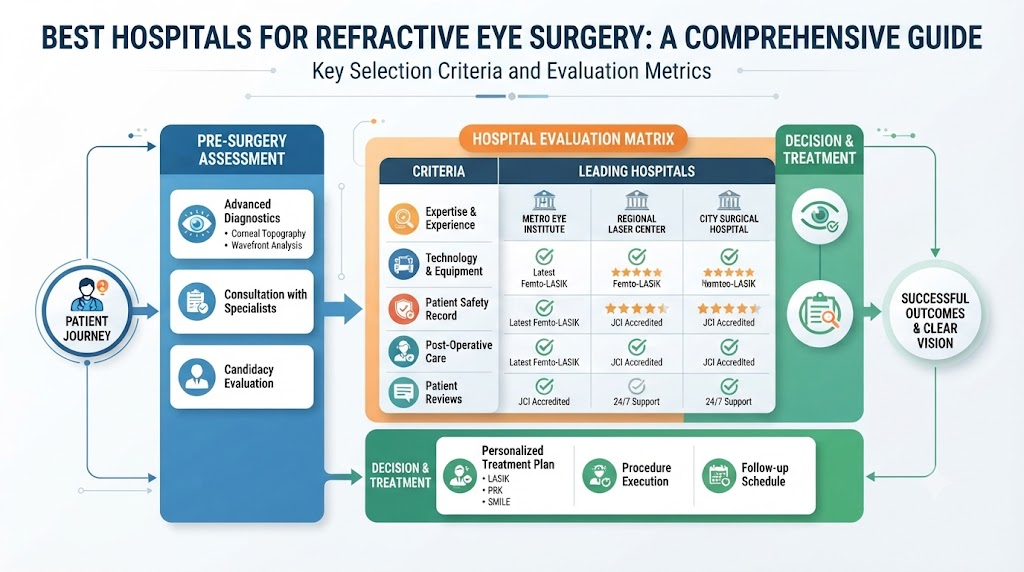
Refractive eye surgery has transformed how millions of people manage their vision, offering a surgical approach to correct common issues like nearsightedness, farsightedness, and astigmatism. Whether it is LASIK, SMILE, or PRK, these procedures aim to reshape the cornea or modify the eye’s focusing power to reduce dependency on corrective lenses.Selecting a hospital known for its specialized refractive surgery department ensures that you receive care based on precise diagnostics, modern safety protocols, and tailored treatment planning. For those beginning their research, BESTEYEHOSPITALS provides essential resources to help you compare leading eye care institutions and understand the standards of excellence in vision correction.
Understanding Refractive Eye Surgery
Refractive errors occur when the shape of the eye prevents light from focusing directly on the retina. Refractive surgery uses advanced laser technology or lens implantation to correct these irregularities, allowing light to focus correctly.
REFRACTIVE SURGERY OVERVIEW TABLE
| Aspect | Description |
| Medical Specialty | Ophthalmology (Refractive Surgery) |
| Purpose | To reduce dependency on glasses/contacts |
| Common Problems | Myopia, Hyperopia, Astigmatism, Presbyopia |
| Typical Candidates | Adults with stable vision & healthy corneas |
| Recovery Time | Days to weeks for visual stabilization |
Common Vision Problems Treated
REFRACTIVE ERRORS TABLE
| Vision Condition | Description | Common Symptoms |
| Myopia | Nearsightedness; trouble with distance | Blurry distant objects |
| Hyperopia | Farsightedness; trouble with near tasks | Eye strain; blurry near objects |
| Astigmatism | Irregular corneal shape | Blurred vision at all distances |
| Presbyopia | Age-related near vision loss | Difficulty reading small print |
Types of Refractive Eye Surgery
REFRACTIVE PROCEDURES TABLE
| Procedure | Best For | Typical Recovery | Main Benefit |
| LASIK | Myopia, Hyperopia, Astigmatism | Fast | Very popular; high precision |
| SMILE | Myopia, Astigmatism | Very fast | Minimally invasive; no flap |
| PRK | Thinner corneas | Longer | No corneal flap created |
| LASEK | Thin corneas | Moderate | Variation of PRK/LASIK |
| ICL | High refractive errors | Moderate | Preserves natural lens |
| RLE | Presbyopia/High errors | Moderate | Replaces natural lens |
Best Hospitals for Refractive Eye Surgery
1. The Advanced Vision Correction Center
- Overview: A globally recognized leader in ophthalmology and laser vision correction.
- Specialists: Surgeons board-certified in refractive subspecialties.
- Available Procedures: Comprehensive suite including LASIK, SMILE, and ICL.
- Why Patients Choose This Hospital: Exceptional focus on pre-surgical diagnostic precision and customized laser mapping.
2. Metropolitan Eye Surgery Institute
- Overview: Integrated vision center with access to full-scale hospital surgical safety.
- Technology: Features the latest generation of femtosecond and excimer laser systems.
- Why Patients Choose This Hospital: The safety of a highly sterile surgical environment combined with dedicated follow-up care programs.
HOSPITAL COMPARISON TABLE
| Hospital Name | Location | LASIK | SMILE | ICL | Advanced Laser Tech | Int’l Support |
| Advanced Vision | Metro | Yes | Yes | Yes | Yes | Yes |
| Metropolitan Eye | Metro | Yes | Yes | Yes | Yes | Yes |
Advanced Technologies Used
TECHNOLOGY TABLE
| Technology | Purpose | Patient Benefit |
| Femtosecond Laser | Creating corneal flaps/incisions | High precision and safety |
| Excimer Laser | Reshaping the cornea | Accuracy in vision correction |
| Wavefront Mapping | Creating a 3D eye map | Highly personalized treatment |
| Corneal Topography | Mapping corneal surface | Essential for screening eligibility |
| AI Planning | Optimizing surgical paths | Enhanced predictability of outcomes |
Recovery After Refractive Surgery
RECOVERY TIMELINE TABLE
| Recovery Stage | What Patients May Experience | Recommended Care |
| First Day | Mild scratchiness/light sensitivity | Use prescribed drops; rest eyes |
| First Week | Vision starts to stabilize | Wear shields at night; avoid eye rubbing |
| First Month | Vision becomes clear and stable | Continue drops; follow-up visits |
| Long-Term | Maintenance of vision stability | Regular annual eye exams |
Future of Refractive Eye Surgery
FUTURE OF REFRACTIVE SURGERY TABLE
| Innovation | Potential Benefit |
| AI Planning | Greater customization for every eye |
| Advanced Lasers | Even faster healing and higher accuracy |
| Customized Treatments | Correcting unique higher-order aberrations |
| Robotic Assistance | Eliminating human-induced variability |
| High-Resolution Imaging | Better diagnostic accuracy |
Frequently Asked Questions (FAQs)
- What is refractive surgery? A procedure to correct the way light focuses in your eye.
- Who is eligible? Those with stable prescriptions and healthy corneas.
- Difference between LASIK and SMILE? LASIK creates a flap; SMILE is a smaller keyhole incision.
- Is it painful? Numbing drops are used; most feel only slight pressure.
- How long is recovery? Most resume normal activity within days.
- Can both eyes be treated same day? Yes, this is common practice.
- What are the risks? Dry eyes, glare, or halos are possible during healing.
- Will I still need glasses? It depends, but dependency is usually significantly reduced.
- How do I choose a hospital? Look for advanced technology and surgeon experience.
- Which procedure is right for me? An ophthalmologist will decide based on your corneal thickness and vision needs.
- Can it treat presbyopia? Yes, via RLE or specialized laser profiles.
- Is it permanent? It corrects existing errors, but age-related vision changes may occur later.
- Why choose specialized centers? They offer broader diagnostic tools.
- How soon can I drive? Once your vision reaches legal standards, usually after the first follow-up.
- Is it covered by insurance? Rarely; most consider it elective.
Final Thoughts
The decision to undergo refractive eye surgery is a significant step toward improving your quality of life. By prioritizing hospitals that offer advanced diagnostic technology, personalized treatment plans, and experienced surgical teams, you place yourself in the best position for a successful outcome. Always engage in a thorough evaluation to ensure you are a suitable candidate and to set realistic expectations for your recovery.For more information and resources to compare facilities, explore to find the trusted support you need for your vision correction journey.