Introduction
Discovering that your child has a cataract can be an overwhelming experience for any parent. A pediatric cataract, which is a clouding of the eye’s natural lens, can disrupt the light reaching the retina and, if left untreated, interfere with the critical early stages of visual development. However, with early diagnosis and modern surgical techniques, children with cataracts can often achieve excellent visual outcomes.In this guide, we will walk you through what pediatric cataracts are, why timely intervention is vital, and how to select the best care for your little one. For reliable information on finding expert pediatric surgeons, understanding eye health, and exploring specialized care, BESTEYEHOSPITALS serves as a trusted resource for families embarking on this important path.
What Is Pediatric Cataract?
A pediatric cataract is the clouding or opacification of the eye’s natural lens. While cataracts are often associated with aging, they can occur in infants (congenital) or develop during childhood (developmental).
Why Early Diagnosis Matters
The first few years of life are a “critical period” for visual development. If a cataract blocks light from reaching the retina, the brain may never learn to interpret visual signals from that eye, potentially leading to permanent vision loss known as amblyopia (lazy eye). Timely surgical removal of the cloudy lens is essential to clear the visual pathway and allow the brain and eyes to develop in harmony.
Why Specialized Pediatric Eye Hospitals Matter
General eye care differs significantly from the specialized needs of a growing child. Choosing a hospital dedicated to pediatric ophthalmology ensures:
- Pediatric Specialists: Doctors specifically trained to manage the delicate visual systems of infants and children.
- Child-Friendly Environment: Facilities designed to reduce anxiety, with age-appropriate testing methods that don’t rely on a child’s ability to read an eye chart.
- Pediatric Anesthesia: Expertise in administering anesthesia to infants and children, which is a specialized field in itself.
- Vision Rehabilitation: Access to orthoptists and therapists who guide the long-term process of wearing glasses or patching to prevent lazy eye.
Causes of Pediatric Cataracts
Pediatric cataracts can arise from a variety of factors:
- Congenital: Present at birth, often due to genetic mutations or hereditary factors.
- Infections: Maternal infections during pregnancy, such as rubella or toxoplasmosis, can affect lens development.
- Metabolic Disorders: Conditions like galactosemia or diabetes can lead to lens clouding.
- Trauma: Eye injuries, such as blunt force or penetrating wounds, can cause cataracts to form later in childhood.
- Unknown Causes: In many cases, despite thorough testing, a specific cause is never identified.
Common Symptoms in Children
Because infants cannot tell you if their vision is blurry, parents must watch for subtle signs:
| Symptom | Possible Significance |
| White Pupil | A visible cloudiness (leukocoria) in the pupil. |
| Poor Eye Contact | An infant struggling to focus on or follow a parent’s face. |
| Squinting/Wandering Eye | A sign that the eyes are not working together. |
| Nystagmus | Rapid, involuntary back-and-forth eye movements. |
| Light Sensitivity | Crying or severe discomfort in bright environments. |
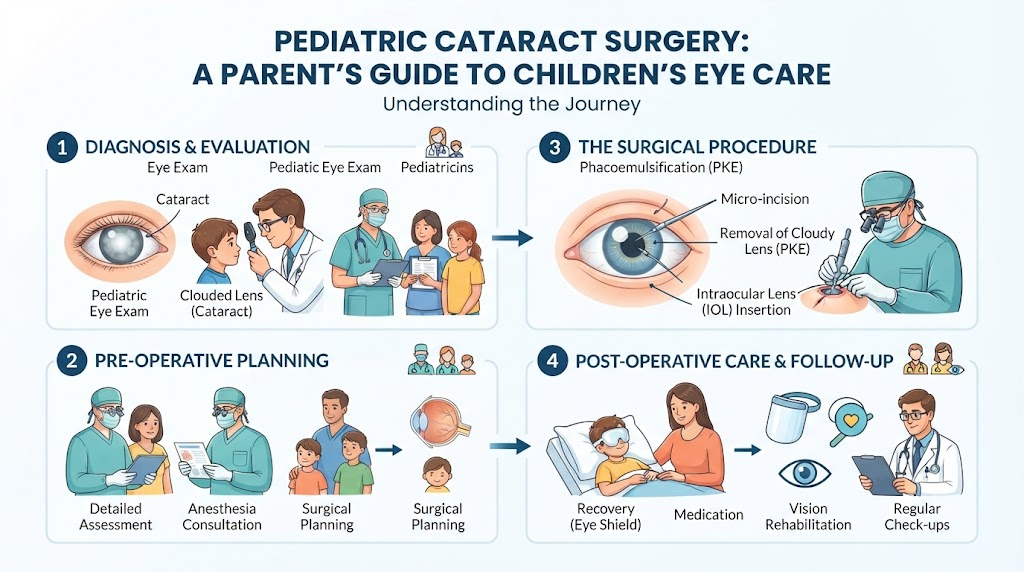
Pediatric Cataract Surgery Explained
Surgery involves removing the cloudy natural lens to restore a clear pathway for light.
- The Procedure: Performed under general anesthesia by a pediatric ophthalmologist.
- IOL Implantation: Depending on the child’s age and eye size, the surgeon may insert an artificial Intraocular Lens (IOL). In infants, doctors often opt for glasses or contact lenses initially, as the eye is still growing rapidly.
- Precision: Surgeons use microscopic instruments specifically designed for the tiny structures of a child’s eye.
Recovery and Long-Term Care
Surgery is just the beginning of the visual journey. Recovery requires a team effort between parents and doctors:
- Post-Op Care: Using prescribed eye drops to prevent inflammation and protecting the eye with a shield.
- Optical Correction: Most children will require glasses or contact lenses after surgery to focus light properly.
- Amblyopia Therapy: If one eye was affected, “patching” the strong eye may be necessary to force the weaker eye to develop.
- Follow-Up: Regular check-ups are mandatory to monitor eye pressure, vision development, and the need for prescription updates.
How to Choose the Right Pediatric Eye Hospital
When evaluating potential hospitals, use this checklist to ensure your child receives the best care:
- Dedicated Department: Does the hospital have a specific pediatric ophthalmology wing?
- Surgical Volume: How often do their surgeons perform pediatric cataract procedures?
- Anesthesia Support: Is there a pediatric anesthesiologist on staff?
- Rehabilitation Services: Are there orthoptists or vision therapists available for follow-up?
- Family-Centered Approach: Is the staff skilled in communicating with both the child and anxious parents?
Common Myths vs. Facts
| Myth | Fact |
| Children cannot have cataracts | Cataracts can occur at birth or during childhood. |
| Surgery guarantees 20/20 vision | Outcomes vary; the goal is to optimize vision development. |
| Glasses aren’t needed after surgery | Most children require glasses or contacts to focus clearly. |
| Cataracts only affect both eyes | They can occur in just one eye (unilateral). |
FAQs
- What is a pediatric cataract?
Clouding of the lens in a child’s eye. - Can babies be born with them?
Yes, these are called congenital cataracts. - Is surgery safe?
Yes, when performed by an experienced pediatric team. - When is surgery recommended?
As soon as the cataract is dense enough to obstruct visual development. - Will my child need glasses?
In almost all cases, yes, to compensate for the removed natural lens. - Can cataracts return?
Sometimes a membrane can grow over the capsule (PCO), which may require a simple laser procedure. - What is amblyopia?
It is a “lazy eye” where the brain ignores signals from a weak eye. - How long is recovery?
Most children return to daily activities quickly, but eye drop use lasts several weeks. - How do doctors diagnose them?
Using a red reflex test, slit-lamp, and dilated exams. - Do I need a specialist?
Yes, pediatric eyes require specialized equipment and expertise. - How often are follow-ups?
Initially very frequent (every few weeks), then tapering off as the child stabilizes. - Is it painful?
The child is under anesthesia during surgery and will receive pain relief afterward. - What if I delay surgery?
Permanent vision loss or “lazy eye” may occur. - How do I prepare my child?
Talk in simple terms, bring a comfort item, and stay calm. - When should I see a doctor?
If you notice a white pupil or unusual eye behavior at any age.
Final Thoughts
Early detection and specialized treatment are the most powerful tools in protecting your child’s vision. While a cataract diagnosis can feel daunting, the pediatric ophthalmology community is highly advanced and dedicated to helping children achieve the best possible visual outcomes.Partnering with an experienced team is the best way to support your child’s visual development for years to come. For more resources on finding expert care, understanding childhood eye conditions, and supporting your family, visit BESTEYEHOSPITALS.