Introduction
The integration of digital technology into modern medicine has radically altered the delivery of healthcare across the globe. Among the various medical fields utilizing digital transformation, ophthalmology has realized rapid growth in remote service delivery. Vision health dictates a significant portion of an individual’s daily functional capacity, making immediate access to specialized clinicians paramount for preventing long-term visual impairment and managing chronic ocular diseases.This educational guide details the clinical parameters of remote eye care, outlines the conditions suitable for virtual management, and provides criteria for evaluating digital hospital infrastructure. When exploring your options for remote vision analysis, platforms like BESTEYEHOSPITALS can help connect patients with trusted insights regarding specialized ophthalmology services, online doctor consultation methods, and comprehensive digital vision care resources.
What Is Eye Care Teleconsultation?
Eye care teleconsultation, widely recognized in clinical settings as teleophthalmology, is the professional practice of utilizing secure digital communication networks to evaluate, diagnose, manage, and monitor ocular conditions remotely. This specialized form of telemedicine uses audio, high-definition video, and digital imaging to bridge the gap between patients and certified eye care providers.
[ Patient at Home ] === Secure Data Link ===> [ Specialized Eye Hospital ]
- HD Video Stream                              - Real-Time Clinical Review
- Digital Eye Images                           - Electronic Triage & Charting
- Symptom Description                          - E-Prescription / Referral Path
A virtual consult differs fundamentally from a traditional in-person eye examination. In an office setting, an ophthalmologist utilizes complex physical machinery, such as a slit lamp biomicroscope, a tonometer to measure internal fluid pressure, and physical lenses to assess structural anatomy and accurate refractive errors.
A teleconsultation focuses on visual triage, symptom assessment, external eye inspection via high-definition video, and monitoring treatment adherence. It acts as a digital entryway to clinical care, allowing specialists to analyze your condition and determine if immediate in-person diagnostic imaging or emergency surgery is required.
The growth of digital healthcare provides significant advantages for general patient management. By utilizing encrypted cloud-based records, teleophthalmology allows for the rapid sharing of high-resolution retinal images and previous medical reports between general physicians and specialized ophthalmic sub-specialists. This ensures a continuous flow of patient data and supports timely clinical decisions without forcing vulnerable or elderly individuals to undergo unnecessary travel.
Who Can Benefit from Eye Care Teleconsultations?
Teleophthalmology serves as an effective medical tool for a broad demographic of patients, particularly those requiring ongoing surveillance or immediate, non-emergency clinical opinions.
- Routine Ocular Follow-Up Appointments: Patients with previously diagnosed, stable eye conditions who require periodic clinical check-ins to monitor symptom patterns and review treatment adherence.
- Individuals Experiencing Dry Eye Symptoms: Patients dealing with chronic burning, grittiness, or fatigue related to tear film instability who need specialized lifestyle guidance and artificial tear adjustments.
- Aesthetic and Functional Eye Allergies: Individuals presenting with seasonal itching, eyelid swelling, and conjunctival redness who require targeted antihistamine management.
- Preliminary Red Eye Evaluation: Triage for sudden discoloration to differentiate between benign, superficial inflammation and critical underlying conditions that demand direct physical visualization.
- Comprehensive Medication and Drop Reviews: Patients requiring a structured review of their topical drop routines, check-ins on potential side effects, or guidance on proper eye drop application techniques.
- Post-Operative Follow-Up Safely: Eligible patients recovering from minor surgeries who can undergo external incision reviews via high-definition video to ensure healing is progressing correctly.
- Chronic Eye Disease Monitoring: Tracking long-term lifestyle compliance and stable baselines for patients living with conditions like glaucoma or non-proliferative diabetic retinopathy.
- Seeking Expert Second Opinions: Individuals looking to have their existing diagnostic reports, visual fields, and retinal scans reviewed by distant sub-specialists before committing to elective interventions.
Eye Conditions Suitable for Teleconsultation
While complex ophthalmic issues require in-person equipment, several common ocular conditions can be managed or monitored effectively through virtual platforms.
Superficial Inflammation and Dryness
- Dry Eye Syndrome: Characterized by irritation, grittiness, and fluctuating vision caused by low tear production or rapid tear evaporation. Digital consultations allow doctors to analyze environmental triggers, evaluate blinking habits during screen use, and recommend specific lipid or aqueous artificial lubricants.
- Allergic Conjunctivitis: Systemic or seasonal allergen exposures that cause bilateral itching, watery discharge, and pink coloration of the sclera. Specialists can quickly identify classic allergy patterns through high-definition video and prescribe target-specific mast-cell stabilizers or antihistamine drops.
- Blepharitis: Chronic inflammation along the eyelid margins caused by clogged oil glands or microbial overgrowth. Online doctors can inspect the crusting patterns along the eyelash line, demonstrate proper lid hygiene techniques, and prescribe supportive antimicrobial drops or ointments.
Lifestyle Strains and Stable Monitoring
- Digital Eye Strain: A common condition linked to prolonged computer and smartphone use, causing blurred vision, headaches, and physical fatigue. Doctors provide valuable advice on optimizing workstation ergonomics, implementing the 20-20-20 rule, and managing light glare.
[ The 20-20-20 Rule for Digital Strain ]
Every 20 Minutes --> Look at an Object 20 Feet Away --> For at least 20 Seconds
- Stable Glaucoma and Diabetic Eye Follow-Up: For patients with well-controlled intraocular pressure or stable, inactive diabetic retinal changes, teleconsultations provide a safe way to review medication compliance, analyze recent local diagnostic tests, and confirm that their stable baseline is maintained between required in-person clinical scans.
Eye Conditions That Require Immediate In-Person Care
| Ocular Condition | Immediate Recommended Action | Clinical Justification |
| Sudden, Unexplained Vision Loss | Emergency ophthalmology evaluation | May indicate central retinal artery occlusion, acute stroke, or optic nerve ischemia |
| Serious Physical Eye Injury | Immediate specialized hospital visit | Risk of globe perforation, internal bleeding, or traumatic retinal detachment |
| Chemical Ocular Exposure | Urgent, immediate emergency treatment | Requires immediate, continuous saline irrigation to prevent deep corneal scarring |
| Severe, Deep-Seated Eye Pain | Prompt in-person clinical examination | Often indicates acute angle-closure glaucoma or severe internal uveitis |
| Sudden Flashes and Floaters | Urgent retinal specialist evaluation | Classic warnings of an active retinal tear or progressive detachment |
Services Offered Through Eye Care Teleconsultations
Advanced eye care institutions have structured their teleophthalmology programs to deliver a wide array of clinical services that mirror the thoroughness of traditional outpatient templates.
                  +-----------------------------------+
                  |   VIRTUAL EYE CARE DISPENSATIONS  |
                  +-----------------------------------+
                   /               |                 \
                  /                |                  \
      [ Visual Triage ]     [ Medication Sync ]    [ Educational Outreach ]
       - External HD review  - Drop renewals and    - Lid hygiene drills
       - Urgent referrals      dose adjustments     - Ergonomic adjustments
- Comprehensive Video Consultations: Real-time interactive sessions where specialists can inspect the external eye structures, track basic ocular mobility, and analyze patient head positions or eyelid symmetry.
- Symptom Analysis and Triage: A structured review of the onset, duration, and severity of vision changes, helping doctors sort benign conditions from issues that require an immediate in-person exam.
- Prescription and Medication Management: The safe renewal, adjustment, or introduction of therapeutic eye drops, managing systemic dosages while checking for potential cross-reactions with concurrent medications.
- Review of Previous Diagnostic Reports: Analyzing uploaded digital data—including high-resolution optical coherence tomography (OCT) scans, visual fields, and external photography—to check for signs of disease progression.
- Post-Procedural Follow-Up Care: Providing a convenient way to check on healing progress after surgeries, review recovery instructions, and verify that the patient is utilizing protective shields and anti-inflammatory drops correctly.
- Direct Referrals for Structural Testing: When a remote consult reveals subtle warning signs, the online doctor can issue direct orders for specialized local imaging, ensuring the patient skips basic triage on arrival.
- Targeted Patient Education: Providing clear guidance on self-care techniques, including warm compress routines, lid hygiene steps, and dietary habits that support macular health.
Advanced Teleophthalmology Technologies
The clinical safety and accuracy of modern remote vision care are supported by an integrated ecosystem of advanced hardware and software technologies.
Secure Communication and Integrated Charts
Leading eye hospitals utilize specialized, encrypted telemedicine platforms that comply with national health privacy standards. These networks use high-bandwidth video streams that allow specialists to view fine details of the eye’s surface.
These platforms connect directly with Electronic Health Records (EHR), allowing the consulting ophthalmologist to view past prescription histories, allergy lists, and tracking data across multiple care settings simultaneously.
Next-Generation Remote Screening Tools
Modern digital care utilizes advanced tools to gather objective data from outside the hospital walls:
- Remote Retinal Imaging Modules: Specialized, compact fundus cameras located at community health clinics or primary care offices. Non-specialist technicians can capture high-resolution images of the retina and upload them to the cloud for immediate review by distant specialists.
- AI-Assisted Screening Support: Cloud platforms equipped with trained artificial intelligence algorithms can analyze uploaded retinal scans instantly, pre-screening for early signs of diabetic retinopathy or macular degeneration to flag high-risk cases for immediate review.
- Mobile Eye Health Applications: Patient-facing smartphone apps that use calibrated screens to perform basic visual acuity tracking, Amsler grid distortions, or color vision screens at home, uploading changes directly to the hospital chart.
Technology Comparison Table
| Technology | Core Clinical Purpose | Direct Patient Benefit |
| Video Consultation Platforms | Enables real-time, interactive visual evaluations across remote regions | Provides convenient, immediate access to sub-specialists without travel stress |
| Electronic Health Records | Consolidates and shares comprehensive, encrypted ocular histories | Ensures complete care continuity and prevents dangerous cross-medication issues |
| Remote Retinal Imaging | Captures detailed backend images of the eye at local care clinics | Allows for advanced retinal screening without requiring travel to major urban medical centers |
| AI-Assisted Screening | Uses specialized algorithms to analyze retinal scans for signs of disease | Supports early identification of serious risks like progressive retinopathy |
How Hospitals Monitor Cardiac and Ocular Patients Remotely
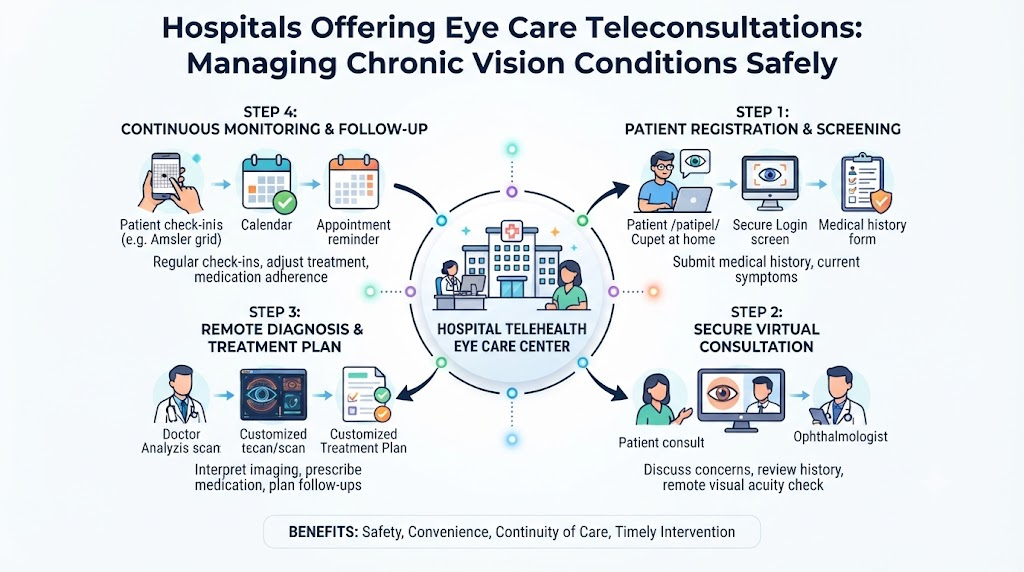
The operational workflow of remote eye care is built around a structured care pathway, matching clinical resources to the patient’s immediate visual needs.
  [ Home Digital Intake ] ---> Patient uploads records and describes current vision symptoms
              |
  [ High-Definition Triage ] -> Doctor conducts live video review of external eye structures
              |
  [ Care Pathway Choice ]
         /          \
  [ Virtual Care ]   [ Direct Hospital Referral ]
  - Drop adjustment   - Scheduled for structural OCT scans
  - Hygiene coaching  - Routed directly to the emergency theater if required
Digital Intake and Live Video Triage
The process begins with an organized digital intake. The patient accesses a secure portal to complete an intake form, upload images of their eye taken under good lighting, and attach previous vision metrics or general health summaries.
During the live video call, the ophthalmologist guides the patient through simple movements, such as looking up, down, and side to side, to inspect the conjunctiva and check eyelid mobility.
Coordinating Care with Local Clinics
To gather objective measurements, advanced hospitals often partner with local optometric clinics or community health centers. Patients can visit these close-to-home locations to have their intraocular pressure measured or undergo specialized photography.
The data is then transmitted securely back to the hospital team. This collaborative model ensures that chronic conditions can be monitored closely without requiring frequent, long-distance travel to central hospital wards.
Benefits of Hospitals Offering Eye Care Teleconsultations
Partnering with an established institution that features integrated teleophthalmology services offers several key advantages for maintaining long-term vision health.
- Immediate Access to Specialized Eye Care: Connects patients directly with sub-specialists, such as retinal or glaucoma experts, who may not be available locally.
- Reduced Travel Stress and Costs: Minimizes the need for long-distance travel, which is particularly beneficial for patients with impaired vision who cannot drive safely.
- Efficient Follow-Up and Appointment Tracking: Streamlines the check-in process, allowing patients to schedule brief virtual reviews to check medication efficacy without wasting time in waiting rooms.
- Continuous Care for Chronic Conditions: Supports ongoing monitoring through regular data updates, helping prevent disease progression over time.
- Increased Independence for Vulnerable Groups: Provides an accessible way for elderly patients or individuals with limited mobility to receive expert ophthalmic evaluations from home.
- Vital Health Access for Remote Communities: Delivers high-quality diagnostic and advisory services directly to rural areas, reducing disparities in vision care.
Limitations of Online Eye Consultations
While teleophthalmology is a valuable diagnostic and monitoring tool, patients must understand its structural limitations to ensure they use it safely.
The Challenge of Remote Physical Exams
The main limitation of a virtual eye consultation is the inability to perform a direct physical examination of the internal ocular structures. Without a specialized lamp, an ophthalmologist cannot look through the clear cornea to examine the crystalline lens, measure intraocular fluid pressure precisely, or perform a dilated fundus exam to check the peripheral retina for tiny tears. This means that while a video call is excellent for assessing surface inflammation, it cannot replace an in-person structural evaluation.
[ Virtual Check Mirror ] -----> Confined to the surface structures of the eye and eyelids
[ Slit Lamp Biomicroscopy ] -> Reveals deeper internal layers, fluids, and peripheral retina
The Need for Specialized Equipment
Many critical diagnostic tests require physical, calibrated equipment that cannot be replicated by a smartphone or home computer. For instance, creating an accurate prescription for corrective lenses requires a specialized phoropter, while mapping nerve fiber layers requires an optical coherence tomography machine.
Additionally, sudden emergencies—such as acute retinal detachments or chemical injuries—require immediate, physical interventions that cannot be delivered through a digital screen.
How to Prepare for an Online Eye Consultation
Taking a few practical steps to prepare before your appointment can significantly improve the accuracy and efficiency of your virtual session.
- Gather Relevant Medical Records: Organize your complete history of eye surgeries, systemic health conditions like diabetes or high blood pressure, and any family history of conditions like glaucoma.
- List Your Current Medications: Write down the exact names and dosages of all your prescriptions, especially any current or recently used therapeutic eye drops.
- Describe Your Symptoms Clearly: Note exactly when your symptoms started, what they feel like (e.g., burning, itching, dull ache), and whether they change at different times of the day.
- Upload Past Ophthalmic Reports: If available, upload clear digital copies or photos of your recent visual field tests, retinal scans, or glasses prescriptions to the patient portal.
- Verify Your Internet Connection: Test your device’s camera, microphone, and internet stability a few minutes before the call to prevent dropouts during your session.
- Optimize Your Lighting Environment: Sit in a well-lit room with steady, overhead light facing you. Avoid sitting with bright windows directly behind you, as backlighting makes it difficult for the doctor to see your eyes clearly on camera.
Choosing the Right Hospital for Eye Teleconsultation
Selecting an appropriate institution for remote vision care involves evaluating their clinical team, digital infrastructure, and continuity of care protocols.
Look for Specialized Clinical Experts
Ensure the hospital’s virtual care program is staffed by board-certified ophthalmologists and experienced sub-specialists. The consulting team should have specific experience using digital communication platforms and feel comfortable assessing visual symptoms through high-definition video interfaces.
Check Digital Safety and Support Tools
A high-quality digital health program should utilize a secure, user-friendly platform that prioritizes patient privacy and handles data transfers smoothly. The hospital should also offer dedicated technical support to help you set up the call, and maintain an organized system for sending electronic prescriptions directly to your local pharmacy.
       [ ACCREDITED DIGITAL HOSPITAL ]
 (Certified Specialists + Secure Software + EHR Integration)
                       |
       [ CONNECTED CARE PATHWAYS ]
  (Local Clinic Partnerships + Direct Emergency Triage Options)
Confirm Clear Referral and Emergency Wards
An effective teleophthalmology service must be fully integrated with physical care facilities. Choose an institution that maintains clear, direct referral pathways to local diagnostic clinics and operates 24/7 in-person emergency wards. This connection ensures that if your virtual doctor notices an urgent warning sign during your call, you can transition to immediate, physical specialist care without delay.
Hospital Selection Checklist
| System Feature | Core Clinical Significance | Specific Indicators to Look For |
| Experienced Ophthalmologists | Ensures expert clinical judgment and accurate interpretation of visual symptoms | Active board certifications; specialized fellowships in fields like retina or glaucoma care |
| Secure Telemedicine Platform | Protects your personal data and health history from unauthorized access | Full compliance with national healthcare privacy and encryption standards |
| Advanced Diagnostic Services | Provides a clear path for in-person evaluations when structural tracking is required | On-site access to high-resolution OCT, digital fundus photography, and visual field analyzers |
| Follow-up Programs | Supports long-term health through consistent monitoring and care updates | Structured systems for managing drop schedules and tracking routine baseline tests |
| Emergency Referral System | Ensures rapid transition to physical care if an urgent issue is detected | Direct routing protocols to local emergency rooms or immediate surgical theaters |
Common Myths vs Facts
Myth: Every type of vision problem and eye disease can be diagnosed and treated through an online consultation.
Fact: Teleophthalmology is an excellent tool for triage, managing minor irritations, and conducting follow-up checks. However, many complex conditions require in-person, physical exams using specialized diagnostic equipment to view the internal structures of the eye safely.
Myth: Remote eye consultations are intended to completely replace traditional eye care hospitals.
Fact: Digital consultations are designed to complement, not replace, traditional physical care. They expand the reach of specialized medicine, offering a convenient way to handle routine checks, non-emergency triage, and ongoing monitoring between required in-person examinations.
Myth: Online eye evaluations are only useful for addressing minor issues like seasonal allergies.
Fact: While highly effective for managing minor issues, virtual consultations are also incredibly valuable for tracking stable chronic diseases, conducting post-surgical checks, reviewing medication routines, and providing access to expert second opinions.
Myth: A comprehensive prescription for corrective glasses or contacts can be completed entirely through a standard video call.
Fact: Determining an accurate prescription requires specialized, physical testing using a phoropter or automated refractor to measure how light focuses through your eye. While basic screening apps exist, a formal prescription requires an in-person evaluation.
Common Mistakes Patients Make
Being aware of common missteps can help you use digital vision services more safely and ensure you receive effective care during your remote sessions.
Ignoring Urgent Warning Signs or Delaying Emergency Care
A dangerous mistake is attempting to schedule a virtual appointment to address serious symptoms like sudden vision loss, deep eye pain, or flashes of light, hoping to avoid a trip to the hospital. These symptoms point to major structural emergencies that need immediate, in-person surgical evaluation. Delaying physical care can lead to permanent vision loss.
Providing an Incomplete or Partial Medical History
Some patients fail to mention concurrent health conditions, such as diabetes, or omit past prescriptions during their virtual intakes. Because your online doctor cannot examine your eyes physically, they rely heavily on the history you provide. Leaving out details can result in incomplete treatment plans or inappropriate drop recommendations.
Self-Medicating with Old Drops Before Your Appointment
Using leftover steroid drops or unprescribed over-the-counter remedies to treat a red eye before your consultation is a serious mistake. These medications can mask important visual signs, alter intraocular fluid pressure, and worsen underlying viral or fungal infections, putting your vision at risk.
Skipping Advised In-Person Follow-Up Exams
Assuming that a virtual checkup completely removes the need for your scheduled in-person imaging is a common pitfall. If your online provider advises you to visit a local clinic for a physical scan or pressure check, failing to go can leave hidden, asymptomatic changes unmanaged.
Practical Solutions
To support your virtual care experience:
- Review the emergency checklist carefully, and go directly to an eye care hospital if you experience any high-risk symptoms.
- Keep an up-to-date list of your current prescriptions, medical conditions, and recent allergies attached to your digital health profile.
- Always use temporary treatments like plain, preservative-free artificial tears to soothe minor irritation while waiting for your professional consultation, rather than using medicated drops.
Real-Life Patient Scenarios
Scenario A: Convenient Post-Surgical Follow-Up From Home
An 74-year-old individual underwent a successful, routine cataract surgery at a major regional eye care hospital. While their early healing went well, the patient lived over two hours away from the surgical center and found long car rides tiring and difficult to arrange.
To make care more manageable, their ophthalmologist scheduled their two-week follow-up as a virtual consultation through the hospital’s secure app. Sitting in a well-lit room, the patient used their smartphone camera to show their incision line clearly. The specialist verified that the eyelid looked healthy, confirmed there was no abnormal swelling, reviewed their anti-inflammatory drop schedule, and saved the patient an exhausting drive while ensuring their recovery remained on track.
Scenario B: Clarifying Progressive Symptoms and Coordinating Care
A 29-year-old software engineer woke up with a red, irritated right eye that produced a watery discharge. Unsure if they were dealing with a minor strain, a seasonal allergy, or a contagious infection, they scheduled an online consultation through a specialized portal.
During the video call, the doctor noted that the redness was spread evenly across both eyes and was accompanied by intense itching and clear tearing, points that matched the patient’s history of seasonal environmental allergies. The ophthalmologist explained it was an allergic reaction, prescribed an over-the-counter antihistamine drop routine, and provided tips on screen use, helping the patient find fast relief without a trip to the clinic.
Scenario C: Early Digital Detection leading to Urgent In-Person Care
A 61-year-old individual with a history of long-standing diabetes noticed faint, dark spots drifting across their left eye. Rather than ignoring the symptom, they scheduled a virtual triage session with a specialized retina hospital.
The doctor listened to the description of the spots and reviewed the patient’s history of blood sugar levels. Recognizing these floaters as an early warning sign of a potential retinal tear or diabetic vitreous bleeding, the online doctor immediately issued an urgent referral. The patient was routed directly to a local partner clinic for a dilated fundus exam and OCT imaging that afternoon, where they received timely treatment that protected their long-term vision.
FAQs (15 Questions)
1.What is teleophthalmology?
Teleophthalmology is the secure use of digital video, imaging, and cloud-based communication to evaluate, manage, and monitor eye conditions remotely, connecting patients with specialized eye doctors from home.
2.Which common eye conditions can be managed safely online?
Virtual care is effective for managing dry eye syndrome, seasonal allergic conjunctivitis, digital eye strain, blepharitis, minor eyelid styes, routine medication reviews, and follow-up checks for stable chronic conditions.
3.When should I skip a virtual consult and visit an eye hospital in person?
Go directly to an emergency eye hospital if you experience sudden vision loss, severe deep eye pain, a physical injury to the eye, exposure to chemicals, or the sudden appearance of flashes of light and dark floaters.
4.Can eye infections be evaluated accurately through a teleconsultation?
Superficial irritations and mild eye redness can be triaged effectively via high-definition video. If the doctor suspects a serious deep infection or corneal ulcer, they will refer you for an immediate in-person exam.
5.How accurate are the evaluations provided during an online eye consultation?
For conditions that can be seen externally—like allergies, lid inflammation, or dry eye—virtual reviews are highly reliable. For deeper structural issues, their accuracy relies on combining the video call with data from local diagnostic scans.
6.How should I prepare my home space for a virtual eye appointment?
Sit in a quiet room with bright, overhead light facing you. Have your current eye drops handy, list your medical history and allergies, and check your camera and internet connection before the call starts.
7.Can online doctors provide formal prescriptions for eye drops?
Yes, qualified ophthalmologists can issue electronic prescriptions for anti-allergy, antimicrobial, or lubricating drops during your consultation, sending them directly to your local pharmacy where permitted by law.
8.Is teleconsultation appropriate following major eye surgery?
Yes, virtual checkups are often used for routine follow-ups after minor surgeries or stable cataract procedures, allowing the surgeon to check your healing progress and review drop schedules without forcing you to travel.
9.What technology do I need to participate in an online eye consult?
You only need a modern smartphone, tablet, or computer equipped with a high-definition front camera, a working microphone, and a stable, secure internet connection to access the hospital’s private portal.
10.How do I identify a reliable hospital that offers teleophthalmology?
Look for accredited medical centers staffed by board-certified ophthalmologists, utilizing secure health platforms, and maintaining clear referral paths to local physical diagnostic clinics.
11.Can children participate in online eye consultations safely?
Yes, virtual sessions are a gentle way to triage minor childhood eye concerns, such as suspected pink eye or mild lid swelling, in a comfortable home environment before planning an in-person visit.
12.Is teleconsultation useful for ongoing glaucoma management?
Yes, it is valuable for reviewing your drop adherence, checking for side effects, and analyzing recent eye pressure data and visual field charts sent from a local optometric partner clinic.
13.What specific symptoms point to an immediate retinal emergency?
The sudden, unprovoked appearance of bright flashes of light, a shower of dark floaters, or a dark shadow covering part of your vision are classic signs of a retinal tear that require immediate physical care.
14.Are my personal ocular records and images kept confidential online?
Yes, reputable eye care hospitals utilize encrypted, private platforms that meet strict national healthcare privacy compliance laws to ensure your medical charts and images remain secure.
15.When should I consult an ophthalmologist immediately?
Schedule a consultation whenever you notice a persistent change in your vision, experience ongoing eye irritation that over-the-counter teardrops do not soothe, or require professional guidance for a chronic eye condition.
Final Thoughts
The development of teleophthalmology has significantly improved access to modern vision care, offering a convenient, private way to connect with specialized eye care teams from anywhere. By utilizing advanced video platforms and cloud-based medical records, hospitals can handle non-emergency triage, manage surface irritations, and monitor chronic conditions efficiently. This digital approach saves patients time and travel friction, helping catch early warning signs before they affect your quality of life.However, remote care works best when used as part of a balanced, hybrid healthcare model. While virtual consultations are excellent for tracking recovery and managing day-to-day symptoms, they cannot replace the deeper structural insights provided by physical exams and advanced in-person imaging. Recognizing the limitations of online care and following your provider’s advice for physical follow-ups is essential for protecting your vision over time.